
Many workshop operators struggle to maintain consistent suction, watching helplessly as cumulative static pressure losses choke their dust extraction systems. Traditionally, facility managers attempt to resolve these airflow drops by allocating standard equipment budgets toward upgrading filter cartridges or expanding duct diameters. However, optimizing the underlying drive motor itself grants unparalleled static pressure resilience and long-term operational efficiency.
Stipulation: Please note that while motor selection is critical, even the most robust motor cannot fully compensate for fundamentally flawed duct layouts or excessive flex-hose runs. For example, transitioning from a universal-motor utility vacuum to a dedicated 1.5 HP induction-driven cyclone system illustrates how motor topology directly sustains cubic feet per minute (CFM) under high static loads.
In this article, we will contrast induction and universal motors, analyzing their torque curves, duty cycles, and performance under high static resistance to help you select the ideal drive for your workshop.
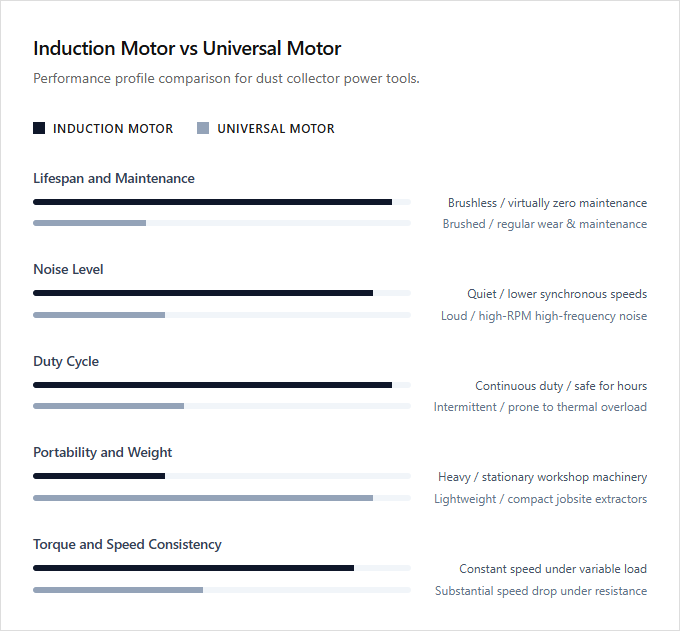
| Factor | Summary |
|---|---|
| Lifespan and Maintenance | Induction motors lack carbon brushes, resulting in a brushless design that requires virtually no maintenance and offers a much longer operational lifespan than universal motors. |
| Noise Level | Operating at lower synchronous speeds, induction motors run significantly quieter and produce less high-frequency electromagnetic noise than high-RPM universal motors. |
| Duty Cycle | Induction motors are engineered for a continuous duty cycle, allowing workshop dust collectors to run safely for hours, whereas universal motors are prone to thermal overload during prolonged use. |
| Portability and Weight | Universal motors possess a much higher power-to-weight ratio, making them ideal for compact, jobsite dust extractors, whereas heavy induction motors are suited for stationary machinery. |
| Torque and Speed Consistency | Induction motors maintain a constant speed under load due to their slip characteristics, while universal motors experience substantial speed drops as mechanical resistance increases. |
Optimizing Static Pressure with Large, Low-Speed Impellers
When selecting a dust collection system, the motor type significantly influences long-term performance and efficiency. Induction motors are engineered for continuous duty, utilizing larger impeller diameters at lower shaft speeds to maintain stable static pressure under system resistance. This mechanical design ensures consistent airflow and suction capacity even as filters collect debris, while minimizing operational noise.
Universal motors rely on high rotational speeds and smaller impellers to move air. Although compact and portable, these motors generate substantial noise and experience noticeable performance drops under heavy resistance. High-volume professional woodworkers requiring quiet, continuous extraction are best suited for induction motor collectors, whereas DIY hobbyists needing portable, budget-friendly machinery prefer universal motor models.
Induction Motors: Continuous Duty Without Brush Friction
When selecting a dust collector, the motor type dictates both performance and longevity. Induction motors are engineered for heavy-duty operation, offering a continuous duty cycle (S1). Because they operate without carbon brushes, they eliminate the frictional heat and thermal dissipation limitations inherent in brushed systems, allowing them to run quietly and efficiently for extended periods under constant load.
In contrast, universal motors rely on carbon brushes that generate significant heat and friction, limiting these machines to intermittent duty cycles. While universal motors are lighter and highly portable, they require regular brush maintenance and wear out faster under continuous use. Stationary workshop professionals requiring uninterrupted, day-long air filtration benefit most from induction models, whereas weekend hobbyists seeking portable, occasional cleanup solutions are well-suited for universal motor collectors.
Optimizing Fan Curves and Static Pressure via VFDs
In workshop dust collection, the choice between induction and universal motors dictates performance longevity and operational efficiency. While universal motors rely on carbon brushes and run at fixed, high speeds, induction motors offer brushless, continuous-duty operation. Integrating a Variable Frequency Drive (VFD) with an induction motor allows operators to modulate the electrical frequency, dynamically optimizing the fan curve and static pressure to match specific ductwork configurations and woodworking machinery requirements.
This electronic speed control maintains optimal CFM (cubic feet per minute) while reducing energy consumption and noise levels. Universal motors lack this sophisticated modulation but provide high power-to-weight ratios in smaller, intermittent-use setups. Heavy-duty commercial shops requiring continuous, quiet, and optimized air filtration benefit most from VFD-enabled induction systems, whereas hobbyists seeking portable, budget-friendly extraction are better served by universal motor models.
Low Rotor Slip Ensures Stable Airflow Under Pressure
When selecting a dust collector, the choice of motor directly impacts performance under load. Induction motors are highly efficient in dedicated workshop systems due to their low rotor slip. This inherent design characteristic allows the motor to maintain a nearly constant speed, ensuring stable volumetric airflow and consistent suction even as filters accumulate debris and static pressure rises.
Universal motors operate at higher speeds but suffer significant RPM drops when facing resistance. While lightweight and compact, they cannot sustain the torque required for continuous, high-volume extraction. Large induction models are best for professional woodworkers requiring quiet, continuous shop-wide filtration, while compact universal units suit DIY hobbyists seeking portable, intermittent clean-up solutions.
Spark-Free Brushless Motors for Combustible Dust
When selecting a dust collector, the choice between an induction and a universal motor directly impacts workshop safety and longevity. Universal motors rely on carbon brushes that generate continuous electrical sparking during operation, posing a serious ignition hazard in environments filled with combustible wood dust. In contrast, the brushless design of an induction motor eliminates these sparking hazards entirely, ensuring a much safer filtration process in high-dust environments.
Induction motors also operate at lower noise levels and offer superior durability, whereas universal motors provide high power in a lighter, more compact frame. High-volume professionals requiring safe, continuous-duty extraction are best served by induction models, while DIY hobbyists needing highly portable, intermittent clean-up will find universal motor collectors suitable.
Induction Motor Efficiency Under Sustained Static Pressure
When selecting a workshop dust collector, the choice between an induction motor and a universal motor directly impacts operational efficiency. Induction motors excel in dedicated, continuous-duty filtration systems, offering superior electrical efficiency and a more stable power factor during sustained static pressure loading. This design minimizes energy loss and thermal stress, allowing the machinery to maintain consistent airflow and suction levels over hours of uninterrupted use.
Conversely, universal motors rely on carbon brushes and operate at much higher decibel levels, making them less efficient under constant loads but highly compact. Stationary workshop professionals requiring quiet, reliable, day-long air filtration are best served by induction motors, whereas mobile contractors and hobbyists benefit more from the lightweight portability of universal-driven vacuums.
Induction Motors Drive Impellers for Peak Static Pressure
When selecting a dust collection system, the choice between an induction motor and a universal motor directly impacts performance stability. Induction motors are engineered for heavy-duty, continuous operation, delivering the sustained torque curve required to drive high-inertia backward-inclined impellers for peak static pressure generation. This sustained power maintains consistent airflow even when overcoming the resistance of complex duct networks and clogged filters.
Universal motors, while louder and prone to rapid brush wear, offer high rotational speeds in a lightweight, compact frame. Stationary workshop professionals requiring continuous, high-volume extraction benefit most from the reliability of induction-driven collectors, while DIY hobbyists and mobile contractors prioritize the lightweight portability and lower upfront cost of universal motor systems.
Leave a comment