
Achieving flawless 3D contours on a milling machine often frustrates machinists, as selecting the wrong cutter leads to excessive hand-finishing, scallop marks, or scrapped workpieces. Traditionally, operators rely on standard tool crib inventories and generic cutting parameters to force-fit complex geometries. However, optimizing your cutter selection grants you the ability to slash cycle times while achieving pristine surface finishes. Note the stipulation: this efficiency requires your CAM programming and machine rigidity to align perfectly with the tool's profile, as seen in high-precision aerospace mold-making where cutter selection dictates final part tolerance.
This article compares Square End Mills and Ball Nose End Mills, analyzing their geometries, step-over strategies, and ideal applications to help you select the perfect cutter for your 3D contouring projects.
| Factor | Summary |
|---|---|
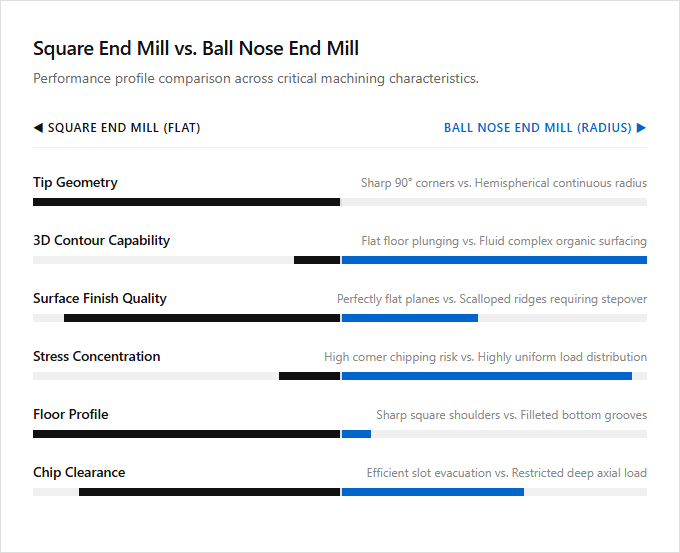
| Tip Geometry | Square end mills feature a flat bottom with sharp corners, whereas ball nose end mills utilize a hemispherical tip designed for intricate 3D contouring. |
| Primary Application | Square end mills excel at slotting, plunging, and roughing flat surfaces, while ball nose end mills are preferred for complex surfacing and finishing operations on curved profiles. |
| Surface Finish | Ball nose end mills leave a scalloped finish on contoured surfaces that requires stepover adjustment, whereas square end mills produce a perfectly flat floor on planar faces. |
| Stress Concentration | Square end mills suffer from high stress concentration at their sharp corners which increases the risk of chipping, while the continuous radius of ball nose end mills distributes cutting forces more evenly. |
| Bottom Profile | Square end mills generate a precise ninety-degree shoulder at the base of a pocket, whereas ball nose end mills create a rounded groove or fillet. |
| Chip Clearance | Square end mills facilitate highly efficient chip evacuation during perpendicular slotting, whereas ball nose end mills require careful chip load management during deep axial engagement. |
Scallop height management during finishing passes
In CNC milling finishing passes, managing scallop height-the leftover material ridges between toolpaths-is critical for achieving the desired surface quality. Square end mills feature a flat bottom, creating perfectly flat surfaces with zero scallop height on horizontal planes. However, they leave significant step-like ridges on contoured or inclined surfaces, making them inefficient for complex geometries.
Ball nose end mills utilize a hemispherical tip to generate smooth, continuous curves on three-dimensional profiles. While they produce scallops on contoured surfaces, operators manage this height by reducing the stepover distance, trading cycle time for a superior finish. Machinists requiring precise 2D pockets and crisp 90-degree shoulders benefit most from square end mills, whereas mold makers and 3D surface sculptors require the curvature capabilities of ball nose end mills.
Effective cutter diameter variation on sloped surfaces
When machining sloped surfaces, the effective cutter diameter of a ball nose end mill varies dynamically based on the inclination angle and axial depth of cut. Because the spherical tip contacts the material at a changing point along its radius, the actual cutting speed fluctuates, requiring precise spindle speed calculations to maintain an optimal surface finish. Square end mills maintain a constant peripheral diameter, but their sharp corners produce a stepped, staircase finish on angled surfaces rather than a smooth profile.
This geometric difference dictates tool selection for specific machining applications. Engineers and mold-makers requiring seamless 3D contouring on complex, curved geometries find the ball nose end mill indispensable, while general machinists prioritizing rapid flat-bottom slotting and precise 90-degree pocketing are best served by the square end mill.
Material removal rate optimization for Z-level roughing
In Z-level roughing, maximizing the material removal rate (MRR) is critical for cycle-time efficiency. Square end mills are highly effective for this phase due to their flat bottom and sharp corners, which allow for a large radial depth of cut. When clearing bulk material in stepped layers, the square geometry engages maximum surface area, making it the superior choice for rapid stock reduction on flat planes.
Ball nose end mills are less efficient for flat-surface roughing because their hemispherical tips limit the effective cutting area, requiring smaller stepovers. They are instead utilized to rough out contoured geometries, minimizing the scallop height left for subsequent finishing passes. Square end mills are ideal for high-production machinists prioritizing rapid bulk removal on flat geometries, while ball nose end mills are preferred by moldmakers and 3D surface programmers targeting complex, organic contours.
Stepover distance calculation for surface roughness control
Achieving targeted surface roughness in milling requires distinct stepover calculations for square and ball nose end mills. For square end mills, stepover is calculated as a direct percentage of the cutter diameter, typically sixty to eighty percent, since the flat bottom naturally produces a planar surface. Conversely, ball nose end mills generate a scallop or cusp height during 3D profiling. Controlling this surface finish requires calculating stepover ($ae$) based on the cutter diameter ($D$) and the allowable scallop height ($h$) using the formula: $ae \approx 2 \sqrt{h(D - h)}$. Smaller stepover distances directly minimize scallop height, yielding a smoother surface finish at the expense of cycle time.
Square end mills are ideal for production machinists performing high-efficiency flat pocketing, slotting, and precise square-shoulder squaring, whereas ball nose end mills are suited for mold makers and 3D surfacing specialists crafting complex, organic contours.
Zero surface speed limitation at the cutter apex
Ball nose end mills face a critical physical limitation known as zero surface speed at the cutter apex. Because the rotational radius approaches zero at the exact center tip, the tool rubs rather than shears the work piece, which can lead to rapid tool wear and poor surface finishes during direct vertical plunging operations.
In comparison, square end mills utilize peripheral cutting edges with a consistent rotational radius, avoiding this zero-speed dead zone during lateral pocketing and profiling. To mitigate the apex limitation of the ball nose, CNC programmers often employ tilted tool axes or specific 3D profiling strategies.
Machinists requiring high-efficiency flat-bottom slotting rely on square end mills, whereas mold makers and 3D contouring specialists utilize ball nose cutters for complex geometries.
Tool deflection resistance under high radial engagement
Under high radial engagement, square end mills experience substantial lateral forces. The sharp, 90-degree corners create concentrated stress points that can increase the risk of tool deflection. However, their consistent cylindrical core provides excellent structural rigidity, making them highly resistant to bending when machining straight vertical walls or slotting at moderate depths.
In contrast, ball nose end mills distribute cutting forces more evenly across their hemispherical tip, which helps mitigate localized stress spikes during heavy radial cuts. Despite this distribution, the tapering core diameter near the tip of a ball nose tool can occasionally allow subtle deflection during deep, complex profiling operations where the radial load shifts.
Precision machinists seeking efficient, high-rigidity flat-bottom slotting will benefit most from square end mills, whereas mold makers and 3D contouring specialists require the unique geometry of ball nose end mills for complex surface finishes.
Fillet radius compatibility in internal 3D cavities
When machining internal 3D cavities, selecting between a square end mill and a ball nose end mill depends heavily on the required fillet radius of the cavity floor and walls. Square end mills feature sharp, ninety-degree corners, making them highly efficient for bulk material removal and creating flat-bottomed pockets with sharp, non-radiused internal corners.
Ball nose end mills possess a hemispherical tip essential for profiling complex, contoured 3D surfaces and generating smooth internal fillet radii. Attempting to machine organic shapes with a square tool results in stepped surfaces, whereas the rounded geometry of the ball nose smoothly interpolates across curved floor-to-wall transitions without leaving abrupt edges.
Machinists requiring precise, flat-bottomed slots and sharp corners utilize square end mills, while mold makers and CNC programmers dealing with complex organic geometries and smooth-radius cavities rely on ball nose end mills.
Leave a comment