
Achieving absolute rigidity during high-speed milling is a constant battle for machinists, where even micro-movements can ruin critical tolerances and destroy expensive tooling. While standard funding sources and capital budgets typically focus on acquiring the raw horsepower of the milling machine itself, the true operational bottleneck often lies in how the workpiece is secured. Optimizing this critical interface grants operators unmatched precision and dramatically reduces setup-related downtime.
However, a crucial stipulation remains: no single workholding method is a universal panacea. For instance, securing thin-gauge steel plates for face milling requires vastly different physics than anchoring heavy, irregular cast iron engine blocks.
This article provides a comparative analysis of T-slot tables and magnetic chucks. We will evaluate their mechanical holding power, setup efficiency, and long-term cost-to-value ratios to help you select the optimal clamping configuration for your workshop's specific production demands.
| Factor | Summary |
|---|---|
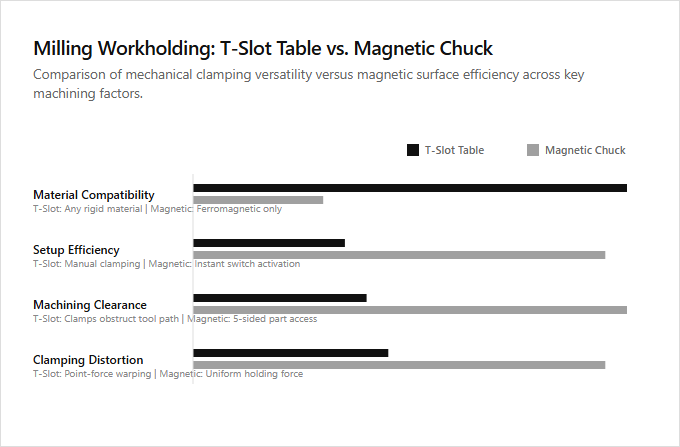
| Workholding Mechanism | While a T-slot table secures workpieces mechanically using threaded T-nuts and clamping studs, a magnetic chuck utilizes magnetic flux to hold parts in place. |
| Material Compatibility | T-slot tables can clamp any rigid material including plastics and non-ferrous alloys, whereas magnetic chucks are strictly limited to ferromagnetic workpieces. |
| Setup Efficiency | Magnetic chucks significantly reduce cycle time through instant switch activation, compared to the manual alignment and tightening required for T-slot step blocks. |
| Machining Clearance | Magnetic chucks provide unobstructed, five-sided access for the milling spindle, while physical clamps on a T-slot table often interfere with the tool path. |
| Clamping Distortion | Mechanical clamping on T-slot tables can cause elastic deformation in thin parts, whereas magnetic chucks distribute holding force uniformly to prevent warping. |
Magnetic Chuck Limitations vs. Universal T-Slot Clamping
When selecting a workholding solution for a milling machine, understanding material compatibility is critical. Magnetic chucks offer rapid setup times and unobstructed top-surface machining, but they are strictly limited to holding ferromagnetic materials like iron and steel. Non-ferrous alloys such as aluminum, copper, and brass cannot be secured by magnetic force, which restricts the overall versatility of the machine in multi-material environments.
In contrast, T-slot tables utilize mechanical fasteners, step blocks, and vises to secure workpieces. This traditional method offers universal clamping capability, successfully securing any material regardless of its chemical composition or magnetic properties. While manual setup takes longer, the mechanical connection provides a reliable grip for heavy-duty milling operations on diverse substrates.
Magnetic chucks are ideal for production facilities focusing on rapid, high-volume steel component manufacturing, whereas T-slot tables are best suited for general machinists and job shops requiring the adaptability to handle diverse, non-standard materials.
Magnetic Chucks vs. Clamps for 5-Sided Machining
Magnetic chucks provide a distinct advantage in milling operations by offering unobstructed five-sided access to the workpiece. By securing the part firmly from its base using magnetic force, these chucks eliminate the need for top and side clamps. This allows cutting tools to follow continuous, complex toolpaths across multiple faces without the risk of tool collision or the need for redundant setups.
In contrast, traditional T-slot tables rely on mechanical clamps and vises that inevitably obstruct workpiece surfaces. Machinists must carefully program toolpaths to steer clear of these physical barriers, which often increases setup times and limits machining efficiency. T-slot tables are best suited for general machinists working with diverse, non-ferrous materials, whereas magnetic chucks are ideal for high-production specialists processing flat, ferrous workpieces.
Strap Clamp Distortion Versus Uniform Magnetic Force
Traditional T-slot tables utilize mechanical strap clamps that exert localized downward pressure on the workpiece. This concentrated point loading introduces significant stress concentration, which frequently leads to physical clamping distortion, particularly in thin-walled or high-precision components.
Conversely, magnetic chucks leverage magnetic flux to distribute holding force uniformly across the entire contact surface. This continuous, even grip eliminates localized stress points and prevents structural warping during heavy milling operations.
Heavy-duty machinists handling non-ferrous, complex geometries will benefit most from T-slot versatility, whereas high-volume production operators prioritizing rapid, distortion-free setups on ferrous parts are ideal candidates for magnetic chuck systems.
Electromagnetic Actuation vs. Manual Alignment: Reducing Setup Time
When optimizing milling machine workflows, the choice between a traditional T-slot table and an electromagnetic chuck heavily influences setup efficiency. Traditional T-slot tables require operators to manually align T-nuts, studs, and clamps, a tedious process that increases machine downtime. In contrast, electromagnetic chucks offer instant actuation via a single switch, securing ferrous workpieces immediately and eliminating physical obstructions around the part. This dramatic reduction in setup time maximizes spindle utilization and increases daily production capacity.
While magnetic chucks streamline operations for flat, ferrous materials, T-slot tables remain indispensable for complex, non-magnetic, or irregularly shaped parts requiring heavy mechanical clamping. Traditional T-slot tables are best suited for general machinists handling diverse, low-volume job shop projects, whereas electromagnetic chucks are ideal for high-production manufacturers focusing on rapid, repetitive machining of steel plates.
Magnetic Holding vs. T-Slot Adaptability for Cast Parts
Magnetic chucks offer rapid workholding for ferrous metals but remain highly sensitive to air gaps. Any surface irregularity, rust, or scale on raw castings creates a physical gap that drastically reduces the magnetic holding force, compromising safety and stability during heavy milling operations. This characteristic requires workpieces to have flat, clean, and pre-machined contact surfaces to ensure maximum clamping security.
T-slot tables overcome these surface limitations by providing mechanical adaptability. Utilizing adjustable step blocks, studs, and clamps, operators can securely anchor irregular raw castings and non-ferrous parts regardless of their surface finish or geometric complexity. Magnetic chucks are ideal for high-volume production specialists working with flat, pre-machined steel, whereas T-slot tables are best suited for custom fabricators and job shops handling diverse, raw-cast geometries.
Electro-Permanent Magnets vs. T-Slots: Workholding Safety
Electro-permanent magnetic chucks offer advanced workholding efficiency for modern milling operations. These systems utilize electric current only during the brief activation and deactivation phases, ensuring that the magnetic clamping force remains fully active even during a sudden power failure. This design prevents accidental workpiece release, providing robust operational safety alongside rapid setup times and unobstructed five-sided machining access.
Conversely, traditional T-slot tables rely on the inherent physical security of mechanical clamps, studs, and bolts. This time-tested method offers absolute mechanical resistance against heavy lateral cutting forces without any reliance on electrical components or material magnetic properties. Traditional T-slot tables are best suited for machinists performing diverse, low-volume setups on varied part geometries, while electro-permanent magnetic chucks are ideal for high-production facilities requiring rapid, repetitive cycle times on ferrous workpieces.
Lateral Shear Resistance: Magnetic Chucks vs. T-Slot Tables
Magnetic chucks secure workpieces primarily through magnetic hold, relying on the friction coefficient between the contact surfaces to resist lateral shear forces. Because this frictional resistance can be overcome during heavy milling, operators employ auxiliary stop blocks. These blocks provide essential physical barriers to absorb lateral thrust, preventing workpiece slippage while maintaining unobstructed top-surface tool access.
T-slot tables utilize direct mechanical clamping to resist lateral forces. T-bolts, step blocks, and clamps physically anchor the workpiece, transferring cutting loads directly into the machine frame for maximum rigidity. Heavy-industrial machinists requiring aggressive material removal on varied geometries prefer the absolute security of T-slot tables, whereas high-volume manufacturing operators prioritizing rapid setup times and uniform parts benefit most from magnetic chuck systems.
Leave a comment