
Selecting the right cordless ratchet wrench often presents a frustrating dilemma: choosing between the compact maneuverability needed for tight spaces and the raw torque required to break stubborn fasteners. Typically, mechanics attempt to resolve this by leveraging their existing tool ecosystems, relying on standard battery platforms they already own to dictate their next purchase.
However, selecting the correct voltage grants operators the critical advantage of optimized mechanical leverage without the risk of stripping threads or damaging components. To manage expectations, it is important to stipulate that higher voltage does not inherently guarantee superior utility in every scenario; for example, a slim 12V ratchet excels in crowded automotive engine bays, whereas a heavy-duty 20V model is indispensable for high-torque suspension work.
This article provides a comparative analysis of 12V versus 20V cordless ratchets. We will evaluate torque output, physical profiles, and battery runtimes to help you select the optimal power tool for your specific mechanical demands.
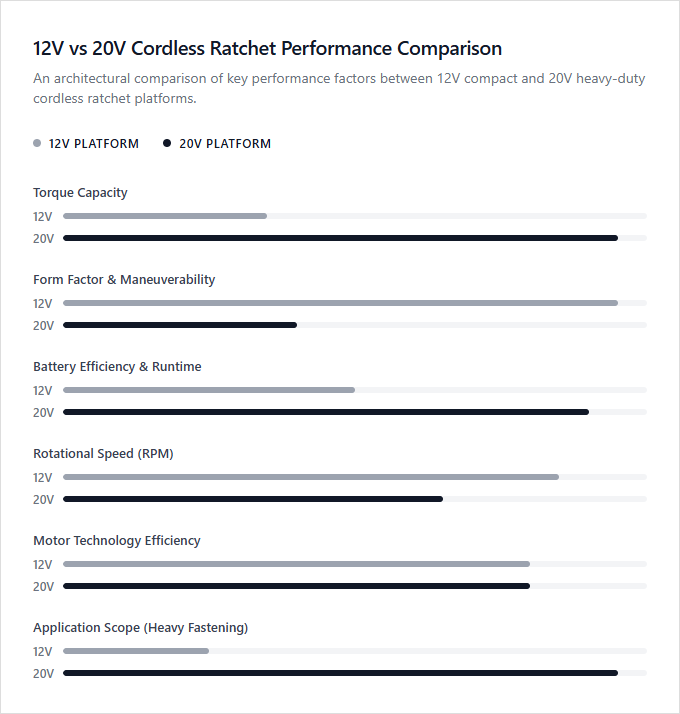
| Factor | Summary |
|---|---|
| Torque Capacity | 20V models deliver significantly higher peak torque output (measured in foot-pounds) than 12V models, which is essential for loosening stubborn or rusted fasteners. |
| Form Factor | 12V cordless ratchets feature a much more compact chassis and lower weight, allowing for superior maneuverability in tight automotive engine bays. |
| Battery Efficiency | 20V platforms utilize larger lithium-ion battery packs that provide higher watt-hour capacities to sustain extended tool runtime under heavy workloads. |
| Rotational Speed | Many 12V ratchets offer impressive no-load speed (measured in revolutions per minute, or RPM) to facilitate the rapid rundown of small fasteners. |
| Motor Technology | Both voltage classes increasingly utilize brushless motors to optimize power transfer efficiency and extend the overall operating lifespan of the tool. |
| Application Scope | The 12V system excels at delicate, low-torque precision assembly, whereas the 20V system is engineered for heavy-duty structural fastening requiring high breakaway torque. |
Fastening torque and breakaway torque limits measured in foot-pounds
When selecting a cordless ratchet, voltage directly dictates the tool's mechanical limits. Compact 12V cordless ratchets are engineered for precision and accessibility, typically delivering fastening torques between 30 to 55 foot-pounds and breakaway torques peaking around 60 foot-pounds. These specifications prevent the over-tightening of delicate fasteners in confined spaces. In contrast, heavy-duty 20V models prioritize raw power, generating fastening torques of 70 to 90 foot-pounds and robust breakaway limits that often exceed 150 foot-pounds to shear through rusted or seized fasteners.
Selecting the appropriate voltage depends on your specific trade requirements and physical workspace constraints. Lightweight 12V models are ideal for automotive technicians performing intricate under-dash or light engine work, while high-torque 20V models suit heavy machinery mechanics and industrial technicians who regularly service large, high-tolerance fasteners.
Nominal voltage output and brushless motor efficiency
When selecting a cordless ratchet, the primary distinction between 12V and 20V platforms lies in nominal voltage output and motor efficiency. A 12V system offers a compact form factor, delivering sufficient torque for tight spaces, while a 20V system provides significantly higher nominal voltage for demanding fastening tasks. Incorporating brushless motor technology further enhances both platforms, maximizing battery runtime and power delivery by eliminating brush friction and reducing energy loss as heat.
Brushless 12V models optimize efficiency for precise, repetitive tasks, whereas 20V brushless ratchets excel in sustaining high-torque demands without stalling under heavy loads. The lightweight 12V ratchet is ideal for automotive technicians navigating cramped engine bays, while the robust 20V variant is best suited for heavy equipment mechanics requiring maximum breakaway torque.
Drive size availability including quarter-inch and three-eighths inch anvils
When selecting a cordless ratchet, battery voltage directly influences the tool's physical footprint and torque output. The compact 12V cordless ratchet is highly prevalent in both quarter-inch and three-eighths inch drive sizes, offering the slim profile necessary for navigating tight engine bays and intricate machinery. In contrast, 20V platforms utilize their increased power for high-torque fastening, though these units often feature larger motor housings that can restrict access in confined areas.
While the quarter-inch anvil is typically exclusive to 12V models for precision tasks, the versatile three-eighths inch anvil is widely available across both voltage tiers. Precision technicians and interior installers benefit most from the lightweight maneuverability of the 12V system, whereas heavy-duty mechanics and agricultural technicians requiring maximum breakaway torque will find the robust 20V models more suitable for their demanding workloads.
No-load speed performance measured in revolutions per minute
When selecting a cordless ratchet wrench, evaluating the no-load speed performance is critical for job efficiency. Typically, 12V cordless ratchets are engineered for precision and agility, offering no-load speeds ranging between 250 and 350 revolutions per minute (RPM). This speed range allows operators to quickly run down fasteners in confined automotive engine bays without the risk of over-tightening.
In contrast, 20V cordless ratchets leverage higher voltage to achieve superior no-load speeds, frequently exceeding 400 RPM. This enhanced rotational speed delivers rapid fastener engagement, which significantly reduces assembly time on larger-scale projects. Compact 12V models are ideal for automotive technicians navigating tight engine bays, while high-velocity 20V models best suit industrial mechanics who require rapid performance for heavy equipment disassembly.
Head clearance profile and ergonomic handgrip dimensions
The 12V cordless ratchet features a compact head clearance profile, allowing it to navigate tight engine bays and confined spaces where maneuverability is critical. In contrast, the 20V variant utilizes a bulkier head design to house the robust gearing necessary for high-torque applications, which limits access in restricted areas.
Ergonomic handgrip dimensions also differ significantly between these platforms. The 12V model offers a slim, lightweight grip that reduces hand fatigue during prolonged overhead use, while the 20V model employs a thicker, more substantial handle to ensure a secure grip when managing higher reaction torque. Automotive technicians working in tight quarters benefit most from the nimble 12V model, whereas heavy equipment mechanics requiring maximum power prefer the robust 20V platform.
Amp-hour capacity and lithium-ion cell weight distribution
When selecting between 12V and 20V cordless ratchets, the configuration of the lithium-ion cells dictates both ergonomics and weight distribution. A 12V system utilizes three internal cells in a slim, inline handle, minimizing tool weight for effortless use in tight spaces. A 20V system requires five or more cells in a bulkier slide-on footprint, shifting the center of gravity downward but offering superior balance when the tool is set down.
This cell structure directly affects amp-hour capacity. The 12V models typically offer 1.5 Ah to 3.0 Ah to prioritize lightweight maneuverability, while 20V systems easily accommodate 4.0 Ah or higher for prolonged high-torque applications. Lightweight 12V ratchets are ideal for automotive technicians navigating cramped engine bays, while robust 20V models are suited for heavy-duty construction workers requiring maximum runtime and torque.
Gear ratio strength for manual ratcheting breakaway force
Cordless ratchets leverage internal gearing to multiply torque, but their manual breakaway force-using the tool as a hand wrench to loosen stubborn bolts-depends on gear head robustness. Compact 12V models feature smaller gear heads typically rated for manual torque thresholds up to 100 foot-pounds. Overloading these smaller mechanisms can cause internal gear failure.
Larger 20V ratchets utilize reinforced steel casings and heavy-duty planetary gears designed to withstand manual breakaway forces exceeding 150 foot-pounds. This structural strength allows users to break loose rusted fasteners manually before activating the motor. Compact 12V ratchets suit precision technicians working in confined engine bays, while robust 20V models are ideal for heavy equipment mechanics requiring maximum manual leverage.
Leave a comment