
Metal fabricators and workshop managers frequently battle the frustration of tool burnout and warped material edges, a common consequence of forcing a power shear beyond its intended limits. While procurement teams often rely on standard equipment funding sources and basic CAPEX budgets to secure general workshop machinery, simply purchasing a standard tool is rarely enough.
Selecting the precise cutting capacity grants operators a distinct competitive advantage, drastically reducing material waste and optimizing workflow efficiency. However, this choice comes with the vital stipulation that raw cutting power must never compromise edge quality or user control. For example, utilizing an 18-gauge shear for precision HVAC ductwork versus deploying a robust 14-gauge model for heavy-duty steel framing illustrates how task-matching prevents costly mechanical failures.
Below, we examine the critical distinctions between fourteen and eighteen-gauge shears, outlining their mechanical tolerances, material compatibility, and operational trade-offs to guide your next procurement decision.
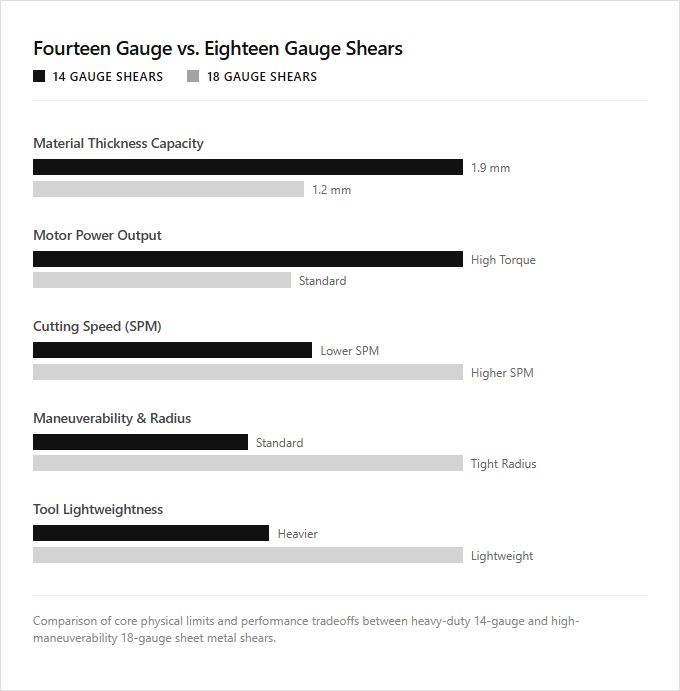
| Factor | Summary |
|---|---|
| Material Thickness Capacity | Fourteen gauge shears can cut through thicker sheet metal up to approximately 1.9 mm, whereas eighteen gauge shears are limited to thinner workpieces around 1.2 mm. |
| Motor Power Output | Fourteen gauge shears utilize high-torque electric motors with higher amperage ratings to overcome the shear resistance of denser metal alloys. |
| Cutting Speed (SPM) | Eighteen gauge shears typically operate at a higher strokes per minute (SPM) rate, which enables faster linear cutting speeds on lighter metals. |
| Maneuverability and Radius | Eighteen gauge shears provide a much tighter minimum cutting radius, making them far better suited for intricate scrollwork and curved profiles. |
| Tool Weight and Ergonomics | Eighteen gauge shears feature a lightweight, compact chassis that significantly reduces operator fatigue during prolonged overhead applications. |
Why 14-Gauge Shears Outpower 18-Gauge Models
When selecting sheet metal shears, the primary distinction between fourteen-gauge and eighteen-gauge models lies in their power capacity and mechanical limits. Fourteen-gauge shears feature higher motor amperage ratings to handle heavier workloads compared to eighteen-gauge models. This increased amperage provides the necessary torque to consistently cut through thicker, tougher metals without motor strain.
In comparison, eighteen-gauge shears are designed with lower-amperage motors optimized for lighter, thinner sheet metal applications. While these tools lack the raw power of their heavy-duty counterparts, they offer superior maneuverability and control for intricate patterns.
Industrial fabricators and structural contractors require the robust power of fourteen-gauge shears for heavy production, whereas HVAC installers and detail-oriented artisans will find the lightweight precision of eighteen-gauge shears best suited for their daily tasks.
14-Gauge vs. 18-Gauge Shear Cutting Capacities
Metal-cutting shear power tools are defined by their gauge capacity, which dictates the maximum material thickness they can cleanly slice. The primary distinction between fourteen-gauge and eighteen-gauge shears lies in their nominal thickness capacities for mild steel. Fourteen-gauge shears are engineered to cut thicker sheets up to 0.0747 inches, whereas eighteen-gauge shears are rated for thinner materials up to 0.0478 inches.
Selecting the appropriate tool depends on the operational environment and the specific demands of the workpiece. Heavy-duty industrial fabricators requiring robust penetration through thick plate metal will find the fourteen-gauge model essential, while HVAC technicians and precision detailers working with light-gauge ductwork are better suited for the maneuverability of eighteen-gauge shears.
High-Speed 18-Gauge Shears for Rapid Metal Cutting
Metal shears are categorized by the maximum material thickness they can cut, with fourteen-gauge and eighteen-gauge models serving distinct operational needs. Eighteen-gauge shears are engineered for lighter materials, operating at a higher strokes-per-minute frequency. This increased speed allows for rapid, efficient linear cutting of thin sheet metal, maximizing productivity during intricate fabrication tasks.
Fourteen-gauge shears prioritize mechanical power over velocity. These tools utilize a slower, high-torque mechanism necessary to slice through thicker, more resilient metals without stalling. Heavy-duty industrial fabricators requiring robust raw material processing benefit most from fourteen-gauge shears, while HVAC technicians and light-gauge metal workers find the high-speed eighteen-gauge models ideal for their rapid, precision installations.
Wider Blade Clearance Prevents 14-Gauge Shear Binding
When selecting metal-cutting power tools, understanding the mechanical distinctions between fourteen-gauge and eighteen-gauge shears is essential for maintaining tool longevity and cut quality. The primary operational difference lies in their material capacity and the corresponding blade setup. Specifically, fourteen-gauge shears require wider blade clearance adjustments to prevent mechanical binding during operation, as tighter settings on thicker metals will stall the motor and damage the cutting edges.
Properly managing these clearance settings ensures smooth, burr-free results and prevents premature tool wear. Heavy-duty fourteen-gauge models are ideal for industrial fabricators processing thick structural materials, whereas lightweight eighteen-gauge shears are suited for residential HVAC technicians and precision artisans who prioritize maneuverability on thinner sheets.
18-Gauge Shears for Intricate Curve and Scroll Cuts
Fourteen-gauge and eighteen-gauge metal shears are designed for distinct sheet metal applications, differing primarily in their material capacity and maneuverability. Fourteen-gauge shears excel at cutting thicker, heavier metals, delivering robust power for demanding industrial tasks. In contrast, eighteen-gauge shears trade raw thickness capacity for enhanced precision on thinner materials.
The primary advantage of eighteen-gauge shears lies in their agility. These tools provide a significantly smaller minimum cutting radius, which makes them highly effective for executing intricate curves, tight radiuses, and complex scroll cuts. This tight-turning capability prevents material distortion on lighter-gauge metals, allowing for clean, detailed finishes that heavier shears cannot achieve.
Heavy-duty fabricators and industrial installers requiring raw power for thick ductwork benefit most from fourteen-gauge shears, while creative metal artists, detail-oriented prototypers, and precision craftsmen working with light-gauge materials are the ideal users for eighteen-gauge models.
Tensile Strength Dictates Shear Gauge Limits
When selecting between fourteen gauge and eighteen gauge power shears, the workpiece's tensile strength is the primary deciding factor. While nominal gauge ratings provide a general baseline, the actual cutting capacity of each tool decreases as the tensile strength of the metal increases. A shear rated for fourteen-gauge mild steel, for example, is typically limited to thinner sixteen- or eighteen-gauge stainless steel due to the higher resistance of the alloy.
Eighteen gauge shears are engineered for thinner, more ductile materials, whereas fourteen gauge models offer the robust mechanical advantage required for thicker metals. Heavy-duty industrial fabricators working with thick plate steel will find the fourteen gauge model indispensable, whereas precision HVAC technicians and auto body restorers will benefit more from the lighter, highly maneuverable eighteen gauge shears.
Improper Shearing of Thin Metals Causes Severe Burrs
Fourteen-gauge and eighteen-gauge power shears are engineered for distinct material thicknesses, and matching the tool to the application is vital for edge quality. Using a heavy-duty fourteen-gauge shear on thinner sheet metals frequently yields poor results. Because the blade clearance on fourteen-gauge models is designed for thicker stock, improper use of these shears on thin metals increases the risk of severe burr formation, tearing, and material deformation along the sheared edge.
Achieving a clean, precise cut requires utilizing the correct mechanical tolerances for the workpiece gauge. Eighteen-gauge shears offer the tighter clearances necessary for pristine finishes on lighter metals, whereas fourteen-gauge shears provide the robust force needed for thicker sheets. Heavy-duty industrial fabricators requiring high-capacity cutting are best suited for fourteen-gauge shears, while precision HVAC technicians and architectural metalworkers benefit most from the control of eighteen-gauge models.
Leave a comment