
In high-volume metal fabrication, selecting the wrong mechanical shear leads to costly material deformation, operator fatigue, and unexpected downtime. While procurement teams typically rely on standard capital equipment budgets to cycle out worn tools, making the wrong choice between pneumatic and electric power systems can quietly erode your operating margins.
Choosing the correct drive mechanism grants production lines a massive boost in duty-cycle efficiency and cut precision. However, this advantage comes with a key stipulation: pneumatic options only realize their true cost-benefit ratio if the facility already possesses a robust, moisture-regulated compressed air infrastructure. For instance, in rapid HVAC ducting fabrication, matching the right shear to the shop's existing utility setup directly prevents premature tool failure.
This guide analyzes the performance, maintenance, and utility requirements of both pneumatic and electric shears to help you choose the ideal tool for your industrial shearing operations.
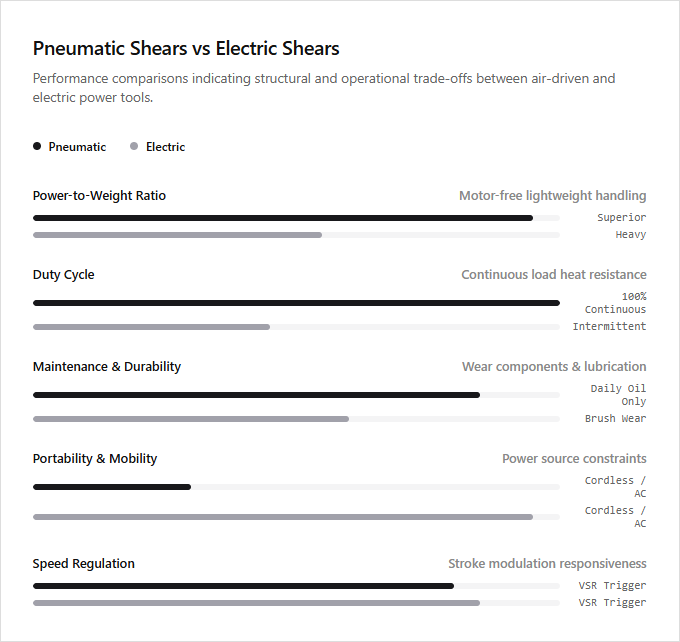
| Factor | Summary |
|---|---|
| Power Source | Pneumatic shears rely on compressed air measured in CFM and PSI, while electric shears are powered by mains AC current or cordless DC lithium-ion batteries. |
| Power-to-Weight Ratio | Pneumatic shears have a superior power-to-weight ratio because they lack a heavy internal motor, making them much lighter and easier to handle than electric counterparts. |
| Duty Cycle | Pneumatic shears can run continuously with a 100% duty cycle without thermal overload, whereas electric shears are prone to heat buildup during prolonged operation. |
| Maintenance and Durability | Pneumatic shears require daily lubrication with air tool oil but lack vulnerable electrical components like carbon brushes and commutators that wear out over time. |
| Portability and Mobility | Electric shears offer maximum portability and maneuverability, especially cordless models, whereas pneumatic shears are tethered to an air compressor by a high-pressure hose. |
| Speed Regulation | Cutting speed is measured in strokes per minute (SPM), which is modulated via an air flow regulator on pneumatic models and an electronic variable speed trigger on electric models. |
Power-to-weight ratio differences in ergonomic tool handling
Pneumatic shears utilize external compressed air, eliminating the need for a heavy onboard motor. This design yields a superior power-to-weight ratio, offering a highly lightweight tool that minimizes operator fatigue during prolonged use. The absence of bulky electrical components allows for a slimmer, more compact grip, which significantly enhances ergonomic handling and maneuverability in tight workspaces.
Electric shears house internal motors and battery packs, which increases their overall weight and shifts the tool's balance point. While this extra mass can make overhead operation more taxing, the self-contained design eliminates the restriction of air hoses. This added heft can also help stabilize the tool, dampening vibrations during long, continuous cuts.
Pneumatic models are ideal for assembly line technicians requiring tireless, repetitive industrial operation, whereas electric shears best serve mobile contractors who need untethered portability across various jobsites.
Intrinsically safe pneumatic operation in ATEX-rated hazardous environments
When selecting shear power tools for industrial applications, the choice between pneumatic and electric models often hinges on the operating environment. Electric shears offer excellent portability and consistent power in standard workshops but present inherent ignition risks due to motor arcing and heat generation. In contrast, pneumatic shears utilize compressed air, eliminating electrical components entirely. This makes them intrinsically safe and the industry standard for ATEX-rated hazardous environments, such as chemical processing plants and refineries where explosive gases or dust are present.
Pneumatic systems also provide a high power-to-weight ratio and can run continuously without the risk of overheating. Electric shears are ideal for general contractors and metal fabricators working in well-ventilated, non-hazardous sites, whereas pneumatic shears are the necessary choice for specialized industrial technicians operating in volatile, high-risk atmospheres.
Air-Vane Motors vs. Electric: Preventing Thermal Overload
Pneumatic shears utilize air-vane motors that inherently support a 100% continuous duty cycle. Because expanding compressed air naturally cools the tool during operation, these shears can run indefinitely without the risk of heat buildup. This thermal stability makes them highly reliable for uninterrupted, high-volume production environments where tool downtime is costly.
Conversely, electric shears rely on motors that generate internal heat under prolonged, heavy resistance. Without scheduled cooling periods, electric units risk thermal overload, which can degrade the motor windings or trigger automatic safety shutdowns. Industrial fabricators requiring constant, heavy-duty cutting in fixed workstations will benefit most from pneumatic shears, while mobile contractors needing portability and intermittent use are better served by electric models.
Variable strokes per minute (SPM) control mechanisms
Pneumatic shears regulate variable strokes per minute (SPM) through air flow manipulation. By adjusting a progressive throttle trigger or an integrated air regulator, operators can infinitely vary the volume of compressed air entering the tool. This mechanism allows for fluid speed adjustments without the risk of motor overheating, preserving mechanical torque even at lower operational speeds.
Electric shears utilize electronic speed control dials or variable-speed triggers that modulate the electrical current flowing to the motor. High-end electric models often feature electronic feedback circuitry to maintain a constant SPM under varying load conditions. While offering highly precise speed selection, continuous low-speed operation can cause heat buildup in electric motors, requiring careful thermal management.
Pneumatic models are suited for industrial fabricators working in stationary workshop environments with established air compressor infrastructure, whereas electric units are ideal for independent contractors and field technicians who prioritize portability and plug-and-play versatility across various job sites.
FRL (Filter-Regulator-Lubricator) maintenance requirements versus carbon brush wear
Pneumatic shears offer exceptional power-to-weight ratios but require consistent maintenance of the supporting air infrastructure. Operating these tools efficiently relies on a Filter-Regulator-Lubricator (FRL) system to remove moisture, regulate pressure, and supply necessary lubrication to the air motor. Neglecting FRL maintenance leads to internal corrosion, sluggish performance, and premature tool failure.
In contrast, electric shears eliminate the need for air compressors but introduce maintenance concerns related to carbon brush wear. These brushes gradually degrade through friction and electrical contact, necessitating periodic inspection and replacement to avoid permanent motor damage. High-volume industrial plants with established air lines are ideal candidates for pneumatic shears, whereas independent contractors prioritizing portability and quick setup are better suited for electric options.
Air Consumption vs. Electrical Outlet Mobility
Pneumatic shears offer an exceptional power-to-weight ratio but depend entirely on a consistent supply of compressed air, measured in cubic feet per minute (CFM). Operating these tools requires a high-capacity air compressor, which restricts their use to dedicated workshop environments equipped with the necessary pneumatic infrastructure.
Electric shears provide superior mobility by utilizing standard electrical outlets or rechargeable battery packs. This independence from air lines allows operators to navigate complex job sites easily, though cordless models must balance runtime with battery weight and corded units remain tethered to local power sources.
Pneumatic shears are ideal for stationary industrial fabricators requiring continuous, heavy-duty production, whereas electric models best serve mobile contractors and HVAC technicians who prioritize portability across diverse job sites.
Constant torque delivery for shearing high-tensile sheet metal gauge capacities
When cutting high-tensile sheet metal, maintaining constant torque is essential to prevent stalling and ensure clean cuts across maximum gauge capacities. Pneumatic shears excel in high-demand environments, delivering consistent, fade-free torque as long as the air supply remains stable, making them highly efficient for continuous industrial production. Electric shears offer immediate, highly controllable power, though standard models may experience slight torque fluctuations under heavy, prolonged loads unless equipped with advanced constant-speed electronics.
The choice between these tool types depends on the operational environment and the specific demands of the workpiece. Pneumatic shears are best suited for industrial fabricators working in dedicated facilities with robust air compressor systems, whereas electric shears are ideal for mobile contractors and field technicians who require portable, plug-and-play versatility across various job sites.
Leave a comment