
Achieving clean, distortion-free radius cuts in sheet metal remains a persistent challenge for metalworkers, who frequently battle tool binding, jagged edges, and costly material waste. While standard shop tooling budgets typically fund traditional band saws or manual snips to address these cutting needs, these conventional methods often fall short of modern production standards.
Upgrading to specialized power shears grants operators the surgical precision needed to eliminate edge distortion and dramatically reduce labor hours. Naturally, maximizing this value-add requires strict adherence to operating parameters, provided that the material thickness and hardness do not exceed the tool's rated gauge capacity.
To navigate these limitations, professional fabricators frequently deploy industry standards such as the Milwaukee 2637-20 or Makita JS1602 to navigate tight curves. Below, we examine the critical mechanical distinctions between straight head and swivel head shears, helping you choose the optimal tool configuration for your precision radius-cutting applications.
| Factor | Summary |
|---|---|
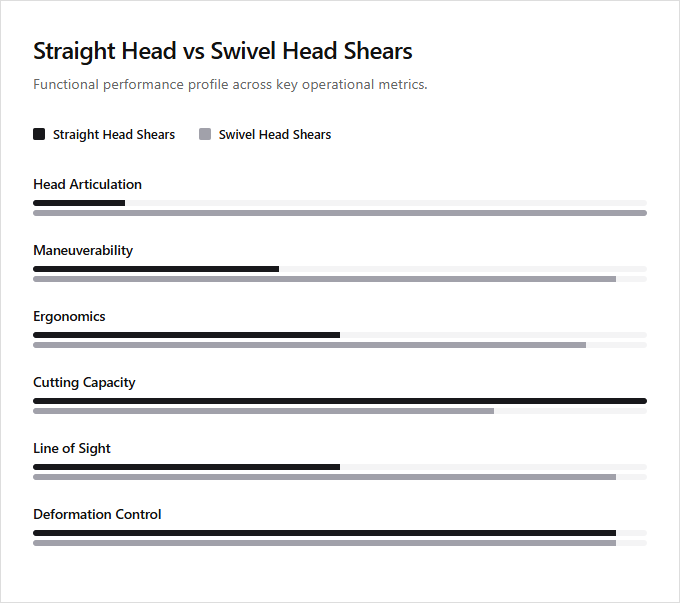
| Head Articulation | Straight head shears feature a fixed cutting orientation, whereas swivel head shears utilize a 360-degree rotating head to navigate tight angles without relocating the tool body. |
| Maneuverability | While straight head shears are optimized for high-speed linear tracking, swivel head shears excel at complex curvilinear cutting and contouring. |
| Ergonomics | Swivel head shears minimize operator fatigue by allowing angle adjustments that maintain a neutral wrist position, unlike rigid straight head models. |
| Cutting Capacity | Straight head shears typically provide a superior mechanical advantage for cutting heavy-gauge sheet metal, whereas the swivel joint can slightly reduce maximum torque transfer. |
| Line of Sight | Swivel head shears improve line-of-sight visibility by offsetting the motor housing away from the cut line during intricate scroll work. |
| Kerf and Distortion | Both designs minimize lateral material deformation by using a dual-cutter system that curls a waste strip away from the workpiece. |
360-Degree Swivel Shears for Continuous Contour Cutting
Power shears are essential for clean, distortion-free metal fabrication, with straight head and swivel head designs offering distinct operational advantages. While straight head shears excel in executing long, direct lines, swivel head models provide superior maneuverability. The 360-degree head rotation in swivel shears facilitates continuous contour cutting without repositioning the tool body. This feature allows operators to navigate tight curves and complex profiles seamlessly, maintaining an optimal cutting angle and reducing physical fatigue during intricate fabrication tasks.
Straight head shears offer a rigid, stable configuration for rapid, high-volume straight cuts. Swivel head shears prioritize accessibility in confined or awkward spaces. Straight head shears are best suited for high-volume production workers executing linear cuts, while swivel head shears are ideal for HVAC installers and custom fabricators requiring frequent curve navigation.
Dual-Cut Shears for Distortion-Free Cuts
When selecting metal-cutting power shears, the choice between straight head and swivel head configurations determines both the quality of the finish and tool maneuverability. Straight head shears utilize a sophisticated dual-cut blade geometry. This design employs two outer blades and a central punch to remove a thin, continuous strip of waste material, which produces a distortion-free waste kerf. This process successfully prevents the deformation of the workpiece, leaving smooth, clean edges on both sides of the cut.
In contrast, swivel head shears feature a rotating head that easily accommodates awkward angles and contoured profiles, though they lack the same distortion-free dual-cut finish on flat sheets. Straight head models are best suited for high-precision workshop fabricators requiring flawless, linear cuts, whereas swivel head models are ideal for HVAC technicians and field installers who frequently navigate complex overhead ductwork.
Swivel Heads Enable Tighter Scroll Cutting
Straight head shears are engineered for linear precision, offering excellent stability and speed when cutting along straight lines or broad curves. While highly efficient for standard sheet metal applications, their rigid design limits maneuverability when navigating complex or tight geometries.
In contrast, the swivel head configuration significantly reduces the minimum cutting radius for tight scroll cutting. By allowing the cutting head to rotate independently of the tool motor, this design enables operators to execute intricate curves and detailed patterns smoothly without binding or distorting the material.
Straight head shears are ideal for roofing installers performing long, continuous cuts, whereas swivel head shears are best suited for HVAC technicians and custom fabricators who regularly execute complex ductwork and artistic metal layouts.
Fixed-Head Shears Optimize Long, Straight Cuts
When selecting sheet metal power shears, understanding head configuration is critical for task efficiency. Straight head shears feature a fixed-head alignment that remains directly in line with the tool body. This rigid design provides optimal line-of-sight tracking, allowing operators to follow marked lines precisely over long linear cuts with maximum stability.
Swivel head shears incorporate a rotating head that adjusts to various angles. This flexibility allows the user to navigate tight curves and contours without awkward wrist strain or tool repositioning. Straight head shears are ideal for production workers executing repetitive, long-distance sheet metal rips, while swivel head models are best suited for HVAC installers and detail fabricators who frequently navigate complex shapes and overhead spaces.
Adjusting Blade Clearance Prevents Burring on Tight Radii
When selecting sheet metal power shears, professionals typically choose between straight head and swivel head configurations. Straight head shears offer a rigid, inline design optimized for rapid, straight cuts and wide curves in heavy-gauge materials. In contrast, swivel head shears feature a rotating head that allows the operator to maneuver through complex profiles and tight spaces without twisting the entire tool body.
For swivel head models, maintaining precise blade adjustment is paramount when executing intricate cuts. Adjustable blade clearance in swivel models is critical to prevent edge burring on tight radii, ensuring a clean finish as the tool navigates sharp angles. This adjustability minimizes material deformation and reduces mechanical strain on the motor during detailed contouring tasks.
Straight head shears are ideal for high-volume production workers focusing on long, linear runs, whereas swivel head shears are best suited for HVAC installers and custom fabricators who frequently navigate complex ductwork and tight radius curves.
Rigid Frames Increase Straight Shear Capacity
Straight head shears and swivel head shears offer distinct mechanical advantages depending on the application. Straight head shears feature a rigid frame construction that minimizes deflection under load. This robust, fixed-head design allows the tool to deliver higher force directly to the blades, enabling a significantly greater material gauge capacity for heavy-duty, straight-line cutting.
Swivel head shears incorporate a rotating cutting head that enhances maneuverability, allowing users to navigate tight curves and irregular profiles with ease. Heavy-industrial fabricators processing thick, flat sheets require the high-gauge capability of straight shears, while HVAC technicians and roofers demand the agile swivel head shears for intricate field installations.
Variable SPM Prevents Blade Binding in Swivel Shears
Sheet metal fabrication demands the right cutting tool for the task, highlighting the distinct operational profiles of straight head and swivel head shears. While straight head shears excel at rapid, linear cuts, swivel head shears offer the maneuverability needed for contouring and navigating curved paths. When steering through these tight curves, variable strokes per minute (SPM) control becomes essential. Adjusting the SPM allows the operator to maintain control, preventing the blades from binding during sharp radius transitions and ensuring clean, continuous edges.
This precise speed regulation allows the tool to accommodate the physical resistance of shifting angles. Straight head shears are ideal for high-volume manufacturing technicians focused on long, linear runs, whereas swivel head shears are best suited for HVAC installers and custom fabricators who frequently execute intricate, multi-directional cuts.
Leave a comment