
Achieving clean, rapid material removal at high RPMs often ends in frustration, as mismatched rotary accessories lead to ruined workpieces, melted materials, and prematurely dulled bits. To resolve this, many operators initially rely on the standard, general-purpose accessory assortments bundled with their rotary tools.
However, upgrading to task-specific tooling grants you the precise cutting efficiency and extreme heat resistance required to tackle demanding fabrication without stalling your motor. The critical stipulation to keep in mind is that workpiece hardness must dictate your accessory choice; ignoring this limitation compromises both tool life and safety. For instance, while high-speed steel (HSS) performs admirably on softwoods and plastics, industrial fabricators rely on Tungsten Carbide to effortlessly clean up dense cast iron weldments.
Below, we evaluate HSS and Tungsten Carbide across critical performance metrics-including heat tolerance, longevity, and cost-per-cut-to help you select the optimal burr for your high-RPM applications.
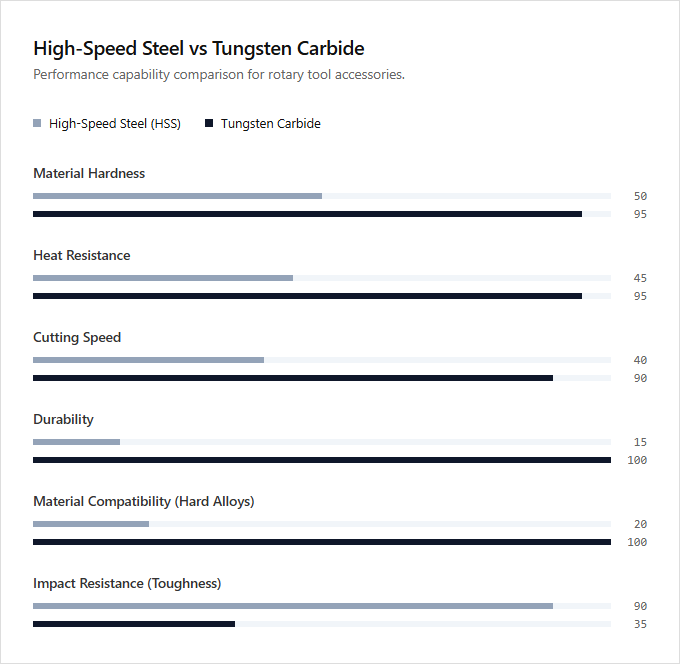
| Factor | Summary |
|---|---|
| Material Hardness | While High-Speed Steel offers sufficient rigidity for general use, Tungsten Carbide exhibits superior hardness nearing that of diamond on the Mohs scale. |
| Heat Resistance | Tungsten Carbide retains its structural integrity at much higher temperatures than High-Speed Steel, preventing thermal degradation during high-RPM operations. |
| Cutting Speed | Carbide burrs can be operated at significantly higher surface feet per minute compared to High-Speed Steel accessories without dulling. |
| Durability | Tungsten Carbide accessories offer exceptional wear resistance, lasting up to ten times longer than High-Speed Steel equivalents under continuous abrasive wear. |
| Material Compatibility | High-Speed Steel is ideal for softer substrates like wood and plastic, whereas Tungsten Carbide is required for machining high-tensile alloys and hardened steel. |
| Impact Resistance | High-Speed Steel possesses greater fracture toughness to withstand mechanical shock, whereas Tungsten Carbide is more brittle and prone to chipping. |
Tungsten Carbide's Superior Red Hardness Over High-Speed Steel
In rotary tool applications, choosing between high-speed steel (HSS) and tungsten carbide cutters depends largely on thermal demands. Tungsten carbide exhibits superior red hardness compared to high-speed steel at elevated temperatures. This characteristic allows carbide accessories to maintain their structural integrity and sharp cutting edges even when friction generates extreme heat during rapid, continuous rotation.
While HSS functions efficiently at lower speeds, it undergoes thermal softening when pushed beyond its thermal limits. Tungsten carbide resists this degradation, facilitating consistent performance during demanding operations on dense materials. High-speed steel is ideal for DIY hobbyists working with softer woods and plastics, whereas tungsten carbide is suited for industrial professionals requiring precision on hardened metals and ceramics.
High-Speed Steel Resists Chipping at High RPMs
When selecting rotary tool accessories, the choice between high-speed steel (HSS) and tungsten carbide depends on the specific demands of the application. High-speed steel is highly valued for its exceptional fracture toughness. This physical property allows HSS cutters to withstand the sudden impact loads of high-RPM operation without chipping, making them highly resilient during intricate carving, routing, or slotting tasks in softer materials.
In contrast, tungsten carbide offers superior hardness and wear resistance, maintaining its sharp cutting edge longer under high temperatures, though it is more brittle under sudden impacts. Trade professionals working with hardened steel, glass, or stone will find tungsten carbide ideal for its durability, while hobbyists and model makers requiring versatile, impact-resistant tools for detailed woodwork are better served by high-speed steel.
Tungsten Carbide Burrs Offer Higher SFM
When selecting rotary tool accessories, the choice between High-Speed Steel (HSS) and tungsten carbide significantly impacts project efficiency and tool longevity. Tungsten carbide burrs operate at much higher surface feet per minute (SFM) thresholds compared to their HSS counterparts. This superior SFM capability allows carbide to maintain its sharp cutting edges at extreme speeds without succumbing to thermal degradation, whereas HSS tends to dull rapidly under high-heat conditions.
Carbide excels at rapid material removal on dense substrates like stainless steel and cast iron, while HSS is optimized for softer materials. High-Speed Steel is ideal for DIY hobbyists seeking cost-effective solutions for light crafting and model making, whereas tungsten carbide is suited for professional fabricators requiring maximum durability for continuous, heavy-duty industrial applications.
HSS Reduces Material Loading in Soft Alloys
Selecting the right rotary tool accessory depends on the material being processed. High-speed steel is highly effective for machining soft, ductile alloys. Its sharp geometry reduces the risk of material loading, preventing the melted buildup that often clogs carbide bits during prolonged contact with softer metals or plastics.
Tungsten carbide provides exceptional hardness and thermal stability, making it the preferred choice for cutting hardened steel, cast iron, and dense hardwoods. Although carbide resists wear longer, it is more brittle than high-speed steel. Hobbyists and modelers shaping soft metals benefit most from high-speed steel due to its clog resistance, while industrial fabricators and heavy-duty woodcarvers require the uncompromising durability of tungsten carbide.
Double-Cut Flutes Optimize Carbide Chip Evacuation
When selecting rotary tool accessories, understanding the material composition of the cutters is essential for project success. High-Speed Steel (HSS) offers excellent flexibility and keen edge retention for general-purpose applications on softer materials. In contrast, tungsten carbide provides superior hardness and heat resistance, allowing the tool to maintain its cutting edge under extreme operating conditions.
Tungsten carbide cutters often feature specialized designs to handle demanding tasks efficiently. A double-cut flute geometry on tungsten carbide optimizes chip evacuation during rapid stock removal, which prevents clogging and ensures a smoother finish. This design produces smaller, more manageable chips, significantly reducing heat buildup and extending the lifespan of the accessory.
HSS is best suited for DIY hobbyists working on softer woods and plastics, whereas tungsten carbide is ideal for industrial fabricators requiring high precision on hardened steels and dense metals.
Tungsten Carbide: Superior Wear Resistance for Extended Tool Life
When selecting accessories for rotary power tools, the choice between High-Speed Steel (HSS) and Tungsten Carbide significantly impacts performance and longevity. High-Speed Steel cutters offer excellent versatility and sharp edges for softer materials. However, Tungsten Carbide provides vastly superior abrasive wear resistance, maintaining its structural integrity and cutting edge under extreme heat and friction for an extended tool life.
Carbide-tipped bits easily withstand heavy-duty applications on hardened steel, ceramics, and hardwoods without dulling prematurely. High-Speed Steel accessories are ideal for hobbyists and DIY enthusiasts working on occasional light-duty wood or plastic projects, whereas Tungsten Carbide tools are best suited for professional machinists, engravers, and tradespeople demanding maximum durability for continuous, high-intensity industrial applications.
Tungsten Carbide Keeps Its Edge Under Intense Heat
When selecting rotary tool accessories, choosing between High-Speed Steel (HSS) and Tungsten Carbide depends largely on thermal demands. While HSS performs reliably for softer materials, it can lose hardness under extreme temperatures. In contrast, Tungsten Carbide excels in demanding applications. This material maintains its cutting edge integrity due to high thermal stability under intense frictional heat, preventing premature dulling during prolonged contact with dense substrates.
Tungsten Carbide bits withstand rapid rotation on hard surfaces like steel and stone without deforming, whereas High-Speed Steel remains highly effective for detailed woodcarving and plastic fabrication. Budget-conscious hobbyists working primarily with softwoods find High-Speed Steel ideal, whereas industrial fabricators and professional engravers tackling hardened metals require the endurance of Tungsten Carbide.
Leave a comment