
High-RPM cordless rotary tools often bog down or lose power during critical cuts, frustrating professionals who require consistent, high-velocity torque. While relying on traditional power solutions-such as standard corded outlets or legacy battery setups-provides a familiar baseline of operation, it frequently compromises the mobility required for intricate, on-site detailing.
Crucially, selecting the optimal battery chemistry grants operators sustained peak voltage and a significantly extended tool lifespan. However, achieving this performance level stipulates a strict understanding of thermal thresholds and discharge curves under heavy resistance. For instance, during high-demand tasks like precision metal grinding or carving dense hardwoods, battery stability directly dictates the quality of the final finish.
To help you navigate these technical trade-offs, this article provides a comprehensive comparison of Lithium-Ion and Nickel-Cadmium chemistries, evaluating their power-to-weight ratios, voltage sag, and duty cycles to identify the optimal power source for your high-speed cordless applications.
| Factor | Summary |
|---|---|
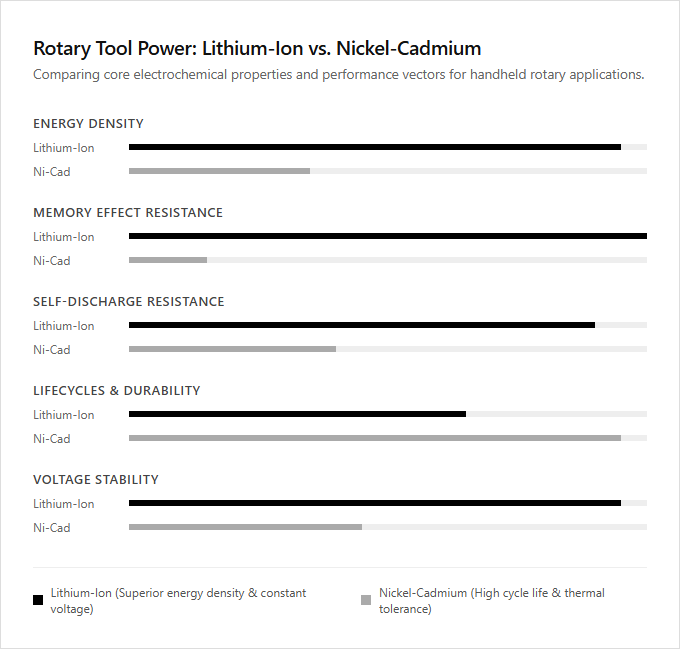
| Energy Density | Lithium-Ion batteries offer a significantly higher energy density than Nickel-Cadmium, allowing rotary tools to be more compact and lightweight while maintaining high power output. |
| Memory Effect | Nickel-Cadmium batteries suffer from the memory effect, which gradually reduces their maximum charge capacity if they are recharged before being fully discharged, whereas Lithium-Ion batteries do not experience this voltage depression. |
| Self-Discharge Rate | Lithium-Ion cells exhibit a much lower self-discharge rate compared to Nickel-Cadmium cells, ensuring the rotary tool retains its charge during prolonged periods of inactivity. |
| Lifecycles and Durability | Nickel-Cadmium batteries generally tolerate a higher number of charge-discharge cycles and extreme temperatures better than Lithium-Ion batteries, making them highly durable in rugged environments. |
| Voltage Sag | Lithium-Ion rotary tools provide constant voltage throughout the discharge cycle, whereas Nickel-Cadmium tools experience significant voltage sag as the battery drains, resulting in a gradual loss of motor RPM. |
Flat Discharge Maintains Consistent High-RPM Spindle Speed
When selecting a cordless rotary tool, the battery chemistry directly dictates operational efficiency. Lithium-ion technology is distinguished by its flat discharge curve, which ensures the tool maintains a consistent high-RPM spindle speed throughout the entire charge cycle. Unlike Nickel-Cadmium (NiCad) batteries, which suffer from gradual voltage sag and a corresponding loss of torque as the capacity depletes, Lithium-ion cells deliver stable power output right up to the point of exhaustion.
This sustained performance prevents the rotary accessory from stalling during demanding cutting, engraving, or grinding tasks. NiCad options, while robust in extreme temperatures and offering a lower initial cost, require frequent pausing as the motor slows down under load. Professional contractors demanding sustained high-speed precision will benefit most from Lithium-ion, whereas occasional DIY hobbyists performing quick, light-duty tasks may find the economical NiCad variant sufficient.
High gravimetric energy density reduces operator fatigue during high-speed applications
When selecting a rotary tool, the choice of battery chemistry significantly influences performance and ergonomics. Lithium-Ion technology offers a high gravimetric energy density, providing substantial power while keeping the tool remarkably lightweight. This weight reduction minimizes operator fatigue during prolonged, high-speed applications such as engraving or detailed carving, where precision and steady hand control are paramount.
Nickel-Cadmium batteries are heavier and exhibit a lower energy density, though they offer robust durability in harsh thermal environments. Professional artisans and detailed hobbyists benefit most from the lightweight maneuverability of Lithium-Ion models, whereas heavy-duty industrial operators requiring rugged, cost-effective tools in extreme temperatures are ideal candidates for Nickel-Cadmium options.
Superior continuous discharge C-rate prevents stalling under heavy grinding loads
When evaluating rotary tools for demanding applications, the choice of battery chemistry directly dictates performance consistency under load. Lithium-ion technology offers a distinct advantage over nickel-cadmium due to its superior continuous discharge C-rate. This high discharge capability ensures a steady, powerful flow of energy, which effectively prevents the motor from stalling under heavy grinding or cutting loads.
Nickel-cadmium batteries often experience rapid voltage drops under resistance, leading to frequent interruptions during intensive tasks. In comparison, lithium-ion cells maintain stable voltage throughout the discharge cycle to deliver sustained torque. Heavy-duty fabricators and professionals requiring uninterrupted power will benefit most from lithium-ion models, while casual hobbyists performing light, intermittent crafting may find nickel-cadmium options suitable.
Zero voltage depression eliminates memory effect during partial charge cycles
When selecting a cordless rotary tool, the battery chemistry dictates both performance consistency and maintenance requirements. Traditional Nickel-Cadmium (NiCad) batteries are prone to "memory effect," a phenomenon where repeated partial discharge cycles cause the battery to hold less charge over time. Lithium-Ion technology features zero voltage depression. This advancement completely eliminates the memory effect, allowing users to recharge the tool at any point during a project without degrading the battery's overall capacity.
Lithium-Ion cells also maintain a steady power output throughout the discharge cycle, whereas NiCad tools experience a gradual drop in motor speed as the battery depletes. Professionals requiring consistent, high-demand power for intricate daily engraving benefit most from Lithium-Ion, while budget-conscious hobbyists performing quick, occasional sanding tasks may still find value in the rugged, lower-cost NiCad option.
Low self-discharge rate preserves charge during extended storage periods
When selecting a cordless rotary tool, the battery chemistry significantly impacts long-term performance and readiness. Lithium-ion technology offers a distinct advantage over traditional nickel-cadmium options due to its extremely low self-discharge rate. While nickel-cadmium batteries can lose a significant portion of their charge daily when idle, lithium-ion cells retain their energy over months of inactivity, ensuring the tool is ready for immediate use without requiring constant topping-off.
This preservation of charge during extended storage periods minimizes preparation time and protects the battery chemistry from deep-discharge degradation. Lithium-ion rotary tools are ideal for occasional DIYers and hobbyists who require reliable performance after months of drawer storage, whereas nickel-cadmium models remain suitable for high-frequency daily professionals who constantly drain and recharge their equipment.
Low internal resistance minimizes thermal dissipation during continuous peak-RPM operation
When selecting a cordless rotary tool, battery chemistry dictates performance under heavy loads. Lithium-ion cells feature significantly lower internal resistance compared to traditional nickel-cadmium alternatives. This physical property minimizes thermal dissipation during continuous peak-RPM operation, allowing lithium-ion tools to maintain high efficiency and prevent thermal throttling. Nickel-cadmium batteries generate substantial heat under sustained loads, which degrades power delivery and shortens the tool's operating life during intensive tasks.
Lithium-ion models also offer a superior power-to-weight ratio and a lack of memory effect, ensuring constant voltage throughout the discharge cycle. Lithium-ion rotary tools are ideal for professional artisans requiring sustained high-speed precision, whereas nickel-cadmium models suit budget-conscious DIY hobbyists undertaking occasional, short-duration projects.
Extended charge-discharge cycle life ensures long-term operational longevity
When selecting a cordless rotary tool, evaluating the battery chemistry is crucial for long-term reliability. Lithium-ion technology offers a superior charge-discharge cycle life compared to nickel-cadmium, sustaining hundreds of additional cycles before experiencing capacity degradation. This extended lifespan ensures that lithium-ion tools maintain their operational longevity and power delivery over years of consistent service, whereas nickel-cadmium batteries suffer from memory effect and gradual capacity loss.
Choosing between these options depends heavily on the frequency of tool usage and project demands. Lithium-ion models are ideal for professionals and frequent DIYers requiring a dependable, low-maintenance tool that is always ready, while nickel-cadmium options remain a cost-effective choice for occasional hobbyists performing light-duty, infrequent tasks.
Leave a comment