
For professional detailers and shop owners, achieving a flawless, hologram-free finish without risking irreversible clear coat burn remains a constant, high-stakes challenge. While standard shop funding sources and equipment budgets often default to basic dual-action polishers as the safe baseline, scaling a business requires investing in more specialized, high-efficiency machinery.
Making the right choice grants operators the ability to slash paint correction times by up to 50% while elevating the depth of the final gloss. However, as an educational stipulation, it is critical to note that advanced drive systems require a refined understanding of paint temperature dynamics; the tool only performs as well as the technician's technique. For instance, compounding heavy wool pads on hard German clear coats requires vastly different torque control than jewel-polishing soft Japanese finishes.
In this guide, we will compare the mechanical mechanics of rotary and gear-driven polishers, evaluating their cut capacity, safety margins, and heat generation to help you select the optimal tool for your workflow.
| Factor | Summary |
|---|---|
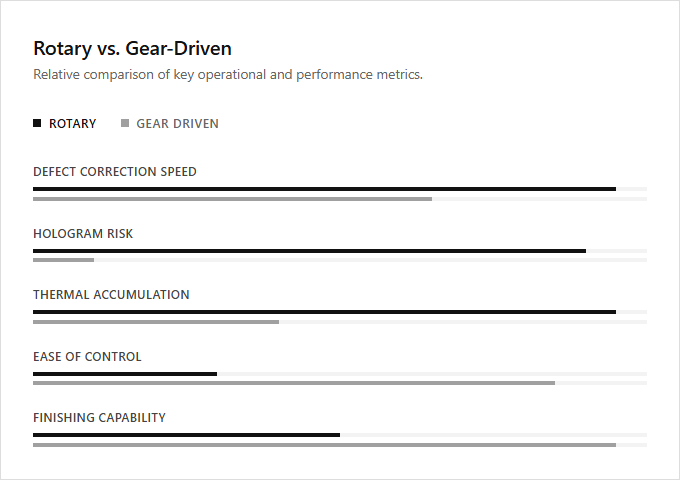
| Drive Mechanism | Rotary polishers utilize direct-drive rotation on a single axis, whereas gear-driven polishers combine forced rotation with orbital oscillation. |
| Defect Correction Speed | Rotary tools deliver rapid paint correction due to high-torque friction, while gear-driven units offer controlled defect removal with a lower risk of paint burn. |
| Hologram Risk | The continuous single-direction rotation of a rotary polisher easily induces holograms, whereas the dual-action movement of gear-driven models prevents these micro-scratches. |
| Thermal Accumulation | Rotary polishers rapidly build up concentrated thermal energy on the clear coat, while gear-driven machines distribute friction to reduce localized heat. |
| Tool Stall and Control | Rotary polishers require advanced technique to prevent panel walking, whereas gear-driven machines eliminate pad stalling under load while remaining highly manageable. |
| Finishing Capability | Rotary polishers excel at heavy compounding but require a refining step, while gear-driven dual-action polishers consistently achieve a hologram-free finish. |
Direct drive circular rotation versus forced epicyclic dual-action orbital motion
Rotary polishers utilize a direct drive system to produce continuous, circular rotation around a single axis. This direct power transfer generates high torque and concentrated friction, making the tool exceptionally efficient for rapid paint correction and deep defect removal. However, this constant speed and localized heat demand precise handling to prevent surface damage.
Gear-driven polishers employ a forced epicyclic dual-action motion, combining gear-driven rotation with an orbital pattern. This forced mechanism prevents stalling under load while distributing heat more evenly across the workspace, significantly reducing the risk of holograms.
Experienced professionals tackling severe paint correction rely on the high-output rotary, whereas body shops and intermediate users seeking consistent, hologram-free results benefit most from the controlled safety of the gear-driven system.
Paint removal rate and cutting efficiency determined by spindle torque
Rotary polishers utilize a direct-drive spindle that rotates on a single axis, delivering maximum torque directly to the pad. This concentrated power ensures an exceptionally high paint removal rate and superior cutting efficiency, making them highly effective at leveling deep scratches and severe paint defects rapidly.
Gear-driven dual-action polishers force both rotational and orbital movements through a geared mechanism. While this design prevents the tool from stalling under heavy loads, the split motion distributes the spindle torque, resulting in a more controlled but slower rate of paint removal than a direct rotary drive.
Rotary polishers are ideal for experienced restoration technicians requiring rapid, heavy-duty paint correction, whereas gear-driven models are best suited for detailing enthusiasts and professionals seeking safe, consistent defect removal without the risk of holograms.
Thermal dynamics and heat dissipation on thin clear coat substrates
Rotary polishers operate on a direct, single-axis rotation, which rapidly generates localized friction. On thin clear coat substrates, this concentrated kinetic energy elevates surface temperatures quickly. Because the thermal energy remains focused within a tight footprint, precise operator technique is required to prevent paint strike-through and thermal damage.
Gear-driven orbital polishers utilize a forced dual-action mechanism that combines rotation with oscillation. This complex movement distributes thermal energy across a wider surface area, enhancing heat dissipation and reducing the risk of heat buildup on delicate paint systems. Rotary units are best suited for highly experienced refinishing specialists who require rapid, aggressive defect removal, whereas gear-driven machines are ideal for safety-conscious detailers seeking predictable correction on sensitive clear coats.
Hologram and buffer trail prevention through forced-rotation finishing kinematics
Rotary polishers operate on a single axis of rotation, generating high friction and rapid cutting action. While highly effective for heavy defect correction, this direct-drive mechanism easily introduces circular micro-marring, known as holograms or buffer trails, during finishing phases. In contrast, gear-driven dual-action polishers employ forced-rotation kinematics, combining forced orbital rotation with forced revolution. This complex, gear-driven path prevents the concentrated heat buildup and repetitive cutting patterns of the rotary, effectively eliminating hologram creation.
The forced-rotation design maintains constant pad movement even under heavy loads, ensuring a consistent, swirl-free finish across complex panel curves. Rotary polishers are best suited for experienced paint correction specialists requiring rapid, aggressive defect removal, while gear-driven tools are ideal for precision detailers and enthusiasts demanding foolproof, hologram-free finishing.
Eliminating Rotational Stall Under High Downforce via Contoured Panels
Rotary polishers feature direct-drive systems where the pad rotates on a single axis driven directly by the motor. Under high downward force, this rotary action cannot be stalled, ensuring continuous cutting power regardless of pressure. Gear-driven orbital polishers use a geared mechanism to force both rotation and oscillation. This positive-drive design similarly eliminates rotational stall on complex structural panel contours where standard random orbital dual-action polishers would stop spinning.
While both tools prevent stalling, they distribute heat and friction differently. Rotary units generate rapid heat for heavy defect correction, whereas gear-driven units offer forced rotation with a safer orbital pattern that reduces holograms on curved panels. Rotary polishers are ideal for experienced paint correction specialists requiring rapid defect removal, while gear-driven units suit general detailers seeking consistent cutting power on complex body lines without the risk of burning the paint.
Risk mitigation of paint burn-through and edge delamination
Rotary polishers operate on a single axis, generating high friction and concentrated heat. While highly efficient for defect removal, this thermal buildup significantly increases the risk of paint burn-through and edge delamination, particularly on thin clear coats or sharp body panels.
Gear-driven dual-action polishers mitigate these risks by combining forced rotation with an orbital pattern. This dual movement prevents pad stalling under pressure while distributing heat evenly across a wider surface area, substantially lowering the danger of localized paint damage.
Rotary machines are best suited for highly skilled refinishing specialists who prioritize speed and heavy defect removal, while gear-driven polishers are ideal for precision detailers and risk-averse operators seeking consistent results with maximum safety.
Operator technique demands regarding pad contact angle and translational speed
Rotary polishers require strict control over the pad contact angle. Keeping the pad perfectly flat is critical to prevent paint burn, though experienced users may slightly tilt the edge for targeted defect removal. Additionally, the operator must maintain a swift, consistent translational speed to prevent dangerous heat buildup in a single localized area.
In contrast, gear-driven polishers offer more latitude. Their forced dual-action rotation allows for minor variations in the pad contact angle without the risk of stalling or immediate paint damage. Operators can also employ a slower translational speed, which allows the polishing compound to break down effectively without generating excessive thermal friction.
Rotary units are best suited for seasoned refinishing professionals requiring rapid, heavy defect correction, whereas gear-driven polishers are ideal for detailing enthusiasts and technicians seeking high-quality finishes with a significantly lower risk of operator error.
Leave a comment