
Achieving a flawless finish on complex woodworking projects is a persistent challenge, often resulting in wasted hours of manual labor and uneven surfaces. While standard hand-sanding and versatile random orbital sanders are the traditional starting points for general finishing, they lack the raw power and geometric control required for specialized tasks. Investing in dedicated machinery offers a major upgrade, delivering unmatched dimensional accuracy and surface flattening that handheld tools simply cannot replicate.
However, these machines are not interchangeable, and utilizing the wrong tool can quickly ruin expensive hardwoods. For example, a heavy-duty drum sander is indispensable for thicknessing wide glued-up panels, while a high-speed disc sander is the premier choice for shaping precise toy wheels or squaring end-grain bevels.
To help you optimize your workshop's capabilities, this guide will analyze drum sanders versus disc sanders, comparing their mechanics, material removal rates, and ideal applications so you can make an informed investment.
| Factor | Summary |
|---|---|
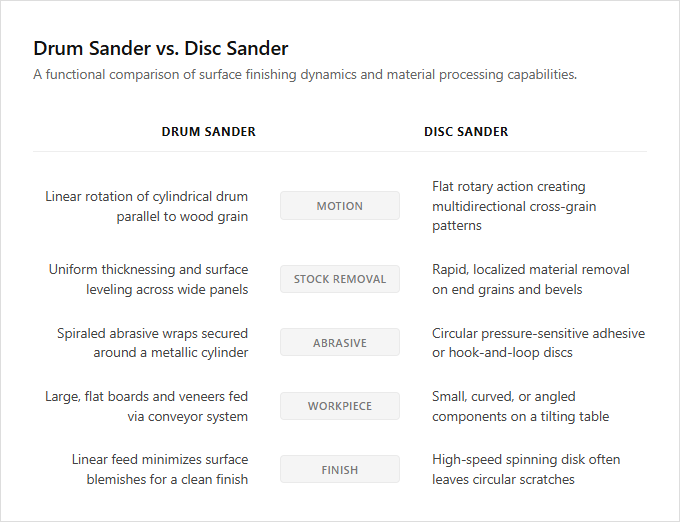
| Primary Motion | A drum sander utilizes linear rotation of a cylindrical drum to sand parallel to the wood grain, whereas a disc sander employs a flat rotary action that creates cross-grain scratch patterns. |
| Stock Removal | Drum sanders excel at uniform thicknessing and surface leveling across wide panels, while disc sanders are designed for rapid, localized material removal on end grains and bevels. |
| Abrasive Format | Drum sanders require spiraled abrasive wraps secured around a metallic cylinder, whereas disc sanders utilize circular pressure-sensitive adhesive or hook-and-loop sanding discs. |
| Workpiece Compatibility | Drum sanders accommodate large, flat boards and veneers fed via conveyor, whereas disc sanders are optimized for small, curved, or angled components supported by a tilting worktable. |
| Finish Quality | The linear feed of a drum sander minimizes surface blemishes for a clean finish, unlike the high-speed spinning disc sander which often leaves circular rotational scratches on the workpiece. |
Drum vs. Disc Sanders: Conveyor vs. Manual Feed
Drum sanders and disc sanders serve distinct roles in woodworking, primarily differentiated by their feeding mechanisms and material control. A drum sander utilizes a continuous conveyor feed system to pull lumber beneath a rotating abrasive drum, ensuring precise, uniform thicknessing across wide panels. This automated process minimizes human error and delivers highly consistent, flat surfaces over large surface areas.
Disc sanders rely on manual workpiece manipulation against a rapidly spinning, rigid platen. This configuration allows for rapid stock removal, precise beveling, and intricate shaping along the workpiece edges. Production-oriented woodworkers requiring exact thickness calibration prefer drum sanders, whereas luthiers, model makers, and general craftsmen focusing on detailed shaping and edge-work are best suited for disc sanders.
Drum vs. Disc Sander Scratch Patterns
When selecting between a drum sander and a disc sander, the primary consideration lies in the resulting finish and grain alignment. Drum sanders utilize a cylindrical rotating action that processes wood linearly. This mechanism ensures that the abrasive runs parallel to the wood grain, producing consistent, linear scratch patterns that blend seamlessly with the natural fibers for a flawless surface finish.
Disc sanders employ a rapidly spinning circular pad. This orbital motion inevitably cuts across the wood fibers, creating distinct rotary cross-grain marks that require additional finishing to eliminate. Cabinetmakers and fine woodworkers seeking pristine, wide-panel flattening benefit most from the drum sander, while general craftspeople and DIY enthusiasts requiring quick material shaping on curved edges will find the disc sander indispensable.
Drum vs. Disc Sanders: Thickness vs. Shaping
Drum sanders and disc sanders serve distinct, highly specialized roles in a professional woodworking environment. The drum sander is designed primarily for precision surfacing, excelling at micro-adjusting thickness across wide panels to ensure a uniform, flat plane. This machine provides consistent downward pressure across the entire workpiece, making it irreplaceable for processing glued-up tabletops and wide face frames without the risk of gouging.
In contrast, the disc sander is engineered for rapid material removal on a smaller scale, specializing in end-grain squaring, precise beveling, and chamfering. Its rigid, rotating abrasive wheel allows for fast, accurate shaping of wood, metal, or plastics along a miter gauge. Cabinetmakers and furniture manufacturers requiring flawless panel calibration benefit most from the drum sander, while luthiers, model makers, and general craftspeople focusing on intricate joinery and edge-profiling will find the disc sander indispensable.
Drum vs. Disc Sander Abrasives Compared
When selecting industrial sanding equipment, understanding the distinct abrasive mounting mechanisms of drum and disc sanders is essential for operational efficiency. Drum sanders utilize spiral-wound abrasive wraps secured by tension master clips, allowing for continuous, uniform surface calibration over wide workpieces. In contrast, disc sanders employ flat, pressure-sensitive adhesive sanding discs mounted to a rotating platter, designed primarily for precise edge work and rapid material removal on end grains.
Each configuration serves specific workshop requirements. Drum sanders excel at thicknessing large panels and finishing wide-board assemblies without gouging, while disc sanders offer exceptional control for shaping curved profiles and squaring end cuts. Cabinetmakers requiring precise thickness calibration and flat surfacing benefit most from a drum sander, whereas luthiers and general woodworkers focusing on intricate detail shaping and rapid end-grain truing will find the disc sander indispensable.
Drum vs. Disc Sanders: Depth and Angle Control
Drum sanders and disc sanders serve distinct roles in professional woodworking, characterized by their unique adjustment mechanisms. Drum sanders excel at thicknessing and surfacing large, flat workpieces. These machines control the depth of cut via a precise drum elevation mechanism, allowing operators to achieve highly accurate, uniform thickness across wide boards.
Disc sanders are engineered for shaping, end-grain smoothing, and precise beveling. Instead of adjusting the abrasive head, disc sanders utilize a tilting work table with a miter gauge for angular accuracy. Drum sanders are ideal for cabinetmakers requiring flawless thickness calibration, while disc sanders are best suited for model makers and joiners who prioritize precise angles and rapid edge shaping.
Drum vs. Disc Sanders: Uniform Speed Prevents Burning
When selecting finishing machinery, understanding the kinematics of abrasive contact is critical. A primary differentiator between drum sanders and disc sanders lies in surface speed consistency. Disc sanders operate with varying peripheral cutting speeds across the disc face, with velocity increasing toward the outer edge. This speed gradient often results in uneven abrasive wear and localized heat buildup, which can cause workpiece burning. In contrast, drum sanders maintain a uniform surface speed across the entire linear contact area, effectively eliminating these thermal and wear discrepancies.
This operational difference dictates the ideal application for each machine type. Drum sanders excel at processing wide, flat panels where consistent thickness and surface uniformity are paramount, while disc sanders are highly effective for rapid material removal, shaping curved edges, and precise end-grain work. Production-oriented cabinetmakers requiring flawless thicknessing benefit most from the drum sander, whereas general woodworkers and luthiers prioritizing rapid edge-shaping and beveling find the disc sander indispensable.
Sander Hazards: Drum Snipe and Disc Kickback
Drum sanders and disc sanders serve distinct roles in a workshop, each presenting unique operational challenges. A drum sander is highly efficient for flat surfacing, but it runs a consistent risk of producing snipe-slight gouging at the board ends-if feed rates or pressure rollers are improperly calibrated.
A disc sander excels at rapid material removal and edge shaping. It demands strict operator vigilance, as feeding a workpiece on the upward-spinning side of the wheel can cause catastrophic kickback. Drum sanders are ideal for professional cabinetmakers requiring uniform thickness over wide panels, whereas disc sanders are best suited for detail-oriented craftspeople and modelers performing precise, angular shaping on smaller components.
Leave a comment