
For woodworking professionals and refinishers, controlling the microscopic dust generated by random orbital sanders is a constant, frustrating battle. Fine particulates easily bypass standard collection systems, settling on freshly finished surfaces and posing serious long-term respiratory hazards. While traditional passive dust bags and onboard canisters offer a baseline level of containment, they lack the static pressure required to clear the sanding pad interface effectively.
Upgrading to active, vacuum-assisted extraction grants operators a virtually airborne-free workspace and extends abrasive life by preventing premature clogging. However, achieving these results requires a careful stipulation: success depends on precisely matching the vacuum's CFM (cubic feet per minute) rating with the sander's specific hole configuration. Industry-standard setups, such as the Mirka DEROS paired with a HEPA-certified extractor, demonstrate the flawless, swirl-free surface preparation achievable with synchronized extraction.
This article provides a comparative analysis of passive versus vacuum-assisted dust collection, evaluating air-flow dynamics, abrasive longevity, and health compliance to help you optimize your shop's extraction efficiency.
| Factor | Summary |
|---|---|
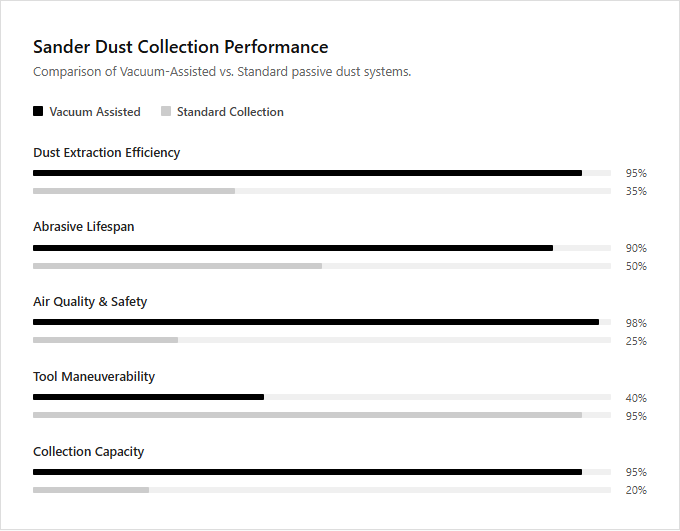
| Dust Extraction Efficiency | Vacuum-assisted sanders utilize an active external vacuum to generate high static pressure, capturing significantly more fine particulate matter than standard sanders relying on passive onboard impeller airflow. |
| Abrasive Lifespan | Active vacuum extraction prevents premature surface loading on the sandpaper, whereas standard dust collection allows debris buildup that quickly degrades abrasive grit efficiency. |
| Air Quality and Safety | Vacuum-assisted systems capture hazardous respirable crystalline silica and airborne dust at the source, while standard dust bags often allow micro-particles to bypass filtration into the ambient air. |
| Tool Maneuverability | Standard dust collection sanders offer superior cordless portability without hose interference, whereas vacuum-assisted setups introduce ergonomic drag due to the heavy attached extraction hose. |
| Collection Capacity | Standard sanders require frequent manual emptying of small onboard canisters, while vacuum-assisted units deposit waste directly into high-capacity shop vacuums equipped with HEPA filtration. |
Passive impeller-driven airflow vs active vacuum-assisted volumetric flow rate
Standard sanders rely on an internal, passive impeller driven by the tool's motor. This onboard fan generates a localized airflow, pushing dust into an attached bag. While mobile, this passive system delivers a limited volumetric flow rate, capturing primarily heavier debris near the sanding pad.
Vacuum-assisted sanders connect to an external extractor to utilize active suction. This configuration creates a high volumetric flow rate that pulls fine particulate away from the work surface. The continuous, high-velocity extraction extends sandpaper life and improves surface visibility.
Standard impeller sanders are ideal for DIY hobbyists requiring maximum mobility for quick outdoor tasks, whereas vacuum-assisted systems are suited for professional woodworkers and refinishers operating in enclosed workshops where strict dust containment is critical.
Static pressure differential required to overcome boundary layer dust accumulation
Standard dust collection sanders rely on passive extraction, utilizing the centrifugal force of the rotating pad to push debris into a collection bag. This method often fails to overcome the boundary layer, a stagnant zone of air and fine dust clinging to the workpiece. Vacuum-assisted sanders solve this by introducing an external suction source, which generates the high static pressure differential required to disrupt this boundary layer and pull micro-dust away from the surface.
The superior static pressure of vacuum systems prevents abrasive loading and extends sandpaper life, while passive systems remain limited by air resistance. Standard sanders are best suited for hobbyists prioritizing portability and quick setups, whereas vacuum-assisted models are essential for professional refinishers requiring flawless surfaces and dust-free work environments.
Multi-hole backing pad geometry and its effect on fluid dynamics
Standard dust collection sanders rely on basic centrifugal force and passive airflow through limited, fixed holes to extract debris. In contrast, vacuum-assisted sanders utilize sophisticated multi-hole backing pad geometries designed to optimize fluid dynamics. These multi-hole configurations, often arranged in spiral or intersecting patterns, generate localized low-pressure zones across the pad surface. This targeted pressure differential maximizes air velocity, actively drawing fine particulates away from the work surface before they can agglomerate.
The resulting airflow dynamics prevent abrasive loading and reduce airborne dust exposure, significantly extending the lifespan of the sanding disc. Standard passive systems are best suited for hobbyists engaging in occasional outdoor woodwork, while vacuum-assisted multi-hole systems are ideal for high-volume professionals requiring pristine surfaces and strict dust containment.
Mitigating Abrasive Wear on Cutting Surfaces
Standard dust collection sanders rely on passive airflow, which frequently leaves residual particulate on the work surface. This accumulation leads to rapid abrasive loading, clogging the grit and causing premature thermal and mechanical degradation of the cutting surface. Vacuum-assisted sanders utilize active suction to immediately draw debris away from the interface, maintaining clean abrasive channels and significantly extending disc longevity.
By continuously clearing fine particulate, active vacuum systems prevent the frictional heat buildup associated with clogged abrasives, ensuring a consistent finish. Standard systems are suitable for DIY enthusiasts handling occasional, light-duty residential projects, whereas vacuum-assisted sanders are ideal for high-volume woodworking professionals who require extended consumable life and flawless surface preparation.
Capture efficiency of hazardous PM2.5 respirable suspended particulate matter
Standard dust collection sanders typically rely on passive extraction, utilizing the tool's internal fan to push debris into a collection bag. While effective for larger wood chips, this method struggles with hazardous PM2.5 respirable suspended particulate matter, allowing microscopic dust to bypass the filter. In contrast, vacuum-assisted sanders connect directly to an external dust extractor. This configuration leverages continuous negative pressure to capture up to 99% of these fine, airborne health hazards directly at the source.
Minimizing respirable dust exposure is critical for long-term pulmonary health and workplace compliance. Standard sanders are best suited for occasional hobbyists performing brief tasks in open-air environments, whereas vacuum-assisted systems are indispensable for professional fabricators and cabinetmakers operating in enclosed, high-production workshops.
Airflow impedance caused by hook-and-loop interface material
Standard dust collection sanders rely on passive extraction, which often struggles with the dense fibers of hook-and-loop fastening systems. This backing material acts as a physical barrier, restricting airflow and allowing fine dust to escape into the work environment. In contrast, vacuum-assisted sanders utilize active suction to overcome this impedance, drawing dust efficiently through the backing pad and hook-and-loop interface directly into a collection system.
By actively pulling air through the obstruction, vacuum-assisted systems maintain clear abrasive surfaces and prolong disc life far better than standard passive collection. Standard dust collection sanders are best suited for hobbyists performing occasional, outdoor woodwork, while vacuum-assisted models are ideal for professionals requiring a clean, particulate-free indoor workshop.
Continuous Negative Pressure Cooling of Abrasive Substrates
Standard orbital sanders rely on passive, fan-driven airflow, which often fails to mitigate heat build-up during extended operation. In contrast, vacuum-assisted systems utilize external suction to establish continuous negative pressure across the backing pad. This ongoing airflow actively draws ambient air through the abrasive substrate, facilitating superior thermal dissipation and preventing premature resin loading.
By maintaining a lower operating temperature, vacuum-assisted models extend the lifespan of the abrasive media and preserve the structural integrity of the workpiece surface. Standard dust collection sanders are best suited for hobbyists undertaking intermittent, light-duty woodwork, whereas vacuum-assisted systems are essential for high-volume professionals requiring prolonged operation and flawless, dust-free finishes.
Leave a comment