
Manufacturing engineers frequently struggle with the inherent variability of manual rack-and-pinion arbor presses in high-precision assembly, where operator fatigue and inconsistent force application often lead to costly scrap. Traditionally, addressing these quality-control bottlenecks relies on standard capital equipment budgets, which typically prioritize large-scale cell automation over incremental benchtop tooling upgrades.
However, bridging this operational gap with servo electric technology grants production teams unprecedented, real-time force-displacement traceability directly at the workbench. To manage expectations, it is important to stipulate that while manual presses remain highly cost-effective for low-volume tactile operations, they cannot meet modern digital-thread compliance requirements.
For example, aerospace component manufacturers utilize servo-driven benchtop presses to guarantee zero-defect insertion of critical flight-control bushings. In this article, we will compare manual and servo electric options, analyze the physical limits of the classic rack-and-pinion design, and outline a framework for optimizing your precision assembly workflow.
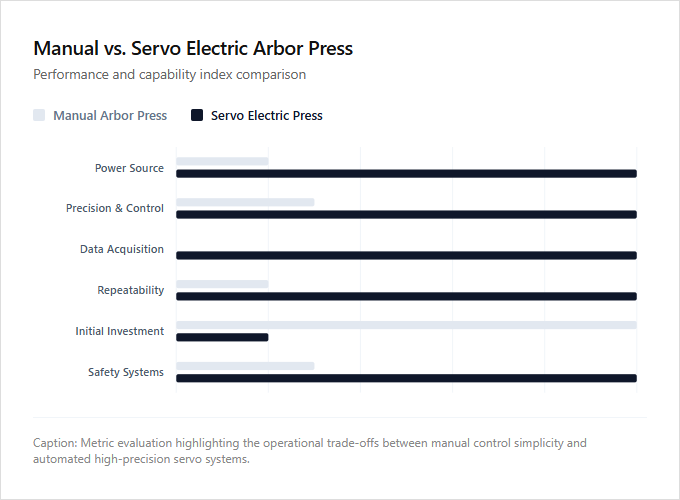
| Factor | Summary |
|---|---|
| Power Source | While the manual arbor press relies entirely on human physical exertion through a mechanical lever, the servo electric press utilizes a high-torque servo motor for automated actuation. |
| Precision and Control | A manual press depends on the operator's physical tactile feedback, whereas a servo electric press achieves sub-micron positional accuracy using closed-loop feedback systems and rotary encoders. |
| Data Acquisition | Unlike manual presses that offer no digital monitoring, servo electric presses generate real-time force-displacement curves to verify part quality during the assembly process. |
| Repeatability | Manual arbor presses suffer from high process variability due to operator fatigue, while servo electric presses deliver consistent stroke repeatability within predefined tolerances. |
| Initial Investment | The manual arbor press is an inexpensive, low-maintenance mechanical tool, whereas the servo electric press requires a significant capital expenditure for its sophisticated motion controller and software. |
| Safety Systems | Manual presses rely purely on basic physical guarding, whereas servo electric presses incorporate electronic safety measures such as light curtains and optoelectronic sensors to prevent injury. |
Servo Electric Presses Achieve Sub-Micron Repeatability
When evaluating industrial assembly technology, the choice between manual arbor presses and servo electric presses hinges on precision and control. Traditional manual arbor presses rely on physical rack-and-pinion gears, which introduce inherent mechanical backlash and rely entirely on operator tactile feedback. In contrast, servo electric presses utilize closed-loop feedback control and high-resolution linear encoders to achieve sub-micron positional repeatability, bypassing these mechanical limitations to ensure highly consistent force application.
This technological divide dictates the operational environments where each system thrives. Manual presses offer a robust, cost-effective solution for low-volume workshop maintenance, whereas servo electric systems excel in high-tolerance automated manufacturing. Manual arbor presses are ideal for machinery technicians performing occasional, low-precision repairs, while servo electric presses are suited for quality-control engineers demanding highly repeatable, data-documented assembly processes.
Manual vs. Servo Press Force Monitoring
Manual arbor presses rely entirely on human tactile feedback, requiring operators to estimate applied force based on the physical resistance felt through the lever. While this traditional method offers mechanical simplicity, it lacks standardized measurement, making consistency highly dependent on operator experience and subjective feel.
Servo electric presses utilize integrated strain-gauge load cells to achieve precise, real-time force-displacement monitoring. This digital system captures exact data throughout the pressing cycle, ensuring repeatable quality and eliminating human error. Manual presses are best suited for general workshop technicians performing low-volume repairs, while servo electric presses are ideal for high-precision quality control engineers requiring strict data traceability.
Retrofitting Manual Presses for Precision Assembly
While traditional manual arbor presses offer simplicity, high-precision industrial assembly demands the elimination of human variability. Upgrading a manual rack-and-pinion press to compete with advanced servo electric systems requires integrating a digital readout and external load sensors. This retrofit provides real-time force and displacement feedback, neutralizing operator dependency and ensuring repeatable quality without the high capital cost of a fully automated electric press.
Servo electric presses inherently deliver programmable control and integrated data acquisition, making them the standard for high-volume, automated production lines. Upgraded manual presses are ideal for skilled technicians performing specialized prototyping and low-volume calibration, whereas automated servo presses are best suited for production line operators requiring hands-free, high-throughput assembly accuracy.
Servo Electric Force Curves for Real-Time QA
In industrial manufacturing, selecting between a manual arbor press and a servo electric press depends on the required level of precision and process control. Standard manual presses rely entirely on operator physical force and tactile feedback, which lacks any inherent data capture. In contrast, servo electric systems integrate advanced sensors to generate digital force-signature curves, providing real-time quality assurance by monitoring every millimeter of the stroke.
This sophisticated data acquisition capability allows manufacturers to instantly detect part defects, variations in material hardness, or assembly errors during production. Manual units are ideal for hobbyists and maintenance technicians performing occasional, low-precision tasks, while servo electric presses are designed for quality control engineers managing high-volume, data-driven production lines.
Overload Protection for Manual and Servo Presses
Manual arbor presses offer a reliable, tactile approach to component assembly and force-application tasks. To protect delicate workpieces, these traditional systems can be enhanced with mechanical torque limiters. This integration effectively prevents operator over-exertion and safeguards against part deformation by slipping once a pre-set force threshold is reached.
Servo electric presses leverage advanced digital control for high-precision manufacturing. Instead of physical clutches, these systems utilize programmable current-limit parameters within the motor drive to provide precise overload protection. This electronic monitoring ensures consistent force repeatability and real-time quality data collection throughout the stroke.
Manual presses are ideal for low-volume technicians seeking cost-effective, hands-on control, whereas servo electric presses are best suited for high-throughput engineers requiring automated, data-driven precision.
Servo-Driven vs. Manual Pressing: The Velocity Advantage
In precision manufacturing, the choice between manual and servo electric arbor presses directly impacts assembly quality. Servo-driven presses utilize advanced motor controls to maintain a constant velocity profile throughout the entire ram stroke. This uniform velocity ensures highly consistent material deformation during interference press-fits, eliminating the structural stresses associated with sudden speed fluctuations.
In comparison, manual arbor presses rely entirely on mechanical leverage, which inherently produces variable ram speeds and inconsistent force application based on operator physical input. Manual presses are suitable for low-volume workshop technicians who require tactile feedback and simple operations, whereas servo electric systems are ideal for high-precision aerospace or medical manufacturers requiring automated, repeatable, and data-verified assembly processes.
Servo vs. Mechanical: Automating Precision Assembly Calibration
In high-precision assembly, maintaining exact force and distance parameters is critical for product integrity. Modern servo electric presses streamline this process by automating dynamic calibration through integrated software, ensuring real-time adjustments and digital data logging. In contrast, manual arbor presses require operators to configure and read physical dial indicators and external load cells to monitor these variables during operation.
While servo systems eliminate human error and ensure repeatable accuracy for complex setups, manual presses rely entirely on the operator's tactile feedback and visual inspection. Manual presses are best suited for low-volume craftsmen and repair technicians who prioritize low-cost simplicity, whereas automated servo electric presses are ideal for high-volume manufacturing engineers who require strict quality control and data traceability.
Leave a comment