
Manufacturing and assembly engineers often struggle to maintain precise control during high-force operations, frequently facing component damage, operator fatigue, or production bottlenecks when scaling up manual processes. While traditional manual arbor presses provide tactile feedback, they cannot sustain the consistent, repeatable tonnage required for modern, high-tolerance manufacturing.
Transitioning to fluid power solutions grants facilities the automated force and process repeatability necessary to scale operations efficiently. However, integrating these systems comes with the stipulation that facility managers must carefully balance available utility infrastructure with specific stroke-profile requirements.
For demanding applications like high-volume bearing insertion, precision stamping, and heavy-duty crimping, choosing the wrong actuation method can result in high maintenance overhead or insufficient tonnage. This article provides a comprehensive comparison of pneumatic and hydraulic arbor presses, analyzing their speed, force capabilities, footprint, and cost to help you select the optimal fluid power actuation for your assembly line.
| Factor | Summary |
|---|---|
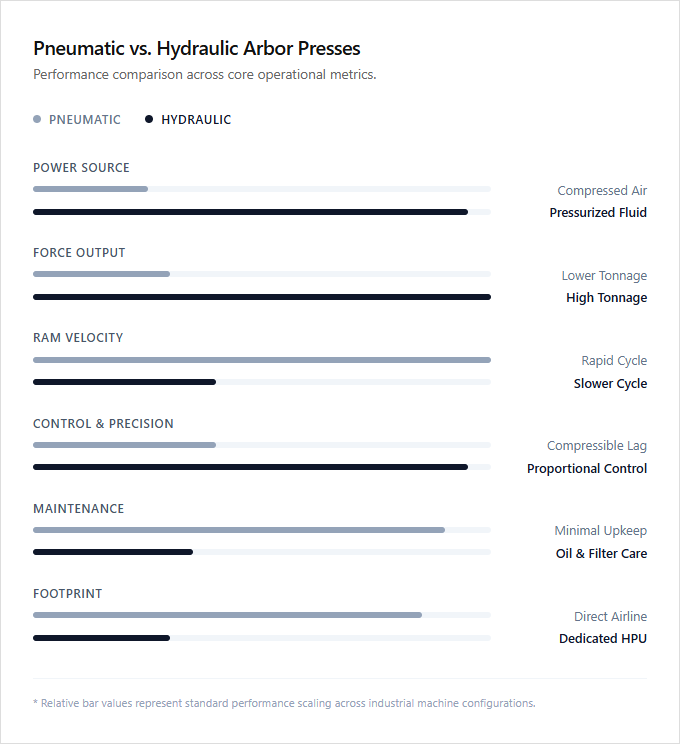
| Power Source | Pneumatic presses utilize compressed air to actuate the piston, whereas hydraulic presses rely on pressurized hydraulic fluid circulated by a pump. |
| Force Output | Hydraulic arbor presses generate significantly higher tonnage due to the high bulk modulus of hydraulic oil compared to the lower density of compressed air. |
| Ram Velocity | Pneumatic presses achieve faster cycle times and rapid ram velocity due to the rapid expansion and low viscosity of compressed air. |
| Control and Precision | Hydraulic systems deliver precise force regulation and stroke repeatability using proportional control valves, whereas pneumatic systems can exhibit compressibility lag. |
| Maintenance | Pneumatic systems require minimal upkeep beyond basic air filtration, while hydraulic systems demand routine oil filtration and monitoring for fluid cavitation. |
| Footprint and Infrastructure | Pneumatic presses operate directly off factory airline connections, whereas hydraulic presses require a dedicated hydraulic power unit that increases the machine footprint. |
Hydraulic vs. Pneumatic Arbor Presses: Force Density
When selecting a powered arbor press, the primary differentiator lies in force density and operating pressure. Hydraulic arbor presses leverage high-pressure fluid systems, typically operating between 1,000 and 10,000 PSI, allowing them to deliver immense force within a remarkably compact footprint. In contrast, pneumatic arbor presses rely on standard shop air, which generally tops out around 100 to 150 PSI, requiring much larger cylinders to achieve comparable output.
This disparity in operating pressure dictates the practical applications of each system. Hydraulic units excel at high-force tasks like heavy metal forming, while pneumatic presses offer rapid, clean cycles for lighter assembly work. Pneumatic systems suit high-speed assembly line operators requiring clean, low-maintenance machinery, whereas hydraulic presses are ideal for heavy-duty industrial fabricators needing maximum force capacity.
Hydraulic Incompressibility Enables Precise High-Force Control
Pneumatic and hydraulic arbor presses serve distinct roles in industrial manufacturing, differing primarily in their power transmission media. Pneumatic systems utilize compressed air, offering rapid cycle times but limited control under fluctuating loads. In contrast, hydraulic arbor presses leverage the physical properties of liquid. Fluid incompressibility in hydraulic media allows for precise position and velocity control during high-force transitions, preventing sudden movements and ensuring consistent pressure application.
Selecting the appropriate technology depends on your specific production requirements and the skill set of your operators. Pneumatic presses are ideal for high-speed, repetitive assembly technicians, while hydraulic presses are best suited for precision engineers and heavy-duty fabricators requiring exact force calibration.
High-Speed Pneumatics for Light Assembly
Selecting the right power arbor press depends heavily on your production volume and force requirements. Pneumatic arbor presses utilize compressed air to deliver rapid actuation speeds and significantly faster cycle rates. This makes pneumatic systems ideal for maximizing throughput in light-to-medium assembly tasks, such as riveting, punching, and crimping, where speed is the primary operational priority.
In contrast, hydraulic arbor presses leverage fluid power to generate immense force with precise, controlled movement. While slower than pneumatic alternatives, hydraulic presses are essential for heavy-duty manufacturing applications like deep drawing and high-tonnage press-fits that demand sustained, intense pressure.
High-speed electronics assembly technicians benefit most from the rapid cycling of pneumatic systems, whereas heavy industrial fabricators require the high-tonnage capabilities of hydraulic presses.
Hydraulic HPUs: Increased Footprint and Energy Consumption
When selecting between pneumatic and hydraulic arbor presses, facility footprint and utility requirements are critical factors. Hydraulic arbor presses depend on a dedicated hydraulic power unit (HPU) to generate necessary force. This auxiliary unit significantly increases the overall floor space required for the workstation and demands higher continuous energy consumption during operation.
Pneumatic arbor presses integrate seamlessly into existing facility infrastructures by utilizing standard plant compressed air connections. Eliminating the need for an external power unit minimizes equipment footprint and lowers utility costs, offering a more streamlined and energy-efficient solution.
Pneumatic systems are ideal for high-volume electronics assembly technicians requiring fast cycle times, whereas hydraulic systems are best suited for heavy industrial fabrication specialists performing high-force component pressing.
Proportional Valves: Precise Tonnage and Ram Positioning
Pneumatic and hydraulic arbor presses serve distinct roles in industrial manufacturing. Pneumatic models utilize compressed air to deliver rapid, repeatable strokes, making them highly efficient for high-speed, light-duty assembly. These systems offer clean operation and straightforward maintenance but lack the extreme force capabilities of fluid power.
Hydraulic arbor presses leverage fluid dynamics to generate immense, controlled force. Integrating proportional flow control valves within these hydraulic circuits enables infinitely variable tonnage adjustment and precise ram positioning. This engineering feature allows for meticulous regulation of force and stroke depth during delicate pressing operations.
Pneumatic systems suit high-volume assembly technicians requiring speed and simplicity, while hydraulic systems are ideal for precision fabricators who demand extreme force control and variable calibration.
Clean Pneumatic Actuation for Sensitive Manufacturing
When selecting between pneumatic and hydraulic arbor presses, environmental cleanliness is often a key deciding factor. Pneumatic arbor presses utilize compressed air, which inherently eliminates the risks of fluid contamination and oil leaks associated with hydraulic fluids. This clean, oil-free operation makes pneumatic systems the preferred choice for sensitive manufacturing environments, such as medical device assembly, aerospace components, and electronics fabrication.
While hydraulic arbor presses excel in delivering immense, steady force for high-tonnage applications, they require regular maintenance to prevent seal degradation. Pneumatic presses are ideal for precision assembly technicians seeking rapid, clean, and low-maintenance operations, whereas hydraulic presses are best suited for heavy-duty metalworkers who require maximum force capability.
Hydraulic Thermal Management for Consistent Fluid Viscosity
Pneumatic and hydraulic arbor presses serve as critical equipment in modern manufacturing, each suited to distinct operational demands. Pneumatic systems utilize compressed air, offering rapid cycle times and clean operation for high-speed, light-duty assembly. Conversely, hydraulic presses deliver the substantial tonnage required for heavy-duty forming and pressing applications.
For high-duty cycle operations, hydraulic systems demand careful thermal management. These systems require heat exchangers to maintain consistent fluid viscosity, ensuring stable force output and protecting internal components from degradation. Sustained operation without temperature regulation can thin the hydraulic fluid, leading to pressure drops and inconsistent stroke execution.
Pneumatic presses are ideal for cleanroom technicians and electronics manufacturers prioritizing speed and low maintenance, whereas hydraulic presses are best suited for heavy industrial fabricators requiring precise, high-tonnage force control.
Leave a comment