
System engineers and facility managers frequently struggle with unexpected efficiency drops and premature motor wear when deploying regenerative blowers. This frustration often stems from treating pressure and vacuum applications as interchangeable processes. Traditionally, teams rely on standard manufacturer data sheets and baseline horsepower ratings to guide their system designs.
However, understanding the precise thermodynamic divergence between these two duties grants operators a substantial operational advantage, unlocking optimal flow rates and significant energy savings. As a critical stipulation, we must recognize that while the physical blower remains identical, air behaves fundamentally differently under compression than it does under vacuum.
For example, a unit configured for pressure-heavy wastewater soil sparging requires vastly different backpressure management than a vacuum-heavy CNC routing hold-down table. In this article, we will examine the mechanical behaviors of pressure versus vacuum duty, detail critical thermal thresholds, and outline actionable strategies to maximize your blower's differential pressure performance.
| Factor | Summary |
|---|---|
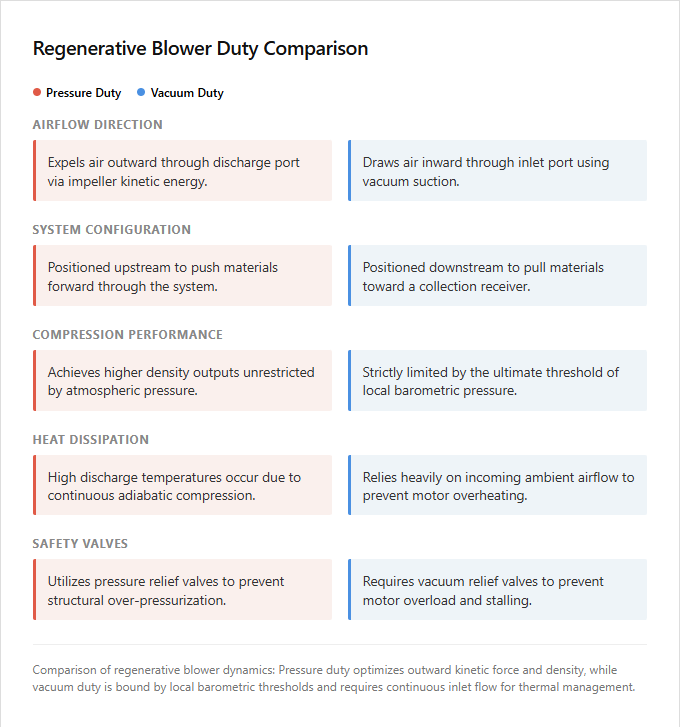
| Airflow Direction | Pressure duty expels air outward through the discharge port, whereas vacuum duty draws air inward through the inlet port using kinetic energy transfer from the impeller. |
| System Configuration | Pressure systems locate the blower upstream to push materials, while vacuum systems position the blower downstream to pull materials toward a receiver. |
| Compression Performance | Pressure duty can achieve higher density outputs, whereas vacuum duty performance is strictly limited by the maximum threshold of local barometric pressure. |
| Heat Dissipation | Pressure duty results in high discharge temperatures due to adiabatic compression, while vacuum duty relies on adequate inlet airflow to prevent motor overheating. |
| Safety Valves | Pressure duty utilizes a pressure relief valve to prevent system over-pressurization, whereas vacuum duty requires a vacuum relief valve to prevent motor overload. |
How Gas Density Affects Inlet ACFM
Regenerative blowers operate dynamically, and their performance is highly sensitive to gas density variations at the inlet. In pressure duty applications, the blower draws in ambient air at standard atmospheric density to push gas through a system, maintaining a relatively stable inlet actual cubic feet per minute (ACFM). In contrast, vacuum duty applications pull air from a restricted volume, which decreases inlet pressure and lowers gas density. This reduction in inlet density requires the blower to handle a larger volume of rarefied gas to maintain mass flow, directly altering the inlet ACFM requirements.
System designers must calculate these density changes to prevent motor overloading and ensure precise volumetric delivery. Pressure duty models are ideal for industrial aeration and pneumatic conveying operators, while vacuum duty configurations are suited for laboratory extraction technicians and automated vacuum hold-down specialists.
Heat of compression and its impact on thermal discharge limits
Regenerative blowers experience distinct thermodynamic profiles when configured for pressure versus vacuum duty. In pressure applications, the blower compresses atmospheric air, which naturally generates significant heat of compression that must be dissipated at the discharge port. Conversely, under vacuum duty, the blower draws from a restricted, lower-density air source; this reduced mass flow limits the medium's capacity to carry heat away, shifting thermal stress directly onto the internal blower components and narrowing the safe operating temperature limits.
Managing these thermal discharge limits is critical to prevent mechanical degradation and motor overload. Industrial operators requiring continuous high-volume material conveying or aeration are best suited for pressure duty, while automation technicians designing localized hold-down systems or precise parts-handling machinery will find vacuum duty more appropriate for their workflows.
Internal slip and its degradation of volumetric efficiency
Regenerative blowers rely on precise internal clearances to channel air, making them highly sensitive to internal slip. This slip occurs when compressed air leaks backward across the impeller blades, directly degrading volumetric efficiency. In pressure duty applications, high backpressure forces a greater volume of air to slip backward, generating heat and reducing net output flow.
During vacuum duty, the blower experiences low inlet density, where internal slip severely limits the maximum achievable vacuum level as the pressure differential increases. System designers requiring bulk material agitation or wastewater aeration benefit most from pressure duty configurations, whereas cleanroom engineers and automation technicians requiring precise part holding or suction lift are best suited for vacuum duty systems.
Pressure relief valves versus vacuum relief valves for system protection
Regenerative blowers operate in two distinct modes: pressure duty, which pushes air through a system, and vacuum duty, which pulls air in. Because these blowers generate significant force, dedicated system protection is critical to prevent motor overload and mechanical failure. Pressure duty configurations utilize pressure relief valves to safely vent excess air when downstream blockages occur. Conversely, vacuum duty setups require vacuum relief valves to introduce ambient air if the intake becomes obstructed, preventing system implosion and extreme thermal buildup.
Selecting the correct relief valve ensures operational safety and equipment longevity across diverse industrial applications. Pressure-duty setups suit engineers managing bulk material transport and aeration systems, while vacuum-duty configurations are ideal for technicians specializing in suction-based manufacturing and localized dust extraction.
Inlet filtration pressure drop and its effect on performance curves
Regenerative blowers exhibit distinct performance characteristics under pressure and vacuum duties, particularly when accounting for inlet filtration pressure drop. In pressure duty, restriction at the inlet filter decreases intake air density. This restriction shifts the discharge performance curve downward, which reduces the overall airflow and discharge pressure. In vacuum duty, an inlet filtration pressure drop increases the vacuum level at the blower inlet, forcing the unit to operate at a higher differential pressure and risk overheating.
Proper filtration management ensures the blower operates safely within its designed performance curves. Pressure duty configurations are ideal for industrial facility managers requiring consistent pneumatic conveying or aeration, whereas vacuum duty configurations are best suited for automation technicians managing workpiece hold-down and pick-and-place systems.
Shaft Seal to Prevent Negative Pressure Air Ingress
Regenerative blowers operate in either pressure or vacuum duty, with each application demanding specific engineering considerations. In vacuum duty, the system operates under negative pressure, which creates a high risk of ambient air ingress. To maintain system purity and process integrity, the shaft seal configuration must be meticulously designed to prevent outside atmospheric air from leaking into the blower chamber.
While pressure duty blowers typically utilize standard single-lip seals to contain outgoing airflow, vacuum duty configurations require specialized double-lip seals or mechanical seals with a reverse-lip orientation. This specific sealing arrangement ensures that the negative pressure differential pulls the sealing lip tighter against the rotating shaft, successfully blocking atmospheric contamination. Positive pressure systems are ideal for industrial aeration technicians requiring consistent high-velocity discharge, whereas vacuum configurations with advanced sealing are essential for laboratory and pneumatic conveying operators handling sensitive, contamination-free processes.
Compression ratio constraints limiting maximum differential pressure capacity
Regenerative blowers operate by accelerating air through a high-speed impeller to create continuous pressure differentials. The operational distinction between pressure duty and vacuum duty depends heavily on the compression ratio, which is strictly limited by the blower's internal clearances and thermodynamic heat generation. This fixed compression ratio constraint dictates the maximum differential pressure the unit can safely achieve without overheating.
During pressure duty, the blower compresses atmospheric air outward, maintaining a higher air density that aids in motor and housing cooling. In contrast, vacuum duty draws from a sub-atmospheric inlet, meaning the identical compression ratio yields a significantly lower maximum differential pressure due to air rarefaction and rapid temperature escalation inside the channels.
Pressure duty models suit facility engineers managing high-force bulk material pneumatic conveying, whereas vacuum duty configurations are tailored for laboratory technicians requiring precise, continuous suction for localized exhaust or pick-and-place automation.
Leave a comment