
Woodworkers often struggle with the frustrating challenge of balancing rapid material removal against the risk of leaving unsightly swirl marks that ruin a final finish. Selecting the wrong instrument frequently results in wasted hours of corrective hand-sanding.
While typical workshop acquisitions-often financed through standard capital funding sources or basic equipment budgets-favor highly versatile multi-tools, a dedicated sanding solution is indispensable. Upgrading to the correct motion technology grants craftsmen the ability to slash preparation times while securing a flawless, glass-like surface.
However, this efficiency comes with a strict stipulation: operators must understand how distinct orbital mechanics interact with specific wood species. For example, stripping paint from stubborn oak requires a vastly different approach than preparing cherry veneer for a clear coat.
Below, we compare orbital and random orbital sanders, analyze their performance in fast stock removal versus fine finishing, and outline how to choose the best tool for your workshop.
| Factor | Summary |
|---|---|
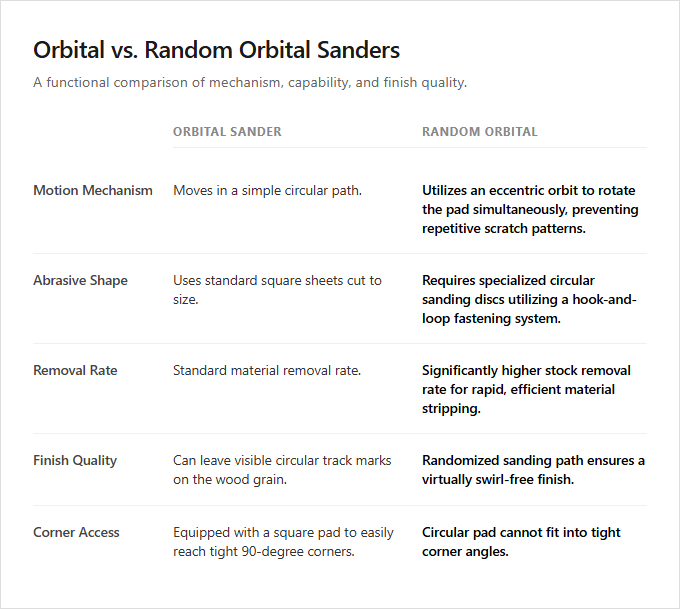
| Motion Mechanism | While the standard orbital sander moves in a simple circular path, the random orbital sander utilizes an eccentric orbit to rotate the pad simultaneously, preventing repetitive scratch patterns. |
| Abrasive Shape | Orbital sanders use standard square sheets cut to size, whereas random orbital sanders require specialized circular sanding discs utilizing a hook-and-loop fastening system. |
| Material Removal Rate | Random orbital sanders feature a significantly higher stock removal rate, making them more efficient for rapid material stripping. |
| Finish Quality | The randomized sanding path of a random orbital sander ensures a virtually swirl-free finish, whereas standard orbital sanders can leave visible circular track marks on the wood grain. |
| Corner Accessibility | Equipped with a square backing pad, the orbital sander easily reaches into tight ninety-degree corners where circular random orbital sanders cannot fit. |
How Random Orbital Sanders Prevent Gouging
When selecting finishing machinery, understanding the mechanical distinctions between sanding technologies is essential. Standard orbital sanders operate using a simple, repeating circular pattern. While highly efficient for rapid material removal on flat surfaces, this linear action requires careful alignment with the wood grain to avoid leaving visible marks.
To address this limitation, random orbital sanders utilize a dual-action motion of simultaneous rotation and orbit. This sophisticated mechanism ensures that the abrasive pad never travels the same path twice, which successfully prevents grain gouging and delivers a virtually swirl-free finish on any surface.
Standard orbital sanders are ideal for budget-conscious DIYers focused on basic stock removal, while random orbital sanders are best suited for detail-oriented woodworkers and professionals requiring flawless finishes on multi-directional grain.
Square Orbital Sanders for 90-Degree Corners
When selecting professional sanding tools, understanding the mechanical and structural differences is essential for project success. The standard orbital sander is characterized by its square platen, a design feature that allows users to sand flush into ninety-degree corners and tight right-angle edges. Operating in a consistent, vibrating circular pattern, this tool is highly effective for flat surfaces and initial stock preparation.
The random orbital sander utilizes a dual-action motion, spinning the sanding disc while simultaneously moving it in an elliptical path to minimize swirl marks. This variation makes it the preferred choice for achieving ultra-smooth, paint-ready finishes on open surfaces. Woodworkers prioritizing flawless, swirl-free finishes on large tabletops will benefit most from the random orbital sander, whereas cabinet makers and detail-oriented refinishers requiring precise corner access will find the standard orbital sander indispensable.
Swirl-Free Sanding with Random Orbital Sanders
When selecting a finishing tool, understanding the mechanical differences between sanding actions is essential for achieving a professional grade. Standard orbital sanders operate in a consistent circular motion, which can leave faint, repetitive swirl marks if not guided carefully. In contrast, random orbital sanders employ a dual-motion drive that spins the pad while simultaneously oscillating it in an ellipse. This combination produces a non-directional elliptical scratch pattern that eliminates visible swirl marks on wood surfaces, ensuring a perfectly smooth finish.
The choice between these two power tools ultimately depends on the specific demands of your project and your skill level. Standard orbital sanders are best suited for budget-conscious DIYers undertaking basic flat-surface preparation, whereas random orbital sanders are the preferred choice for professional furniture makers and refinishers who require flawless, stain-ready finishes on complex workpieces.
Quarter-Sheet Clamping in Standard Orbital Sanders
When selecting finishing equipment, understanding the mechanical distinctions between orbital sanders and random orbital sanders is essential. Standard orbital sanders, often referred to as sheet sanders, operate in a consistent orbital pattern. A primary advantage of this design is economic efficiency; standard orbital sanders utilize cost-effective quarters of standard abrasive sheets secured by mechanical clamps, eliminating the need for specialized hook-and-loop backing.
In contrast, random orbital sanders employ a dual-action rotation that spins while moving in ellipses, which significantly minimizes swirl marks on the workpiece. These devices require proprietary perforated sanding discs that facilitate superior dust collection but incur higher operating costs over time. Standard orbital sanders are ideal for budget-conscious DIYers tackling flat, square corners, whereas random orbital sanders are best suited for professional woodworkers requiring a premium, swirl-free finish on complex surfaces.
Random Orbital Sanders: Best for Rapid Stock Removal
When selecting finishing equipment, understanding the operational differences between orbital and random orbital sanders is essential. Standard orbital sanders employ a consistent, circular orbit to deliver ultra-smooth surfaces on flat areas, while random orbital sanders utilize a dual-action motion that combines rotation with oscillation to eliminate swirl patterns.
This dynamic movement allows random orbital sanders to provide a significantly higher material removal rate, making them superior for rapid stock removal. They efficiently level uneven joints and strip thick coatings of paint or varnish in a fraction of the time. Standard orbital sanders are ideal for budget-conscious hobbyists requiring light touch-ups, whereas random orbital sanders are perfect for active restorers and professional carpenters needing versatile, high-volume performance.
Hook-and-Loop Systems for Random Orbital Sanders
Orbital sanders and random orbital sanders serve distinct roles in professional woodworking and surface preparation. Standard orbital sanders move in a consistent, circular path and feature a square pad, making them excellent for reaching into tight corners. In contrast, random orbital sanders combine orbital and rotational motions to produce a completely random sanding pattern that virtually eliminates visible swirl marks.
Efficiency is a primary advantage of the random orbital design. Random orbital sanders employ a hook-and-loop fastening system for rapid disc changes and secure attachment. This mechanism minimizes downtime when transitioning between grits, ensuring the abrasive pad remains perfectly aligned and firmly adhered even under heavy pressure.
Standard orbital sanders are best suited for budget-conscious DIYers tackling basic furniture prep and flat, square edges, while random orbital sanders are the ideal choice for fine woodworkers and refinishers who require a flawless, swirl-free finish on large, visible surfaces.
How OPM Determines Sander Speed and Aggressiveness
When choosing between an orbital sander and a random orbital sander, performance is defined by their rated orbits per minute (OPM). This key metric dictates both operating speed and aggressiveness. Standard orbital sanders move in a consistent, repeating circular path at a fixed OPM, delivering predictable, moderate material removal ideal for flat surfaces and quick edge prep.
In contrast, random orbital sanders pair orbital motion with free rotation, utilizing adjustable OPM rates to deliver highly aggressive stock removal without leaving swirl marks. High OPM settings accelerate heavy material removal, whereas lower speeds provide the precise control needed for ultra-smooth finishes. Standard orbital sanders are excellent for casual DIYers tackling basic flat-surface prep, while random orbital sanders are the superior choice for professional woodworkers demanding a flawless finish on complex, multi-directional wood grain.
Leave a comment