
Machinists, fabricators, and hobbyists alike often face the frustrating reality of stalled rotary tools, ruined workpieces, or rapidly degrading accessories during precision grinding. Selecting the wrong cutting head not only wastes valuable time but can permanently damage expensive materials, leaving operators questioning their setup.
Traditionally, operators turn to standard aluminum oxide mounted stones or basic sanding drums to handle general material removal. While these conventional options serve as accessible, low-cost starting points, they frequently lack the durability and accuracy required for high-tolerance detailing or hardened surfaces.
Upgrading to professional-grade rotary accessories-specifically carbide burrs and diamond bits-grants users the surgical control and extreme cutting efficiency necessary to unlock the full potential of a high-speed die grinder.
However, utilizing these advanced tools requires adhering to a critical stipulation: they are not universally interchangeable. A carbide burr designed for rapid stock removal will fail catastrophically on glass, while a diamond bit will quickly clog and overheat on soft metals like aluminum. True precision depends on matching the tool's physical properties to specific substrates, whether you are shaping hardened steel, carving intricate glass, or engraving stone.
This article provides a comprehensive comparison of carbide burrs and diamond bits. We will analyze their material compositions, evaluate their performance across different mediums, and deliver a clear decision-making framework to help you choose the optimal accessory for your next precision grinding project.
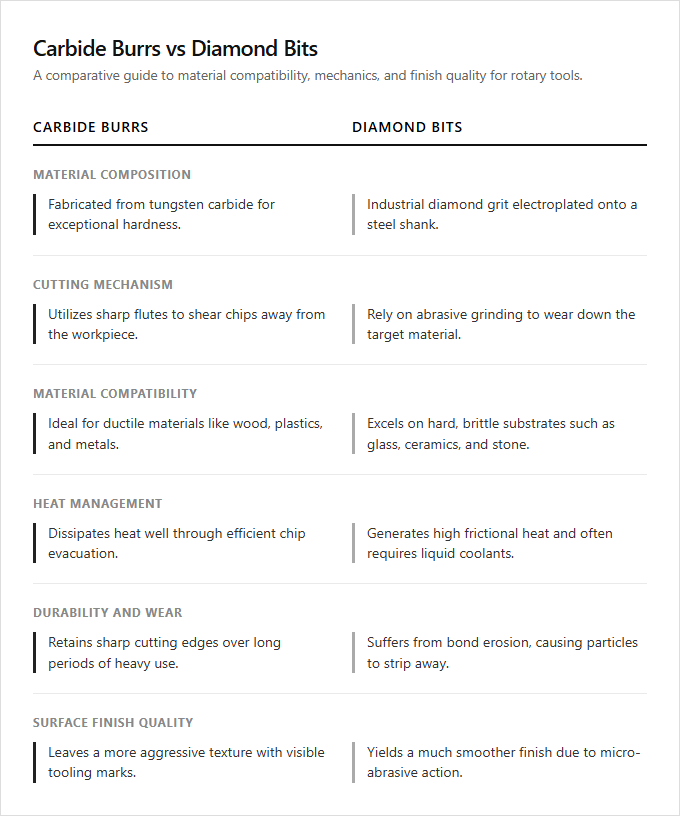
| Factor | Summary |
|---|---|
| Material Composition | Carbide burrs are fabricated from tungsten carbide for exceptional hardness, whereas diamond bits consist of industrial diamond grit electroplated onto a steel shank. |
| Cutting Mechanism | Carbide burrs utilize sharp flutes to shear chips away from the workpiece, while diamond bits rely on abrasive grinding to wear down the target material. |
| Material Compatibility | Carbide burrs are ideal for ductile materials like wood, plastics, and metals, whereas diamond bits excel on extremely hard, brittle substrates such as glass, ceramics, and stone. |
| Heat Management | Carbide burrs dissipate heat well through efficient chip evacuation, but diamond bits generate high frictional heat and often require liquid coolants to prevent premature wear. |
| Durability and Wear | Carbide burrs retain their sharp cutting edges over long periods of heavy use, while diamond bits eventually suffer from bond erosion, causing the diamond particles to strip away. |
| Surface Finish Quality | Carbide burrs leave a more aggressive texture with visible tooling marks, whereas diamond bits yield a much smoother finish due to their micro-abrasive action. |
Carbide Burrs vs. Diamond Bits: Shearing vs. Abrading
When selecting accessories for high-speed rotary tools, understanding the material removal mechanism is essential. Tungsten carbide burrs remove material via shearing with helical flutes. These sharp, rotating edges act like miniature milling cutters, rapidly carving away metals, wood, and plastics while producing distinct chips.
In contrast, diamond bits abrade surfaces using electroplated industrial diamond grit. Instead of cutting, these accessories grind away material at a microscopic level. This abrasive action makes them highly effective on extremely hard, brittle materials such as glass, ceramic, and stone where traditional fluted cutters would quickly dull.
Carbide burrs are ideal for fabricators and woodworkers needing rapid stock removal, while diamond bits are best suited for glass artists, jewelers, and detailers performing precise engraving on hard substrates.
Carbide Burrs vs. Diamond Bits: Material Guide
Rotary tool accessories are engineered for specific material interactions to optimize cutting efficiency and tool longevity. Carbide burrs excel when machining ductile metals and alloys, such as aluminum, brass, and steel, where they cleanly shave away material without clogging. Their aggressive fluting geometry rapidly removes stock while maintaining thermal stability.
For harder substrates, diamond bits are engineered specifically for high-hardness, brittle materials exceeding 7 on the Mohs hardness scale, including glass, ceramics, and stone. Rather than cutting, the embedded diamond grit grinds away the surface to prevent fracturing. Metal fabricators and machinists handling ductile alloys require carbide burrs for rapid shaping, whereas glass artists, lapidaries, and ceramicists benefit most from the precision grinding of diamond bits.
Performance Factors of Carbide Burrs and Diamond Bits
Selecting the appropriate rotary tool accessory depends heavily on workpiece material and the desired finish. Carbide burrs are engineered for rapid stock removal on metals and hardwoods. For these tools, single-cut and double-cut flute configurations determine chip clearance; single-cut flutes feature a single spiral groove for heavy stock removal, while double-cut configurations incorporate cross-flutes to improve chip clearance and reduce loading.
Conversely, diamond bits utilize embedded industrial diamond grit to grind extremely hard, brittle materials. For these accessories, mesh size determines the material removal rate and surface finish, with lower mesh numbers denoting coarser grit for rapid grinding and higher mesh numbers indicating finer particles for detailed smoothing.
Machinists and metalworkers requiring aggressive material shaping typically benefit from the shearing action of carbide burrs, whereas glass crafters, lapidaries, and ceramic artists demand the precise, abrasive action of diamond bits.
Carbide vs. Diamond Bits: Rotational Speed Differences
Carbide burrs and diamond bits serve distinct roles in rotary tool applications, primarily differentiated by their cutting mechanics and thermal limits. Carbide burrs utilize sharp flutes to cut material, requiring high spindle speeds to maintain the optimal chip load per tooth. This elevated velocity ensures efficient material removal and prevents the tool from grabbing or chipping during operation.
Conversely, diamond bits function through grinding and rely on significantly lower rotational speeds to manage heat generation. Operating diamond abrasives at excessive speeds causes rapid thermal degradation, which destroys the bonding matrix and dulls the tool. Precision speed control is essential to preserve the structural integrity of the diamond grit.
Carbide burrs are ideal for metalworkers and woodcarvers requiring rapid stock removal on ductile materials, while diamond bits are suited for glass artisans and stone sculptors performing detailed engraving on hard, brittle substrates.
Lifespan Limits of Carbide Burrs vs. Diamond Bits
Carbide burrs offer exceptional material removal rates on hard metals, yet their efficiency decreases significantly when applied to soft, non-ferrous materials. On these softer metals, the primary limitation is material loading, where debris packs into the flutes and clogs the cutting edges, rendering the tool ineffective.
In contrast, diamond bits excel at grinding extremely hard, brittle substrates like glass and ceramics. The operational lifespan of a diamond bit is not limited by clogging, but by bond erosion and diamond stripping, processes where the binder wears away and causes the abrasive diamond particles to dislodge from the mandrel.
Industrial machinists working with steel and iron benefit most from the rapid cutting action of carbide burrs, while glass artisans and stone carvers require the specialized precision of diamond bits.
Dry Carbide Burrs vs. Wet Diamond Bits
Carbide burrs are engineered for rapid material removal and typically operate under dry conditions. Their solid tungsten carbide construction retains hardness at high temperatures, allowing operators to run them at high speeds without external lubrication. This makes dry operation the standard, most efficient method for shaping, cutting, and deburring metals or hardwoods.
Diamond bits consist of industrial diamond grit secured via a nickel electroplated matrix. Because high temperatures cause thermal degradation of this nickel bond, these accessories require continuous liquid coolant during operation to prevent premature wear. Carbide burrs are ideal for fabricators needing rapid, dry metal removal, while diamond bits are suited for glass artists and lapidary hobbyists requiring wet-grinding precision on brittle materials.
Surface Finish: Carbide Burrs vs. Diamond Bits
Carbide burrs operate through a precise cutting action, utilizing sharp flutes to rapidly shear material away from the workpiece. This mechanical excavation leaves a distinct, directional machined surface finish that reflects the tool's path. This characteristics makes them highly efficient for heavy stock removal, shaping, and deburring of metals and hard woods.
In contrast, diamond bits rely on a matrix of industrial diamond grit to grind the workpiece. They achieve an exceptionally low surface roughness (Ra value) through a process of micro-fracture and abrading, essentially polishing the material at a microscopic level. Carbide burrs are ideal for fabricators and machinists focused on rapid material removal and shaping, whereas diamond bits are suited for glass artists, stone carvers, and detailers requiring precision finishing on hard, brittle substrates.
Leave a comment