
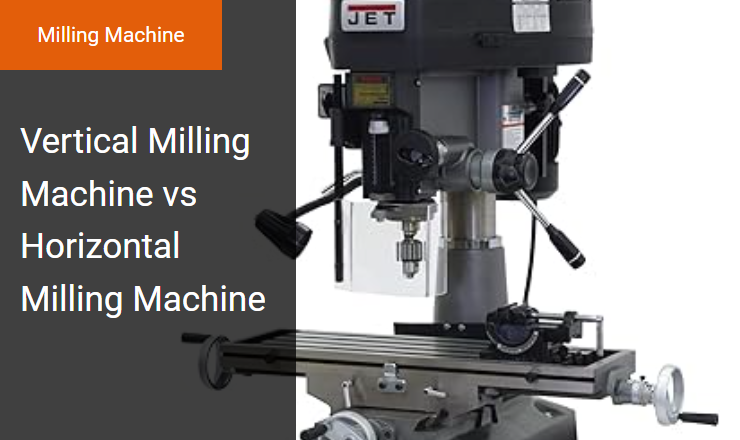
For manufacturing engineers and shop managers, selecting the ideal spindle configuration often presents a frustrating operational bottleneck, resulting in compromised tool life, excessive vibrations, and inefficient cycle times. Traditionally, facilities attempt to resolve these inefficiencies by relying on standard workshop defaults or generic machining handbooks that overlook specific application dynamics.
However, mastering the distinction between configurations grants production teams the power to drastically reduce lead times, optimize material removal rates, and achieve flawless surface finishes. To manage expectations, we must stipulate that neither spindle orientation is universally superior; operational success is strictly dictated by workpiece geometry, material hardness, and chip clearance requirements.
For example, while horizontal setups excel at high-volume chip evacuation during heavy-duty pocketing, vertical machines remain the industry gold standard for intricate die-sinking and face milling. In this guide, we will dissect the mechanical rigidities, tooling dynamics, and cost-to-yield ratios of both orientations to help you select the optimal machine for your facility.
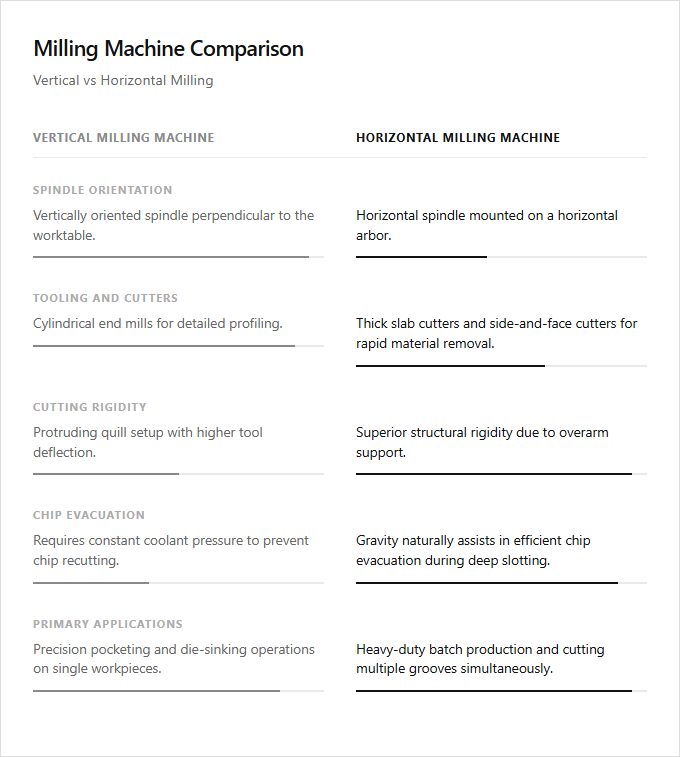
| Factor | Summary |
|---|---|
| Spindle Orientation | While the vertical milling machine features a vertically oriented spindle perpendicular to the worktable, the horizontal milling machine utilizes a horizontal spindle mounted on a horizontal arbor. |
| Tooling and Cutters | Vertical mills typically use cylindrical end mills for detailed profiling, whereas horizontal mills employ thick slab cutters and side-and-face cutters for rapid material removal. |
| Cutting Rigidity | Horizontal milling machines offer superior structural rigidity due to the overarm support, minimizing tool deflection compared to the vertical mill's protruding quill setup. |
| Chip Evacuation | Gravity naturally assists horizontal mills in efficient chip evacuation during deep slotting operations, whereas vertical mills require constant coolant pressure to prevent chip recutting. |
| Primary Applications | Vertical mills excel at precision pocketing and die-sinking operations on single workpieces, while horizontal mills are preferred for heavy-duty batch production and cutting multiple grooves simultaneously. |
Gravitational chip evacuation efficiency in horizontal spindle orientation
Vertical and horizontal milling machines differ primarily in spindle orientation, which fundamentally impacts debris management during heavy machining. In vertical configurations, gravitational forces cause chips to accumulate within the cutting zone, often requiring high-pressure coolant systems to prevent thermal damage and tool recutting. Conversely, the horizontal spindle orientation leverages gravity to its advantage, allowing metal chips to fall freely away from the workpiece and directly into the waste trough.
This natural gravitational chip evacuation in horizontal mills significantly reduces tool wear, lowers heat buildup, and ensures superior surface finishes during deep-pocketing or high-volume operations. Precision toolmakers and prototype developers favor the intuitive setup and visibility of vertical machines, whereas high-volume industrial manufacturers and heavy-duty machinists benefit most from the superior production efficiency of horizontal systems.
Arbor support and overarm rigidity during horizontal milling
In machining, the distinction between vertical and horizontal milling machines lies in spindle orientation and structural rigidity. Horizontal machines utilize a horizontal spindle with an arbor to hold cutters. To counter significant bending forces during heavy cuts, these machines employ a robust overarm and arbor support. This setup bridges the spindle to the arbor's outer end, providing exceptional mechanical rigidity and minimizing tool deflection.
Vertical milling machines secure tools directly in the spindle, lacking this horizontal arbor configuration. While vertical mills offer excellent visibility for intricate plunge cuts, they lack the high-material-removal stability of a supported horizontal arbor. Vertical machines are ideal for technicians focused on detailed prototyping and vertical cavity work, whereas horizontal machines are suited for industrial operators requiring heavy, continuous material removal.
Quill feed movement and Z-axis precision in vertical setups
Vertical milling machines feature a spindle oriented vertically, allowing for direct Z-axis control through the quill feed. This specialized quill movement enables precise plunge cutting, drilling, and fine depth adjustments. In contrast, horizontal milling machines utilize a horizontal arbor, which distributes cutting forces over a broader area but lacks the same responsive, direct-drive quill sensitivity required for intricate vertical operations.
The vertical setup excels in high-precision Z-axis detailing because the quill allows operators to feel cutting resistance directly. This axial alignment minimizes tool deflection during delicate boring and pocketing tasks, whereas horizontal setups prioritize heavy material removal along the horizontal plane. Detail-oriented prototype machinists and toolmakers thrive using vertical mills for intricate components, while high-volume industrial operators prefer horizontal mills for rapid, heavy-duty hogging.
Multi-sided tombstone workholding indexing on horizontal rotary tables
Vertical milling machines (VMCs) excel in top-down operations but often require manual intervention for multi-sided work. In contrast, horizontal milling machines (HMCs) leverage horizontal rotary tables paired with multi-sided tombstone workholding. This integration allows the spindle to access multiple faces of several parts in a single setup. By indexing the tombstone, the HMC minimizes setup times, improves geometric accuracy, and maximizes spindle uptime.
While VMCs offer high visibility and accessibility for quick, single-sided jobs, HMCs with indexing tombstones are designed for high-density, automated production. VMCs are best suited for prototype developers and job shop machinists requiring rapid, low-volume setups, whereas HMCs are ideal for high-volume manufacturing engineers focused on continuous, unattended production.
Spindle throat clearance and workpiece envelope capacity differences
Vertical milling machines feature a vertical spindle, providing excellent visibility and a generous throat clearance between the column and the cutting tool. This design is optimized for upright workpiece envelopes, allowing easy access for top-down operations on tall parts. Horizontal milling machines orient the spindle parallel to the table, which significantly expands the horizontal workpiece envelope capacity and accommodates long, heavy materials with minimal deflection.
The structural layout dictates the ideal operational environment for each machine type. Toolmakers and prototype developers requiring high visibility for intricate, low-volume jobs benefit most from the vertical mill, while industrial manufacturers processing heavy, multi-sided components favor the horizontal mill.
Tool deflection reduction via short gauge lengths in vertical spindles
Vertical and horizontal milling machines offer distinct structural advantages depending on the machining application. In vertical milling, the spindle's orientation allows for significantly shorter gauge lengths. By minimizing the distance between the spindle bearing and the cutting tool, vertical setups inherently reduce tool deflection under heavy cutting forces. This enhanced rigidity ensures superior dimensional accuracy and finer surface finishes during intricate face milling and profiling operations.
Horizontal milling machines utilize a horizontal spindle and arbor support system that excels at deep slotting and heavy material removal. While horizontal setups leverage gravity for excellent chip evacuation during long production runs, they lack the close-coupled rigidity for vertical detailing. Vertical mills are ideal for prototype engineers and toolmakers requiring high-precision detail work, whereas horizontal mills best serve industrial manufacturing operators focusing on rapid, high-volume material removal.
Pallet changer integration for continuous horizontal machining cycles
Vertical and horizontal milling machines offer distinct advantages in production environments. While vertical mills excel in visibility and setup simplicity, horizontal milling machines are uniquely optimized for continuous, high-volume operation. This efficiency is primarily driven by the seamless integration of automatic pallet changers, which allow operators to load new workpieces on an external pallet while the spindle actively machines another inside the enclosure.
This integration minimizes spindle downtime and maximizes throughput, a capability less common in vertical configurations due to chip clearance and spindle orientation limitations. High-volume manufacturers requiring uninterrupted, automated production runs benefit most from horizontal systems with pallet changers, whereas general machinists prioritizing quick setups for low-volume, custom parts are better suited for vertical mills.
Leave a comment