
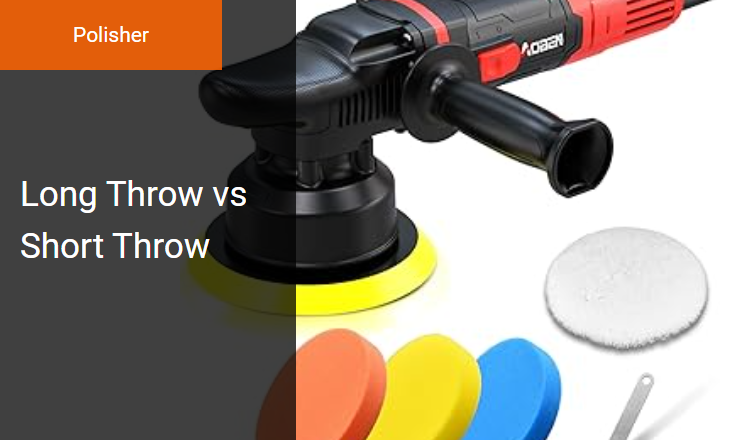
Achieving a flawless, hologram-free finish can be incredibly frustrating when your dual-action (DA) polisher isn't suited to the job, leading to wasted hours and hand fatigue. Traditionally, detailers allocate their equipment budgets toward standard 8mm short-throw units or risky rotary buffers as their primary paint correction investments.
However, selecting the precise orbit throw grants detailers unprecedented correction speed and a dramatically reduced risk of burning through clear coat. Note the key stipulation: a machine's throw is only as effective as the operator's technique and the specific panel contours being treated. For instance, a 21mm long-throw (like the Rupes LHR21) excels on expansive, flat hoods but struggles on tight pillars where an 8mm short-throw shines.
In this guide, we will analyze the mechanics of long-throw versus short-throw polishers, compare their cutting efficiency, and help you select the optimal tool for your detailing workflow.
| Factor | Summary |
|---|---|
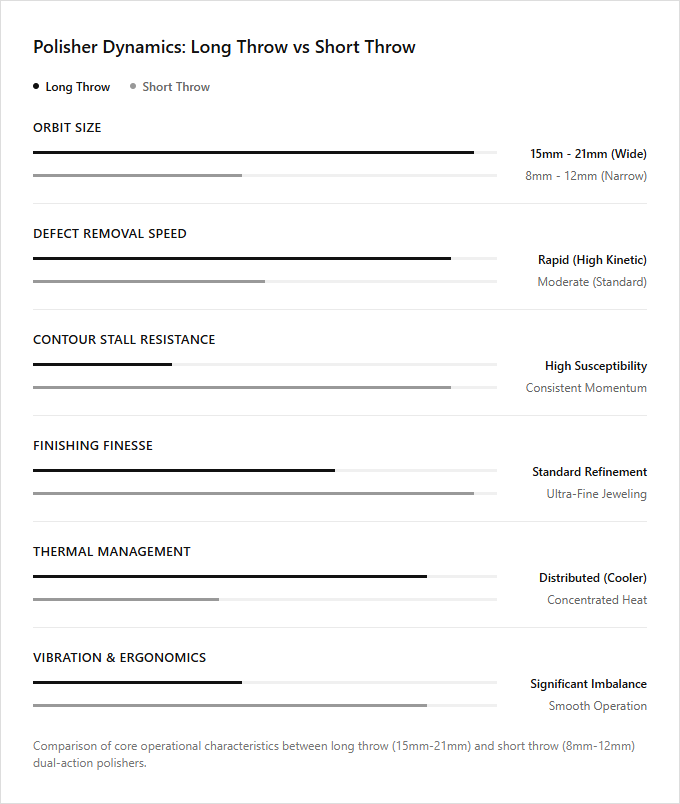
| Orbit Size | Long throw polishers feature a larger eccentric orbit (typically 15mm to 21mm) for wider coverage, whereas short throw polishers utilize a smaller stroke length (typically 8mm to 12mm) for concentrated movement. |
| Defect Removal Speed | Long throw units accelerate paint correction by leveraging higher kinetic energy to break down diminishing abrasives rapidly, while short throw tools require more time to level severe imperfections. |
| Pad Rotation Stall | Short throw polishers maintain consistent rotational momentum on curved panels, whereas long throw machines are highly susceptible to backing plate stalling when navigating tight contours. |
| Finishing Capability | Short throw polishers excel at ultra-fine jeweling and final-step refining because their tight oscillation path minimizes the risk of micro-marring on soft paint systems. |
| Thermal Management | Long throw polishers distribute friction-induced heat across a broader surface area, reducing the risk of localized thermal paint swelling compared to the concentrated footprint of short throw devices. |
| Vibration and Handling | Long throw polishers generate significant dynamic imbalance requiring robust counterweight engineering, whereas short throw tools inherently produce less vibration for improved operator ergonomics. |
How Orbit Stroke Length Affects Paint Coverage
Dual-action polishers utilize orbit stroke lengths ranging from 8mm to 21mm, directly determining the tool's paint coverage area and correction efficiency. A short-throw polisher, typically featuring an 8mm to 12mm orbit, concentrates its oscillation over a smaller surface. This tighter movement provides superior precision and control, making it highly effective for navigating complex body lines, tight curves, and narrow panels.
A long-throw polisher operates with a 15mm to 21mm stroke, covering a substantially larger surface area with each rotation. This wider oscillation disperses heat efficiently and levels paint imperfections rapidly across broad, flat expanses. Short-throw models are ideal for meticulous detailers focusing on intricate, high-precision correction, whereas long-throw units are best suited for high-volume collision professionals requiring rapid defect removal on large vehicles.
Torque-Induced Pad Stalling on Concave Panels
Dual-action polishers are defined by their orbit size, which directly influences torque transfer. Long-throw polishers, while highly efficient on flat surfaces, are highly susceptible to pad stalling when navigating concave panels. The expansive orbital path increases lateral resistance, causing the pad to stop rotating when it encounters the concentrated, uneven pressure of curved body lines.
Short-throw polishers mitigate this issue by maintaining more consistent rotational momentum on complex contours. Their smaller orbit concentrates the motor's energy over a tighter area, which prevents the pad from binding or stalling in tight recesses. Professional detailers specializing in intricate, curvaceous sports cars heavily rely on short-throw units for precision, whereas high-volume collision repair technicians prefer long-throw polishers to quickly correct expansive, flat body panels.
Rotational kinetic energy differences influencing defect removal and cutting speed
The operational variance between long-throw and short-throw dual-action polishers is defined by the rotational kinetic energy generated at the polishing pad. Long-throw polishers, utilizing orbits of 15mm to 21mm, travel a greater distance per revolution, which yields higher peripheral velocity. This elevated velocity translates into substantial kinetic energy, significantly accelerating paint leveling, defect removal, and overall cutting speed.
Short-throw polishers, typically featuring 8mm to 12mm orbits, produce lower kinetic energy but distribute force over a more concentrated area. This tighter oscillation path enhances tool control and reduces pad stalling on complex, curved body panels. High-volume detailing professionals seeking rapid paint correction on flat surfaces typically opt for long-throw units, while enthusiasts and precision technicians favor short-throw polishers for intricate panels and tight contours.
Counterweight dynamic balance affecting operator fatigue and hand-arm vibration
Dual-action polishers rely on a precise counterweight system to offset the eccentric movement of the polishing pad. Long-throw polishers, typically featuring a 15mm to 21mm orbit, require larger counterweights to balance the wider motion. While modern engineering optimizes this dynamic balance, the increased mass and longer travel inherently generate higher kinetic energy, which can translate into greater hand-arm vibration and quicker operator fatigue during extended use.
Conversely, short-throw polishers utilize smaller counterweights due to their tighter 8mm to 12mm orbital path. This configuration allows for a more inherently stable dynamic balance, significantly minimizing vibration and reducing physical strain on the operator's joints. Long-throw models are ideal for high-volume detailing professionals seeking rapid paint correction on large, flat panels, whereas short-throw units are best suited for precision specialists or enthusiasts requiring maximum control on intricate contours.
Clear Coat Heat Buildup and Dissipation
Long throw dual-action polishers distribute friction over a larger surface area per orbit. This wider oscillation facilitates rapid heat dissipation across the paintwork, reducing the risk of localized thermal buildup on delicate clear coats. Short throw polishers concentrate mechanical energy on a tighter footprint. This localized action generates heat more rapidly within a focused zone, requiring careful movement to prevent paint burning.
Managing these thermal dynamics is critical for preserving clear coat thickness. High-volume collision centers and professional detailers prioritizing fast correction on large panels typically opt for long throw polishers, whereas hobbyists and spot-repair specialists benefit most from the controlled precision of short throw models.
OPM Ratio of Dual-Action Oscillation to Rotation
Dual-action polishers utilize a precise balance between pad oscillation and free-spinning rotation to correct paint defects. Long-throw polishers, featuring a 15mm to 21mm stroke, cover a larger surface area per orbit. This wider orbital displacement generates significant momentum, allowing the pad to maintain consistent rotation at lower orbits per minute (OPM) and maximizing cutting efficiency on flat expanses.
Short-throw units, with an 8mm to 12mm stroke, require a higher OPM ratio to sustain pad rotation under pressure due to the smaller oscillation path. This tighter orbital pattern delivers localized friction and exceptional stability on complex curves. Professional detailers seeking rapid correction on large, flat vehicles benefit most from long-throw models, whereas enthusiasts and those focusing on intricate, heavily contoured bodywork prefer the control of short-throw polishers.
Finishing refinement capabilities and micro-marring prevention on soft finishes
When refining delicate paintwork, the orbital stroke length-or throw-significantly impacts the final finish. Long throw polishers, typically featuring 15mm to 21mm orbits, excel at rapid correction but can occasionally induce micro-marring on extremely soft clear coats due to the high lateral speed of the pad. Conversely, short throw polishers with 8mm to 12mm orbits deliver a more concentrated, stable oscillation that reduces paint surface tension and heat, making them highly effective at preventing haze and achieving flawless finishing refinement on sensitive surfaces.
High-volume detailing professionals prioritizing rapid correction over large panels favor the efficiency of long throw units, while meticulous specialists and enthusiasts working on intricate vehicle contours or ultra-soft finishes rely on the precise control of short throw polishers.
Leave a comment