
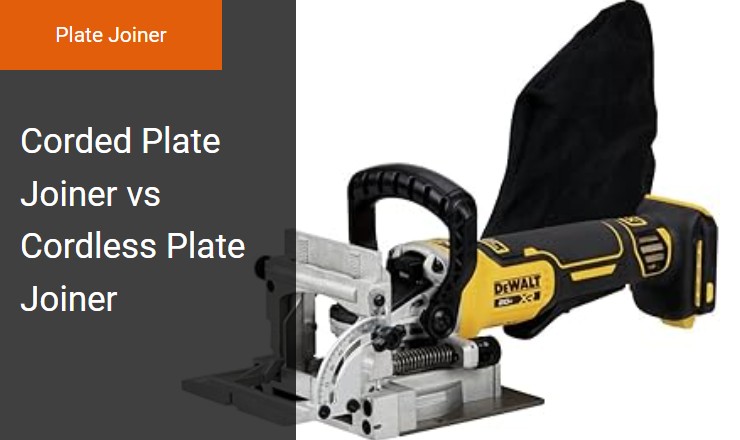
Achieving perfectly flush, seamless joints in precision woodworking remains a persistent struggle for craftsmen, often marred by misaligned biscuit slots and frustrating workpiece shifts. When allocating shop capital from standard equipment funding sources, woodworkers must carefully evaluate whether to invest in a corded or cordless plate joiner.
Selecting the correct platform grants you the ability to execute flawless, high-strength miters and T-joints with absolute confidence and efficiency. However, as an educational stipulation, it is important to note that even the most advanced joiner requires meticulous fence calibration and proper user technique to prevent registration errors. Industry-standard models, such as the corded DeWalt DW682 and the cordless Makita DPJ180, demonstrate how differing power delivery systems cater to distinct workshop dynamics.
In this guide, we will analyze the critical differences in torque, mobility, dust extraction, and runtime between corded and cordless plate joiners, helping you select the optimal tool for your precision joinery needs.
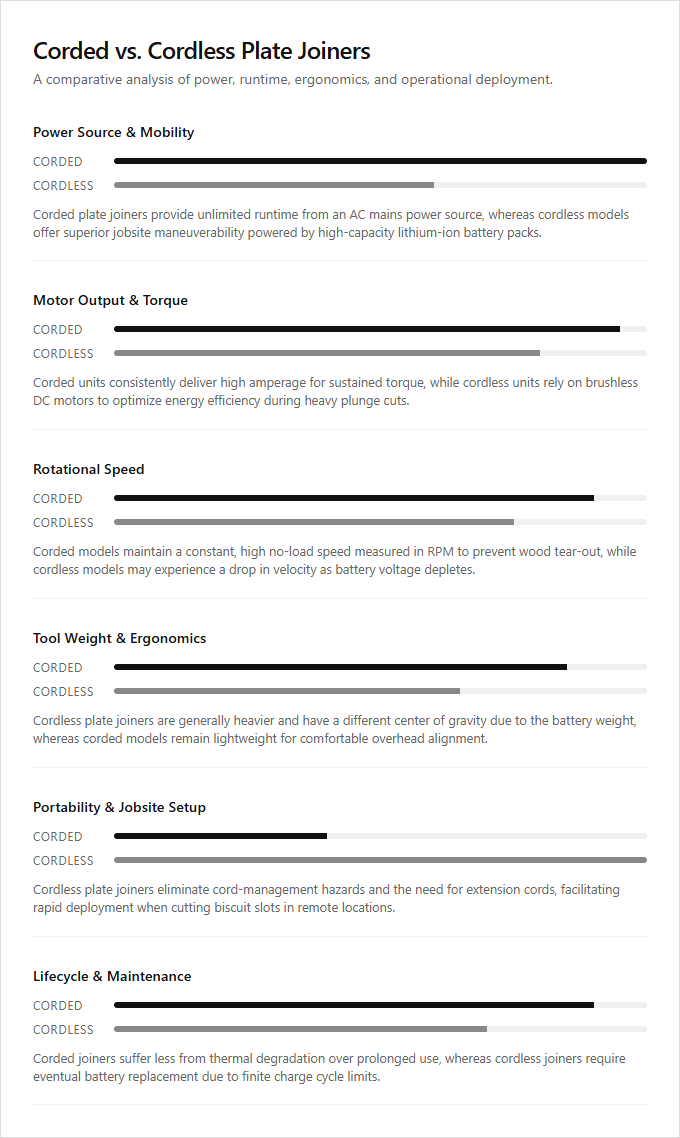
| Factor | Summary |
|---|---|
| Power Source & Mobility | Corded plate joiners provide unlimited runtime from an AC mains power source, whereas cordless models offer superior jobsite maneuverability powered by high-capacity lithium-ion battery packs. |
| Motor Output & Torque | Corded units consistently deliver high amperage for sustained torque, while cordless units rely on brushless DC motors to optimize energy efficiency during heavy plunge cuts. |
| Rotational Speed | Corded models maintain a constant, high no-load speed measured in RPM to prevent wood tear-out, while cordless models may experience a drop in velocity as battery voltage depletes. |
| Tool Weight & Ergonomics | Cordless plate joiners are generally heavier and have a different center of gravity due to the battery weight, whereas corded models remain lightweight for comfortable overhead alignment. |
| Portability & Jobsite Setup | Cordless plate joiners eliminate cord-management hazards and the need for extension cords, facilitating rapid deployment when cutting biscuit slots in remote locations. |
| Lifecycle & Maintenance | Corded joiners suffer less from thermal degradation over prolonged use, whereas cordless joiners require eventual battery replacement due to finite charge cycle limits. |
Continuous amperage draw vs battery runtime
Corded plate joiners rely on a continuous amperage draw from a standard electrical outlet, typically ranging from 5 to 7 amps. This steady power supply ensures consistent blade speed and maximum torque, preventing the motor from bogging down during deep plunges into dense hardwoods. Woodworkers can operate the tool indefinitely without experiencing any performance degradation or voltage drops over extended production runs.
Cordless plate joiners offer unmatched portability, yet their utility is limited by battery runtime and cell capacity. While modern high-capacity lithium-ion batteries provide ample power for quick adjustments, intensive workshop projects require frequent battery swapping and recharging to maintain peak cutting efficiency. High-volume furniture makers requiring uninterrupted power prefer corded models, whereas mobile installers and finish carpenters favor cordless units for rapid on-site cabinet modifications.
Sustained no-load RPM during deep plunges
When executing deep plunges into dense hardwoods, maintaining a sustained no-load RPM is critical for clean, precise biscuit slots. Corded plate joiners excel in this area by drawing continuous AC power, which prevents the motor from bogging down under heavy resistance. This constant energy supply ensures the blade maintains its maximum rotational speed throughout the entire plunge cycle, reducing the risk of wood scorching and motor strain.
In contrast, cordless plate joiners rely on battery power, where sustained deep plunges can cause a slight drop in RPM as the battery depletes or heats up under load. Although modern brushless motors mitigate this performance dip, corded models remain superior for high-volume, stationary workshop cabinetmakers who demand uninterrupted power, while cordless units are best suited for mobile finish carpenters who prioritize jobsite portability and quick, intermittent joints over continuous heavy-duty production.
Tool weight and center of gravity shift
When selecting a plate joiner, the power source significantly influences the tool's weight distribution and overall balance. Corded models offer a lightweight profile because they lack an onboard battery. This keeps the center of gravity stable and close to the shoe, ensuring consistent downward pressure and minimal user fatigue during high-volume shop assembly. The tool's balance remains unchanged throughout operation, facilitating precise, repeatable slot alignment.
In contrast, cordless plate joiners carry a heavy battery pack, typically positioned at the rear of the handle. This shifts the center of gravity backward, requiring more wrist effort to keep the tool perfectly flat against the workpiece face. Corded models are ideal for stationary woodworkers prioritizing prolonged precision and comfort, while cordless units best suit mobile contractors requiring on-site flexibility.
Dust extraction port efficiency and vacuum hose tethering
Corded plate joiners deliver uninterrupted power, maintaining the high, consistent velocity necessary for optimal dust extraction port efficiency. In a stationary workshop, tethering a vacuum hose to a corded unit is highly manageable, as the operator is already accustomed to managing the power cable alongside the extraction hose for clean, continuous routing.
In contrast, cordless plate joiners offer superior mobility, though attaching a traditional vacuum hose can create a counterintuitive tethering effect that diminishes their portable advantage. While cordless models feature efficient dust ports designed for onboard collection bags, connecting a vacuum hose remains necessary for pristine workspaces. Corded models are ideal for stationary workshop woodworkers requiring maximum dust containment during high-volume production, while cordless versions are suited for mobile installers who prioritize quick, untethered adjustments on the job site.
Vibration impact on rack-and-pinion fence precision
Corded plate joiners provide a consistent power supply that maintains steady motor speeds. This stable electrical flow minimizes harmonic vibrations, allowing the rack-and-pinion fence to remain securely locked and precisely aligned during heavy cutting cycles. The lack of battery weight also improves the tool's center of gravity, preventing micro-adjustments from drifting during repetitive workshop operations.
Cordless plate joiners offer superior portability, but battery discharge and variable motor loads can introduce fluctuating vibration frequencies. These shifting harmonics can occasionally loosen or misalign the rack-and-pinion mechanism if it is not firmly clamped. Corded models are ideal for stationary furniture makers requiring absolute accuracy, while cordless units best suit mobile installers who prioritize rapid setup on active jobsites.
Electronic blade brake activation speed
Cordless plate joiners frequently excel in electronic blade brake activation speed, stopping the spinning cutter in under two seconds upon trigger release. This rapid deceleration is driven by modern brushless motors and integrated electronic controllers designed for immediate power interruption. Corded plate joiners, while offering consistent power, often utilize traditional mechanical brakes or older electronic systems that require additional seconds to bring the blade to a complete standstill.
This variation in stopping speed directly impacts workplace safety and project pacing, as faster blade brakes allow operators to safely transition between joints without waiting. Stationary workshop craftsmen who prioritize endless runtime tend to choose corded models, while mobile cabinet installers and finish carpenters who value quick-stopping safety and portability are better suited for cordless alternatives.
Depth adjustment consistency for #0, #10, and #20 biscuit slots
When comparing corded and cordless plate joiners, depth adjustment consistency for standard #0, #10, and #20 biscuit slots depends heavily on power stability. Corded models deliver constant voltage, ensuring the motor maintains maximum RPMs throughout the plunge cut. This unwavering power prevents depth deviations, resulting in highly repeatable, precise slots. Cordless plate joiners offer excellent modern calibration, but their depth consistency can subtly shift as battery power depletes during heavy use.
Both tool types feature reliable detents for rapid switching between biscuit sizes, yet the sustained torque of a corded tool ensures the blade reaches its exact depth without resistance. High-volume workshop cabinetmakers requiring uninterrupted, flawless alignment are best suited for corded models, while mobile finish carpenters prioritizing portability on diverse jobsites will find cordless joiners ideal.
Leave a comment