
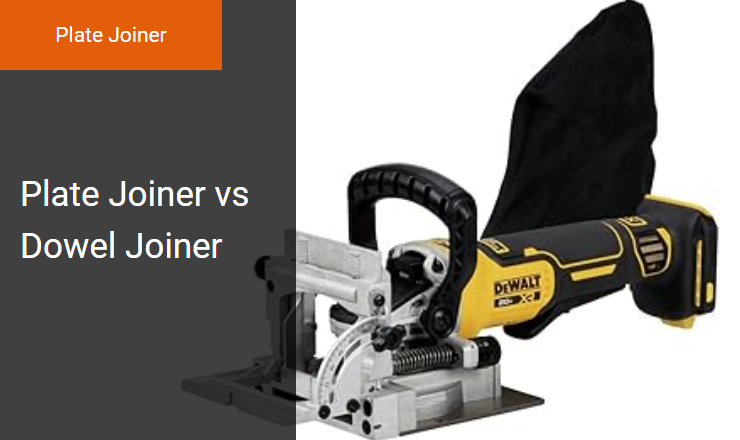
Achieving perfectly flush face joints on solid timber or sheet goods remains a constant frustration for woodworkers, often resulting in tedious sanding or permanently misaligned assemblies. While traditional joint-strengthening methods like standard doweling and pocket screws offer familiar pathways to assembly, they frequently lack the tolerance needed for seamless alignment on complex builds.
A dedicated plate joiner bridges this gap, granting unparalleled lateral play during assembly to ensure effortless micro-adjustments during critical glue-ups. As an educational stipulation, however, it is vital to note that while compressed wood biscuits excel at alignment and shear strength, they are not engineered for heavy structural load-bearing joints.
For applications like wide tabletop panel alignments or cabinet carcass construction, this tool offers unmatched efficiency. Below, we will contrast the plate joiner directly against the dowel joiner, analyzing their strength, accuracy, and ease of use to help you select the optimal tool for your workshop.
| Factor | Summary |
|---|---|
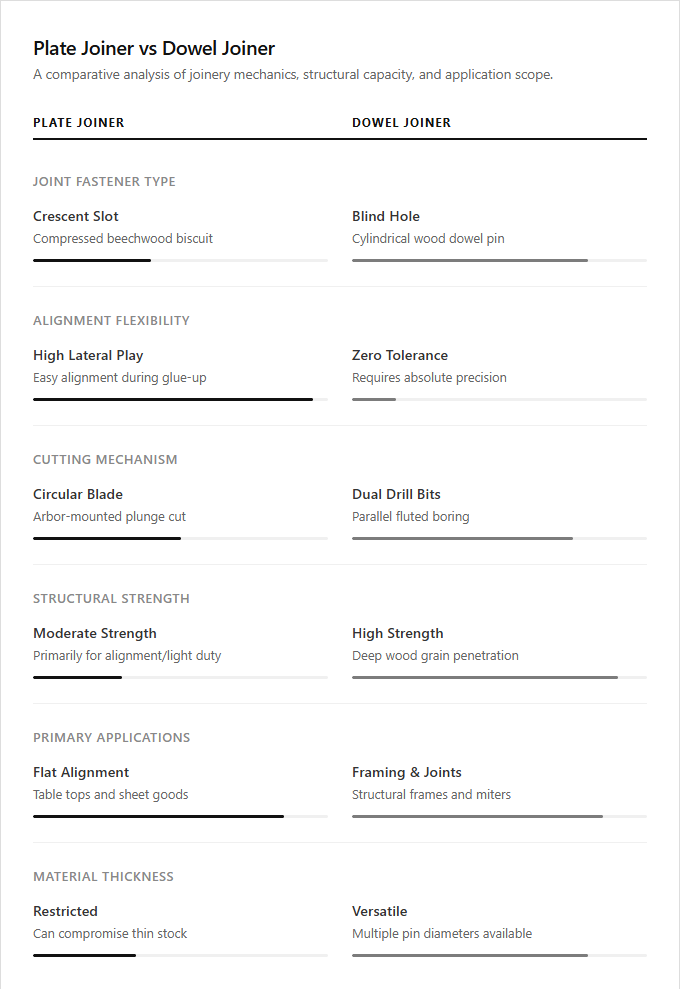
| Joint Fastener Type | While a plate joiner utilizes compressed beechwood biscuits inserted into crescent-shaped slots, a dowel joiner employs cylindrical wood dowel pins inserted into precisely drilled blind holes. |
| Alignment Flexibility | Plate joiners offer significant lateral play along the joint slot for easy alignment during glue-up, whereas dowel joiners require precise positioning due to having zero lateral tolerance. |
| Cutting Mechanism | A plate joiner uses an arbor-mounted circular saw blade to plunge-cut slots, while a dowel joiner uses a dual-spindle plunge mechanism with fluted brad-point drill bits to bore parallel holes. |
| Structural Strength | Dowel joiners provide superior tensile and shear strength due to deeper penetration into the wood grain, whereas biscuit joints are primarily designed for alignment and lighter face-frame duty. |
| Primary Applications | Plate joiners are ideal for edge-to-edge alignment of table tops and sheet goods, while dowel joiners excel in structural furniture frames, mitered joints, and cabinet carcass assembly. |
| Material Thickness | Biscuit slots can severely compromise the structural integrity of thin stock, whereas dowel joiners offer multiple pin diameter options to safely accommodate varying material thicknesses. |
Plate Joiner Slots Simplify Glue-Up Alignment
When comparing joinery methods, the primary distinction between a plate joiner and a dowel joiner lies in alignment flexibility. A plate joiner cuts crescent-shaped slots that are wider than the wooden biscuits. This design provides valuable lateral tolerance along the joint line, allowing woodworkers to slide workpieces slightly left or right during glue-up to achieve a perfectly flush alignment before the adhesive cures.
In contrast, dowel joiners require precise, unforgiving drilling because dowel pins offer virtually no lateral play once inserted. While dowels provide exceptional shear strength for heavy-duty frames, the forgiving nature of biscuit slots simplifies panel alignment. Plate joiners are ideal for cabinetmakers seeking rapid, adjustable sheet-goods assembly, whereas dowel joiners best suit traditional furniture makers requiring maximum joint strength and rigid, exact positioning.
Water-Activated Swelling Secures Beechwood Biscuit Joints
When comparing plate joiners to dowel joiners, the primary distinction lies in the alignment flexibility and the specific bonding mechanism. Plate joiners utilize compressed beechwood biscuits that offer a unique structural advantage. Upon contact with water-based wood glue, these biscuits undergo rapid hygroscopic expansion. This swelling action tightly wedges the biscuit within the semi-elliptical slot, creating a highly secure, permanent lock as the adhesive cures.
Dowel joiners rely on precise, cylindrical wooden pins that offer superior shear strength but require meticulous alignment during setup. While plate joiners allow for slight lateral adjustments during assembly, dowel joiners demand exact hole positioning. Plate joiners are ideal for cabinetmakers seeking fast, forgiving alignment on flat panels, whereas dowel joiners suit traditional furniture makers requiring high-strength, precisely aligned frame joints.
Glue-Bonding Surface Area: Biscuits vs. Dowels
When comparing joinery methods, the primary structural advantage of a plate joiner lies in the expanded glue-bonding surface area. The football-shaped wood biscuits expand upon absorbing water-based glue, creating a wide, continuous bond across the mating slot. In contrast, dowel joiners rely on localized, cylindrical insertions that offer concentrated strength but cover significantly less surface area per joint. This makes plate joinery highly effective for lateral alignment and sheer strength in sheet goods.
For projects requiring rapid alignment and maximum surface adhesion, such as wide tabletop glue-ups, the biscuit joiner remains highly efficient. Dowel joiners are ideal for traditional furniture makers seeking precise, high-strength joints in structural frames, whereas plate joiners best serve cabinetmakers and hobbyists prioritizing fast, forgiving alignment during panel assembly.
Accurate fence registration ensures coplanar alignment of the mating workpieces
When selecting between a plate joiner and a dowel joiner, the alignment mechanism is the primary technical differentiator. Both tools require meticulous technique, as accurate fence registration ensures coplanar alignment of the mating workpieces. A plate joiner utilizes a wide, adjustable fence to reference the face of the wood, cutting a crescent-shaped slot that allows for helpful lateral adjustment during glue-up. Conversely, a dowel joiner drills fixed, parallel holes, demanding exact positioning because the resulting joint offers no lateral tolerance once assembled.
Maintaining a flat, stable fence against the wood during operation prevents stepped joints and guarantees a flush finish. Plate joiners are ideal for cabinet makers who value rapid assembly and forgiving tolerances, whereas dowel joiners are best suited for precision woodworkers who require high-strength, structural joints and absolute alignment accuracy.
Dowels Outperform Biscuits Under Heavy Structural Loads
When comparing plate joiners to dowel joiners, structural integrity is a primary consideration. Dowel joiners utilize thick, solid wood pegs that penetrate deeply into both workpieces, offering significantly higher shear strength under heavy structural loads. In contrast, plate joiners utilize thin, compressed wooden biscuits. While biscuits excel at quick lateral alignment, their slender profile cannot withstand intense gravitational or shearing forces as effectively as robust dowels.
Under heavy weight, biscuits are prone to flexing or shearing, whereas thick dowels act as internal reinforcement pins that distribute stress across a larger surface area. Plate joiners are ideal for production woodworkers prioritizing speed and alignment in panel glue-ups, whereas dowel joiners are best suited for traditional furniture makers constructing heavy, load-bearing frames.
Precise Plunge Calibration to Prevent Blade Blowout
When working with thin stock profiles, precise plunge depth calibration is critical to prevent tool blowout. A plate joiner features a spring-loaded motor housing and a fine-tunable, stepped depth stop that locks the crescent blade's travel with mechanical certainty. This precise calibration ensures the blade carves a secure pocket for the biscuit without breaching the delicate outer face of the workpiece.
Conversely, a dowel joiner utilizes dual spinning drill bits that rely on adjustable mechanical stops to limit depth. While highly accurate, calibrating these drills on narrow profiles requires careful setup to avoid boring through the stock. Cabinetmakers prioritizing rapid, forgiving alignment in panel assembly favor the plate joiner, whereas precision furniture makers requiring deep, load-bearing joint registration choose the dowel joiner.
Biscuit Size Effects on Miter Joint Tensile Strength
In mitered joinery, a plate joiner provides crucial tensile strength reinforcement by utilizing compressed wood biscuits in designated sizes. Selecting #0 biscuits for delicate frames, #10 for standard casings, and #20 for large mitered carcasses maximizes the glue-bonding surface area. Once adhesive is applied, these biscuits expand within the precision-cut slots, creating a mechanical lock that effectively resists pulling forces across the mitered seam.
While dowel joiners offer superior shear resistance in heavy structural joints, they lack the lateral adjustment leeway inherent to biscuit joinery. Plate joiners are ideal for cabinetmakers and installers who require rapid, forgiving alignment during panel and miter assembly, whereas dowel joiners are best suited for precision-oriented furniture makers constructing high-load structural frames.
Leave a comment