
Selecting the right concrete tool often leaves contractors torn between the relentless power of corded models and the rapid mobility of cordless technology. When tackling high-impact SDS-Plus drilling, balancing continuous runtime against physical portability is a constant job site frustration. Typically, construction firms bridge this operational gap by relying on standard equipment budgets and temporary generator setups to keep tools running.
However, securing the correct platform grants your crew unparalleled field efficiency and drastically reduces fatigue during intensive tasks like overhead anchoring. As a stipulation, buyers must recognize that battery voltage ratings do not automatically translate to superior impact energy. For instance, drilling hundreds of 1/2-inch drop-in anchors into cured concrete requires a precise calibration of Joules and BPM, rather than raw wattage alone.
This article evaluates corded versus cordless SDS-Plus rotary hammers, comparing motor efficiency, weight-to-power ratios, and long-term durability to help you select the ultimate high-impact concrete tool.
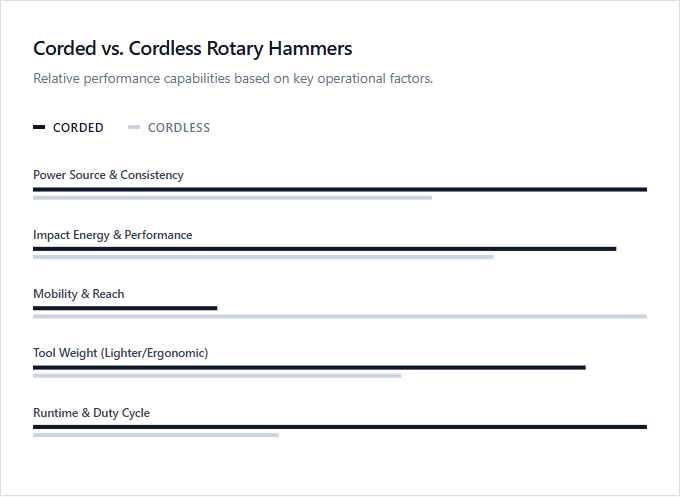
| Factor | Summary |
|---|---|
| Power Source & Consistency | Corded rotary hammers deliver constant, high-wattage current directly from the grid, avoiding the voltage drop typically experienced as cordless battery cells deplete. |
| Impact Energy & Performance | Corded models consistently provide higher impact energy measured in Joules due to their unrestricted power draw, whereas cordless units rely on advanced brushless motors to maximize electro-pneumatic efficiency. |
| Mobility & Reach | Cordless rotary hammers offer unmatched maneuverability on scaffolding or remote jobsites where access to an AC mains power source is unavailable. |
| Tool Weight | Corded tools are lighter because they lack a heavy lithium-ion battery pack, resulting in a better power-to-weight ratio during overhead drilling. |
| Runtime & Downtime | Corded tools support an unlimited continuous duty cycle, while cordless tools are constrained by the amp-hour rating of their batteries and require swapping packs. |
Impact Energy Determines Concrete Drilling and Demolition
When selecting a rotary hammer for concrete applications, the primary performance metric to evaluate is impact energy, measured in Joules. This rating directly determines the tool's concrete drilling speed and demolition capability across both power configurations. While corded models traditionally delivered higher, uninterrupted impact energy for heavy-duty chipping, advancements in high-voltage battery technology have enabled cordless units to achieve comparable Joule ratings for demanding penetration tasks.
Corded rotary hammers offer sustained power for continuous, high-intensity drilling where power drops are unacceptable, whereas cordless options provide superior jobsite mobility without sacrificing necessary impact force. Heavy-duty commercial contractors requiring non-stop, high-volume demolition generally benefit from corded models, whereas electrical installers and service technicians prefer cordless units for quick, highly portable overhead drilling.
Brushless Motors Maximize Cordless Efficiency and Torque
When selecting a rotary hammer for concrete applications, the choice between corded and cordless models depends on power requirements and jobsite mobility. Corded rotary hammers offer uninterrupted power supply and consistent performance, making them highly reliable for heavy-duty, continuous drilling and chipping operations.
Conversely, cordless rotary hammers provide unmatched portability on active jobsites. Modern cordless models rely on brushless motor technology to maximize battery efficiency and torque output, delivering high-level performance that closely rivals traditional corded alternatives.
Corded models are best suited for high-volume industrial contractors requiring continuous runtime, while cordless units are ideal for MEP installers and mobile technicians who prioritize agility and rapid setup.
SDS-Plus Chuck: Optimal Power and Smooth Sliding
When selecting a rotary hammer for concrete applications, professionals must evaluate the distinct operational advantages of corded versus cordless models. Despite their power source differences, both configurations rely heavily on the advanced SDS-Plus chuck system. This specialized mechanism ensures optimal sliding action and facilitates high-impact power transmission, allowing both corded and cordless units to deliver maximum demolition energy directly to the masonry bit without slippage.
Corded rotary hammers provide uninterrupted, consistent performance for heavy-duty, continuous drilling in dense concrete, while cordless models offer unmatched portability on dynamic jobsites. Corded units are ideal for industrial masonry contractors requiring relentless endurance for all-day drilling, whereas cordless options best serve electrical technicians and HVAC installers who prioritize mobility across various work zones.
BPM and RPM Dictate Masonry Drilling Speed
When drilling through high-psi masonry, the efficiency of a rotary hammer relies heavily on its blows per minute (BPM) and rotational speed. These twin metrics directly dictate the tool's drilling velocity and concrete penetration. Corded rotary hammers consistently deliver maximum, uninterrupted power, maintaining peak BPM and rotational speeds even under heavy, continuous loads without the risk of voltage drop.
Modern cordless rotary hammers offer highly competitive peak performance due to advancements in brushless motors and high-voltage battery platforms, though their sustained velocity can decrease as the battery depletes. Choosing the optimal power source depends on your specific operational environment. Corded models are ideal for industrial concrete specialists performing high-volume, stationary drilling, whereas cordless units best serve electrical and mechanical contractors who prioritize mobility and quick setups across changing jobsites.
Electro-Pneumatic Hammers: Driving High-Impact Force
Both corded and cordless rotary hammers rely on advanced electro-pneumatic hammer mechanisms to tackle demanding masonry tasks. Within these tools, a motor-driven piston compresses air to propel a striker, creating the powerful compression stroke necessary for high-impact force. Corded rotary hammers excel in delivering sustained, maximum wattage to this pneumatic system, ensuring relentless energy for continuous, heavy-duty chiseling and deep-hole drilling.
Conversely, cordless rotary hammers utilize high-voltage battery platforms to drive the same electro-pneumatic action, offering superior portability without the constraint of power cords. Stationary masonry contractors requiring uninterrupted runtime for high-volume drilling are best suited for corded models, while service technicians and utility workers prioritizing mobility on remote jobsites benefit most from cordless flexibility.
How Ah Ratings Drive Cordless Battery Performance
When selecting a rotary hammer for concrete applications, the choice between corded and cordless platforms involves balancing consistent power delivery with mobility. Modern cordless rotary hammers offer impressive performance, where Ampere-hour (Ah) ratings dictate the continuous runtime and sustained output of cordless lithium-ion platforms. Higher Ah battery packs allow the tool to maintain high torque and impact energy during demanding drilling cycles, bridging the historical performance gap.
Corded rotary hammers bypass battery limitations entirely, delivering uninterrupted power directly from an electrical source for heavy-duty applications. Professional contractors requiring endless runtime for intensive, stationary demolition rely on corded models, while service technicians prioritizing portability and quick setups on scattered jobsites benefit most from high-capacity cordless systems.
Clutches and Sensors Prevent High-Torque Drill Kickback
When drilling into reinforced concrete, bit binding presents a significant safety hazard. Modern rotary hammers, both corded and cordless, mitigate this risk through advanced engineering. Integral mechanical slip clutches physically disengage the drive shaft during a jam, while electronic active feedback sensors instantly cut motor power upon detecting sudden, uncontrolled tool rotation. These integrated safety systems prevent dangerous high-torque kickback, protecting operators from sudden wrist and arm injuries.
Corded rotary hammers deliver uninterrupted, high-torque performance for heavy-duty, continuous drilling on sites with established power sources. Cordless models leverage advanced battery technology to offer these identical safety features alongside unmatched mobility on remote or congested jobsites. Corded units are ideal for industrial demolition specialists requiring continuous runtime, while cordless options best suit utility technicians and mobile contractors needing rapid setup and maximum portability.
Leave a comment