
Every contractor knows the frustration of a jammed framing nailer mid-job, or the tedious chore of cleaning up sharp plastic shards littered across a client's yard. Choosing between paper tape and plastic collated nails is not merely a minor purchasing detail; it directly impacts your daily job-site productivity and tool longevity.
Typically, professionals rely on standard hardware suppliers and bulk procurement budgets to keep their crews equipped with whatever fasteners are readily available. However, choosing your collation method solely on initial supply costs overlooks critical operational variables. Opting for the precise collation style grants crews a significant reduction in tool downtime and clean-up labor.
Of course, this selection carries the stipulation that regional building codes and specific tool compatibility-such as deploying Paslode paper-tape nails for code-compliant shear wall framing-must remain your primary guide.
Below, we break down the durability, environmental impact, and cost-efficiency of both paper and plastic collation types, offering a clear roadmap to optimize your framing operations.
| Factor | Summary |
|---|---|
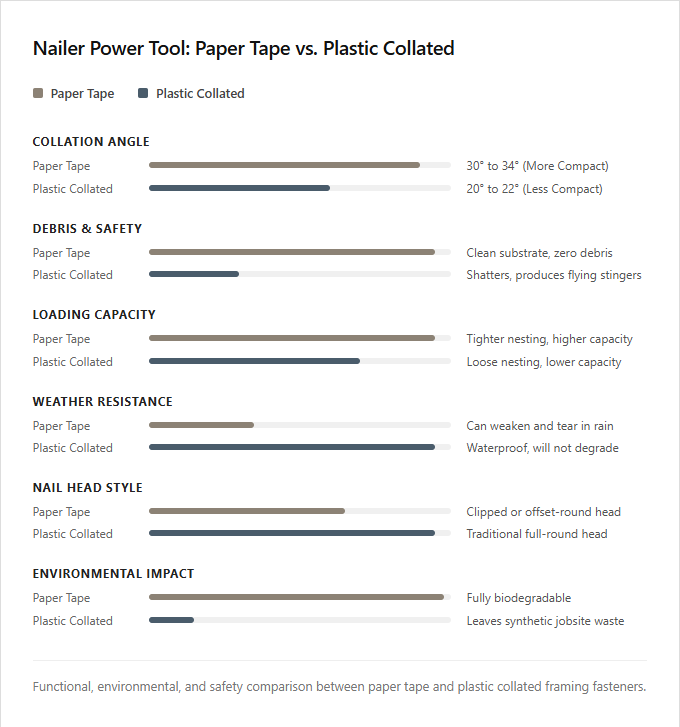
| Collation Angle | Paper tape nails typically feature a 30 to 34-degree collation angle, whereas plastic collated nails are usually set at a 20 to 22-degree angle to accommodate the nailer's magazine. |
| Debris and Safety | Plastic collation shatters upon driver blade impact, producing flying stingers that require safety glasses, whereas paper tape is driven cleanly into the substrate. |
| Loading Capacity | Paper tape strips allow for tighter nesting of fasteners, resulting in a higher magazine capacity and fewer reloading interruptions during operation. |
| Weather Resistance | Plastic collated nails offer superior moisture resistance and will not degrade in wet conditions, unlike paper tape which can weaken and tear when exposed to rain. |
| Nail Head Style | Paper tape nails often utilize a clipped-head or offset-round-head design to facilitate tight collation, whereas plastic collated nails typically feature a traditional full-round-head. |
| Environmental Impact | Paper tape is fully biodegradable and leaves no synthetic waste on the jobsite, making it a more ecologically friendly option than non-biodegradable plastic collation. |
High-Capacity 30-34° Paper-Collated Fasteners
When choosing framing nailer fasteners, the collation material significantly impacts job site efficiency and tool handling. Paper-collated fasteners feature a 30-to-34-degree collation angle allowing higher magazine capacity and a more compact tool profile. This steep angle enables users to navigate tight framing studs easily, while the paper tape shears cleanly without leaving messy debris or dangerous flying shards on the work site.
Plastic-collated nails typically utilize a 21-degree angle, resulting in a longer magazine but offering superior moisture resistance during outdoor storage. Professional framers prioritizing speed and maneuverability in tight spaces favor paper tape, while budget-conscious builders and outdoor deck contractors working in damp environments benefit most from plastic collation.
Plastic-collated fasteners generate hazardous flying debris during the shear cycle
When selecting collation types for framing nailers, safety and job site cleanliness are critical factors. Plastic-collated fasteners are joined by a rigid plastic strip that shatters during the shear cycle. This process generates sharp, high-velocity flying debris that can cause eye injuries and clutters the workspace. Paper-tape fasteners are bound by a paper strip that shears cleanly and is consumed during the drive, leaving virtually no hazardous residue behind.
Paper-tape collation is highly favored on indoor residential jobs and in strict safety environments due to its lack of dangerous waste. Plastic-collated systems are preferred by outdoor framing crews needing weather-resistant durability, while paper-tape systems are ideal for indoor contractors and safety-conscious professionals prioritizing a debris-free workspace.
Cold-Weather Brittleness in Plastic Collation
When choosing between paper tape and plastic collated framing nails, environmental conditions play a critical role in tool performance. Plastic-collated nails hold fasteners together with a rigid plastic strip that shears upon firing. In cold temperatures, this plastic material becomes highly brittle, often fracturing prematurely during transport or loading, which leads to frequent tool jams and wasted fasteners on the job site.
Paper-taped nails offer a resilient alternative, as the paper tape is bound with high-performance adhesive that remains flexible in extreme temperatures. This design ensures clean shearing without leaving plastic debris on the work surface. Paper-collated nails are ideal for year-round contractors working in harsh winter climates, while plastic-collated fasteners remain a practical choice for indoor installers and DIY enthusiasts operating in temperate environments.
Polymer Adhesives Keep Paper Tape Strong When Wet
When selecting collation materials for pneumatic framing nailers, professionals must weigh the distinct performance characteristics of paper tape and plastic strip options. Paper tape collation is engineered for maximum resilience on demanding jobsites. Modern paper-collated nails utilize advanced moisture-resistant polymer adhesives, allowing the strips to maintain their structural integrity even when exposed to wet, rainy conditions. This specialized adhesive barrier prevents the tape from softening or breaking apart, ensuring consistent feeding and minimizing tool jams during inclement weather.
In contrast, plastic collated nails offer a rigid, cost-effective alternative that performs reliably in dry environments, though they tend to produce flying plastic debris upon firing. High-volume framing contractors working year-round in unpredictable outdoor environments benefit most from the weather-resistant reliability of paper tape, whereas budget-conscious DIYers and indoor finish carpenters typically prefer plastic collated nails for controlled, dry conditions.
21-Degree Plastic-Collated Full Round Head Nails
When selecting a framing nailer, the choice between paper tape and plastic collated fasteners significantly impacts project efficiency and building code compliance. Plastic-collated nails utilize a 21-degree angle to accommodate full round head configurations, which are frequently mandated by structural codes in seismic and high-wind regions. In contrast, paper-tape nails are joined at steeper angles, typically 30 to 34 degrees, which allows for a more compact magazine design and greater nail capacity.
While paper tape is engineered to shear cleanly and drive fully into the wood, plastic collation can sometimes scatter debris across the workspace during firing. Paper-tape systems are best suited for high-volume production framers who prioritize rapid firing and minimal cleanup, whereas plastic-collated systems are ideal for heavy-duty structural contractors who must satisfy rigorous local building regulations.
Paper Tape Collation Maximizes Fasteners Per Strip
When choosing between paper tape and plastic collated framing nails, collation design directly impacts job site efficiency. Paper tape collation allows for a tighter pitch to maximize the number of fasteners per strip. This dense spacing allows users to load more nails into the magazine at once, reducing reload frequency during high-volume projects. The paper strips shear cleanly upon impact, leaving no debris on the work surface.
Plastic collated nails utilize rigid plastic bands that resist moisture and withstand harsh outdoor storage. High-volume framing contractors seeking maximum magazine capacity and clean finishes benefit most from paper tape, whereas residential builders working in damp environments find plastic collated nails ideal for their durability and cost-effectiveness.
Paper-Collated Nails: No Residue, No Jams
When selecting collation materials for pneumatic framing nailers, tool reliability and maintenance are critical factors. Paper-collated nails provide a distinct operational advantage because the paper tape shears away cleanly during firing. This process leaves no plastic residue or debris inside the tool feed mechanism, which significantly reduces bypass jams and ensures consistent feeding.
Conversely, plastic-collated fasteners tend to scatter debris upon impact, which can accumulate in the magazine and cause frequent mechanical disruptions. Professional framing contractors requiring maximum uptime on busy jobsites are best suited for paper tape, whereas residential DIYers seeking cost-effective fasteners for outdoor storage conditions typically opt for plastic collation.
Leave a comment