
For woodworkers executing high-precision joinery, few things are more frustrating than watching a beautifully crafted piece of trim split during final assembly, or spending hours filling conspicuous fastener holes. While standard workshop fastening methods-such as traditional wood glue or larger finish nails-remain essential staples, they often fail when applied to delicate, intricate workpieces.
By selecting the appropriate micro-fastener, craftsmen grant themselves the ability to achieve immediate, virtually invisible holds on fragile components. However, a key stipulation remains: neither tool is a universal remedy, as holding power must always be balanced against material density. For example, while a 23-gauge pin is perfect for securing delicate glass retaining beads on cabinetry, an 18-gauge brad is required to hold heavier baseboards and casing.
This article provides an in-depth comparison of 23-gauge pin nailers and 18-gauge brad nailers, evaluating their holding strength, hole visibility, and optimal applications to ensure you choose the right tool for your delicate woodworking projects.
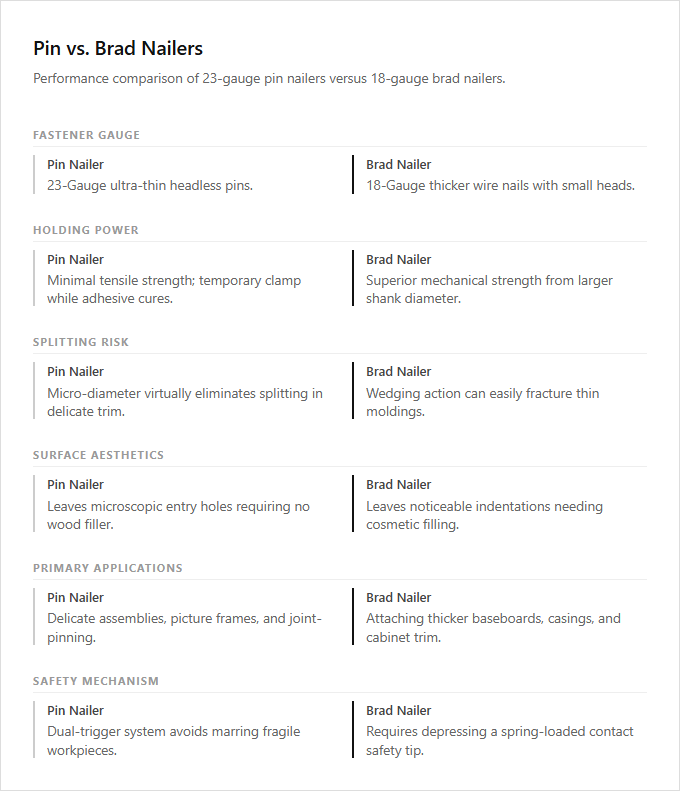
| Factor | Summary |
|---|---|
| Fastener Gauge | Pin nailers utilize ultra-thin 23-gauge headless pins, whereas brad nailers drive thicker 18-gauge wire nails with small heads. |
| Holding Power | Brad nailers provide superior mechanical holding power due to their larger shank diameter, while pin nailers offer minimal tensile strength and primarily serve as temporary clamps during adhesive curing. |
| Splitting Risk | The micro-diameter of pin fasteners virtually eliminates wood splitting in delicate softwood trim, whereas the wedging action of brad nails can easily fracture fragile, thin moldings. |
| Surface Aesthetics | Headless pin nailers leave microscopic entry holes that require no wood filler, while brad nails leave noticeable indentations that necessitate cosmetic filling and sanding. |
| Primary Applications | Pin nailers are engineered for delicate woodworking assemblies like intricate picture frames and joint-pinning, whereas brad nailers are designed for attaching thicker baseboards, casings, and cabinet trim. |
| Safety Mechanism | Brad nailers require a spring-loaded contact safety tip to be depressed before firing, while many pin nailers use a dual-trigger mechanism to prevent marring fragile workpieces. |
Why 23-Gauge Pins Are Thinner Than 18-Gauge Brads
When selecting between a pin nailer and a brad nailer, the primary distinction lies in the physical fastener size. The wire gauge diameter variation dictates that 23-gauge pins are much thinner than 18-gauge brad nails. This difference in thickness significantly impacts both the holding strength and the visual footprint left on the workpiece.
The ultra-thin 23-gauge pin lacks a head, leaving an almost invisible entry hole that requires virtually no wood filler. In comparison, 18-gauge brad nails feature a small head, providing the necessary holding power to secure heavier trim components without the risk of separation.
Choosing the correct tool depends on the specific demands of your woodworking or assembly projects. Pin nailers are ideal for detail-oriented artisans working on delicate jewelry boxes and intricate trim, while brad nailers are suited for general carpenters installing baseboards, cabinetry, and crown molding.
Headless Pin vs. Brad Nail Head Profiles
Pin nailers utilize 23-gauge fasteners that are virtually headless. This extremely low-profile design allows the pin to sink completely below the wood surface, leaving an almost invisible entry hole that rarely requires wood putty. While this headless profile preserves the aesthetic integrity of delicate pieces, it offers limited holding power.
In contrast, brad nailers drive larger 18-gauge fasteners featuring a distinct, T-shaped head. This T-head design provides significantly more surface area, which increases the gripping and holding force of the nail. Although it leaves a larger, visible hole that requires filling and sanding, it secures thicker materials much more reliably.
Pin nailers are ideal for delicate craftspeople performing intricate, temporary trim work, whereas brad nailers are suited for residential carpenters installing heavier baseboards and casings.
18-Gauge Brads Are Stronger Than 23-Gauge Pins
When selecting fastening systems for woodworking and cabinetry, understanding the structural differences between 18-gauge brad nailers and 23-gauge pin nailers is essential. Mechanical holding power and shear strength are significantly higher in 18-gauge brads than 23-gauge pins. This disparity exists because the thicker wire diameter and defined head of the brad nail provide a robust physical grip, anchoring materials firmly against shifting and pulling forces.
The 23-gauge pin nailer utilizes an ultra-thin, headless wire designed primarily to hold delicate trim in place while adhesive cures. These micro-pins leave virtually invisible entry holes but offer minimal independent structural support. Brad nailers are best suited for trim carpenters installing heavy baseboards and casings, while pin nailers are ideal for detail artisans crafting delicate cabinetry or intricate furniture overlays.
Ultra-Thin Pins Prevent Delicate Wood Splitting
Choosing between a pin nailer and a brad nailer depends on the delicacy of your workpiece. While 18-gauge brad nailers provide strong holding power for standard trim, their thicker profile can easily split fragile materials. In contrast, the substrate splitting risk is drastically reduced in delicate wood profiles when using ultra-thin 23-gauge pins, making them indispensable for intricate components.
These headless pins leave nearly invisible entry holes that require no puttying, though they lack the shear strength of larger fasteners. Brad nailers are the preferred choice for general trim carpenters and DIYers installing heavy baseboards, while pin nailers are ideal for detailed furniture makers and finish carpenters executing precise, decorative embellishments.
Countersink Size Dictates Wood Filler Volume
When choosing between a pin nailer and a brad nailer, the primary consideration is the countersink hole footprint left on the wood surface. Pin nailers drive ultra-thin 23-gauge headless pins, leaving an almost imperceptible entry point. This micro-sized footprint requires virtually no wood filler, allowing woodworkers to skip intensive patching and sanding before applying a final finish.
Conversely, brad nailers utilize thicker 18-gauge fasteners with distinct heads, creating a significantly larger indentation upon impact. This larger footprint demands a greater volume of wood filler and careful prep work to achieve a flush, paint-ready surface. Pin nailers are ideal for detail-oriented artisans installing delicate, intricate trim, while brad nailers are suited for general carpenters needing robust holding power for heavier cabinetry and casing.
18-Gauge Tools Support Longer Fasteners Than 23-Gauge
When comparing pneumatic fastening options, the distinction between 18-gauge brad nailers and 23-gauge micro-pinners centers on holding power and fastener length. Brad nailers offer a significantly greater fastener length capacity, typically accommodating brads from 5/8 inch up to 2 inches. Micro-pinners, designed for delicate trim, generally limit their fastener length to 1-3/8 inches because of the ultra-thin wire profile.
The thicker profile and extended length of 18-gauge fasteners provide the mechanical grip necessary for securing heavier casings and baseboards. Micro-pins leave nearly invisible holes but lack structural strength, meaning they serve primarily to hold pieces in place while adhesive cures.
Cabinetmakers and trim carpenters benefit most from the robust holding power of the 18-gauge brad nailer, whereas finish woodworkers and instrument makers require the precision of the 23-gauge micro-pinner for split-free fastening on delicate moldings.
Pin Nails vs. Brad Nails: Curing vs. Structural Joinery
In professional woodworking and finish carpentry, the choice between pin and brad nailers depends on the required joint strength. Pin nailers utilize ultra-thin, headless fasteners designed primarily to hold delicate components in place while adhesive cures. Because these micro-pins lack holding power on their own, the cured wood glue serves as the primary structural bond.
Brad nailers drive thicker, headed fasteners that provide sufficient shear strength for standalone structural joinery. These tools secure heavier trim, casing, and cabinetry components reliably without relying on adhesives. Pin nailers are best suited for meticulous craftspeople performing delicate, invisible detailing, while brad nailers are the preferred choice for general carpenters installing heavy-duty molding and cabinetry.
Leave a comment