
Achieving a flawless, swirl-free finish on automotive paint often leaves professional detailers and enthusiasts facing a frustrating dilemma: balancing correcting efficiency with surface safety. Selecting the wrong dual action (DA) polisher throw can result in either hours of wasted labor or accidental damage to delicate body lines.
While traditional 8mm short-throw units or high-risk rotary machines have historically been the standard capital investments for paint correction, modern thin clear coats demand a more sophisticated approach. Opting for the correct long-throw orbit grants operators the ability to slash compounding times in half while maintaining absolute safety over sensitive edges.
However, we must stipulate that throw size is not a one-size-fits-all solution; optimal performance remains highly dependent on panel curvature. For example, a 21mm machine like the Rupes LHR21 excels on broad, flat hoods, whereas a 15mm throw is indispensable for the intricate contours of modern sports cars.
Below, we will analyze the technical differences between 15mm and 21mm DA polishers, comparing their cutting power, finishing capabilities, and overall versatility to help you select the ideal tool for your workshop.
| Factor | Summary |
|---|---|
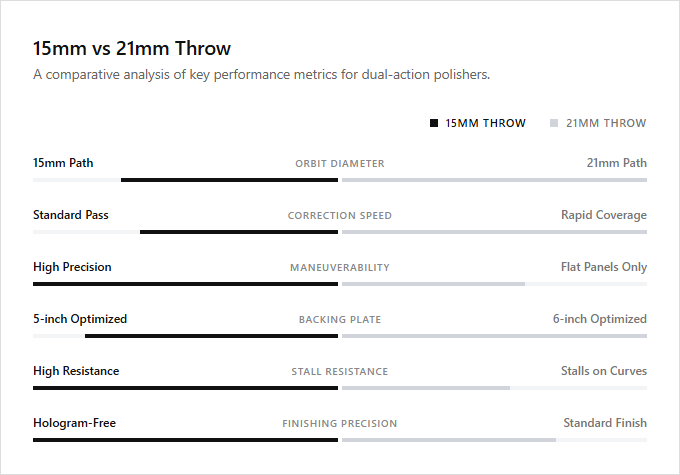
| Orbit Diameter | The 21mm throw features a larger eccentric orbit that covers more surface area per revolution than the tighter 15mm oscillation path. |
| Correction Speed | A 21mm polisher offers faster paint correction on flat panels due to its greater coverage, whereas a 15mm tool requires more passes to achieve the same compounding efficiency. |
| Maneuverability | The 15mm throw provides superior control and navigation on complex body contours, reducing the risk of accidental panel edge damage. |
| Backing Plate Compatibility | A 21mm polisher is typically paired with a larger six-inch backing plate, while a 15mm polisher is optimized for a five-inch backing plate to maximize concentrated downward force. |
| Rotational Stall | The 15mm throw is less susceptible to rotational stall on curved surfaces because its shorter stroke requires less kinetic energy to maintain pad rotation. |
| Finishing Precision | A 15mm tool delivers a more refined, hologram-free finish on sensitive clear coats due to its tighter, more stable dual-action pattern. |
Orbit diameter determines the cutting speed and paint correction efficiency
The orbit diameter, or "throw," of a dual-action polisher directly dictates its cutting speed and paint correction efficiency. A larger throw covers more surface area per rotation, accelerating the defect removal process on expansive, flat panels. A smaller throw concentrates the polishing action over a tighter area, which delivers superior torque and prevents stalling on curved or contoured surfaces.
A 21mm throw offers maximum coverage and rapid correction, making quick work of large vehicles. Conversely, a 15mm throw provides a balanced blend of correction power and precise maneuverability for intricate body lines. The 21mm polisher is ideal for high-volume detailing professionals focusing on speed, while the versatile 15mm model is best suited for enthusiasts and technicians requiring a single, all-around tool for complex vehicle shapes.
Greater Surface Coverage with a 21mm Orbit
When selecting a dual-action polisher, the orbit size, or throw, is a critical factor in determining efficiency. A twenty-one millimeter throw provides a significantly larger surface area coverage per pass compared to a fifteen millimeter alternative. This expanded oscillation diameter allows operators to correct paint imperfections across broad, flat panels in a fraction of the time, maximizing overall shop productivity.
While the fifteen millimeter throw offers superior precision and control on curved surfaces or tight body lines, it requires more passes to cover large areas. The larger twenty-one millimeter orbit excels on expansive surfaces but demands more skill to manage tool stalling on complex contours. High-volume collision centers and technicians detailing large commercial vehicles or marine craft will benefit most from the rapid correction of the twenty-one millimeter model, whereas precision-focused detailers and enthusiasts working on intricate sports cars will find the fifteen millimeter tool more versatile.
Large-Throw Pad Stalling on Complex Contours
When selecting a dual-action polisher, the orbit size-or throw-significantly influences both correction speed and tool control. A twenty-one millimeter throw covers more surface area quickly, making it highly effective for flat panels. However, this wider oscillation increases the likelihood of pad stalling when encountering complex body contours and tight transitions, as the contact patch easily loses rotational momentum on curved surfaces.
In contrast, a fifteen millimeter throw maintains rotation more consistently over curved bodywork because the smaller orbit handles pressure changes more effectively. While the fifteen millimeter tool offers superior versatility for intricate vehicle designs, the twenty-one millimeter variant remains highly efficient for flat, expansive panels. The fifteen millimeter polisher is ideal for detailers working on sports cars with intricate body lines, whereas the twenty-one millimeter tool best serves high-volume technicians focusing on large, flat vehicles.
Plate Size Limits Pad Versatility on 21mm Machines
When selecting a dual-action polisher, the choice between a 15mm and a 21mm throw significantly impacts operational versatility. A 21mm orbit offers rapid defect correction on expansive, flat panels but is engineered strictly for larger backing plates, typically 6 inches. This design constraint prevents operators from downsizing to smaller plates or pads, as doing so disrupts the machine's counterweight balance, leading to severe vibration and reduced control.
Conversely, 15mm polishers offer greater adaptability, comfortably accommodating 5-inch backing plates to navigate tight curves, contours, and intricate body lines. The highly adaptable 15mm polisher is ideal for detailing enthusiasts and versatile technicians working on diverse vehicle shapes, while the specialized 21mm tool is best suited for high-volume commercial specialists prioritizing rapid correction on large, flat surfaces like boats, recreational vehicles, and commercial trucks.
Counterweight balance optimization reduces machine vibration and user fatigue
When selecting a dual-action polisher, the choice between a 15mm and a 21mm throw significantly impacts efficiency and operator comfort. Manufacturers optimize the internal counterweight systems for each specific orbit to minimize harmonic vibration. This precise balance engineering ensures that rotational forces are neutralized, directly reducing the physical strain and fatigue transferred to the technician during extended detailing sessions.
While the 15mm throw offers superior control on curved panels, the larger 21mm throw maximizes surface coverage on expansive areas. The 15mm model is best suited for precision paint correction specialists working on intricate body lines, whereas the 21mm model is ideal for high-volume commercial operators tackling large, flat surfaces on marine vessels and fleet vehicles.
Frictional heat dissipation increases with the larger throw distance
When selecting a dual-action polisher, the throw distance-typically 15mm or 21mm-is a critical factor in performance and thermal management. A larger 21mm orbit covers more surface area per rotation, distributing work energy across a wider plane. This expanded movement significantly increases frictional heat dissipation, preventing localized heat buildup on the paint surface and reducing the risk of clear coat damage during intensive correction phases.
In contrast, a 15mm throw offers superior control and concentrated polishing power on curved panels and tight body lines where a larger orbit might stall. While the 21mm throw excels at rapid defect removal on expansive areas due to its efficient heat dispersion, the 15mm model remains the standard for precision detailing. The 15mm unit is ideal for detailing enthusiasts working on intricate vehicle contours, whereas the 21mm polisher is best suited for high-volume collision professionals prioritizing rapid correction on large, flat surfaces.
How 15mm Throws Minimize Micro-Marring
When selecting a dual-action polisher, the throw-or orbit size-significantly influences both finishing quality and paint correction speed. A fifteen-millimeter throw offers a tighter oscillation pattern, which distributes downward pressure more evenly and minimizes the risk of micro-marring on delicate surfaces. This smaller orbit provides superior control and a highly refined finish, making it particularly effective for navigating intricate body panels and softer clear coats.
In contrast, a twenty-one-millimeter throw covers a larger surface area per orbit, accelerating defect removal on expansive, flat panels. While this wider pattern increases efficiency, it demands precise handling to prevent buffer trails on sensitive finishes. The fifteen-millimeter model is ideal for meticulous detailers working on complex vehicle contours and soft paints, whereas the twenty-one-millimeter option is best suited for high-volume technicians prioritizing rapid correction on large, flat commercial vehicles.
Leave a comment