
Achieving flawless paint correction often presents a frustrating challenge for detailing professionals who frequently battle pad stall and sluggish defect removal on complex vehicle contours. While standard equipment funding sources and shop acquisition budgets typically steer operations toward purchasing stock, out-of-the-box polisher configurations, technicians are often left struggling to maximize their tool's true mechanical potential.
Optimizing your backing plate size grants an immediate, high-yield increase in cutting efficiency and torque delivery without the capital expense of upgrading the entire power tool. However, this efficiency boost carries the strict stipulation that the operator must precisely align the backing plate mass with the specific orbit and counterweight design of the tool. For instance, configuring a Rupes LHR15 MarkIII with a 5-inch plate illustrates how concentrated downward pressure improves rotation consistency on curved panels.
In this guide, we will analyze the critical performance differences between 5-inch and 6-inch backing plates, detailing how plate selection directly impacts heat management, defect removal rate, and overall machine stability.
| Factor | Summary |
|---|---|
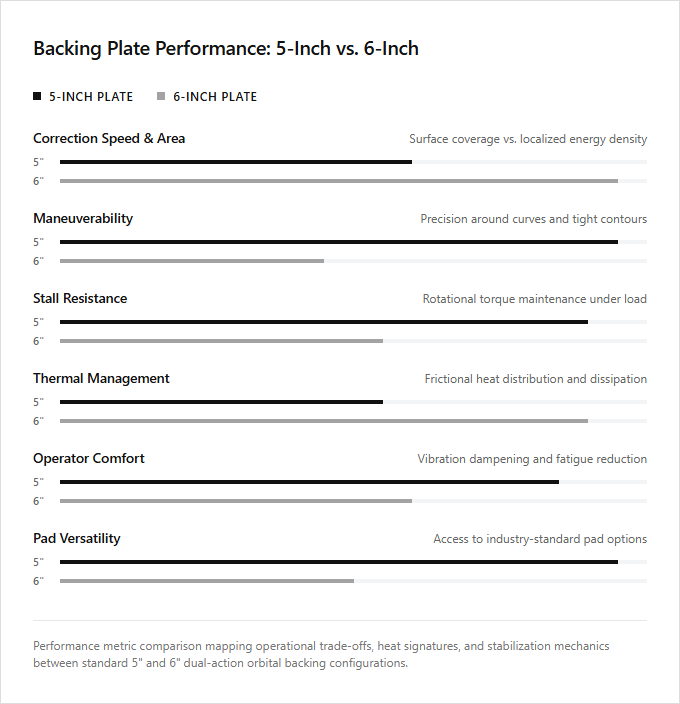
| Surface Area & Correction Speed | The six-inch backing plate covers more surface area to speed up flat-panel correction, while the five-inch plate concentrates orbital energy for faster defect removal in localized areas. |
| Maneuverability & Precision | A five-inch backing plate offers superior maneuverability around complex body contours and tight curves compared to the bulkier six-inch alternative. |
| Rotational Torque & Stall Resistance | Five-inch backing plates experience less rotational stall on dual-action polishers because the smaller radius requires less kinetic torque to maintain pad rotation under load. |
| Heat Dissipation & Thermal Management | Larger six-inch plates dissipate frictional heat more efficiently across a broader surface, whereas five-inch configurations can concentrate thermal energy more rapidly during heavy compounding. |
| Vibration & Operator Fatigue | Using a five-inch plate often reduces counterbalance mismatch and harmonic vibration on standard polishers, leading to less operator fatigue during extended detailing sessions. |
| Pad Compatibility & Versatility | The five-inch backing plate is considered the industry standard, offering greater versatility and compatibility with a wider selection of compounding, polishing, and finishing pads. |
5-inch backing plates minimize rotational stall under load.
Selecting the optimal backing plate size is a critical decision for maximizing dual-action polisher efficiency. The five-inch backing plate is highly favored in the industry because it concentrates the machine's orbital energy over a smaller surface area, which significantly minimizes rotational stall under load. This resistance to stalling ensures consistent cutting and polishing action, even when navigating complex body curves or applying necessary downward pressure.
Six-inch backing plates cover more surface area to speed up work on flat sections, though they are more prone to stalling on contoured surfaces. Detailed correction specialists requiring precision and control prefer the nimble five-inch plate, whereas high-volume commercial technicians focusing on large, flat panels benefit most from the expansive coverage of the six-inch system.
Smaller Plates: More Pressure, Faster Defect Removal
Selecting the correct backing plate is vital for optimal machine polishing. A five-inch backing plate excels in defect removal compared to a six-inch plate due to basic physics. Smaller plate diameters concentrate the tool's downward pressure over a reduced surface area, allowing the compounding pad to cut through deep scratches and oxidation much faster.
A six-inch plate spreads the machine's energy over a larger footprint, which reduces localized cutting power but covers flat panels quickly. The larger six-inch setup is highly efficient for high-volume technicians working on flat, expansive vehicles, whereas the agile five-inch configuration is perfect for precision detailers and enthusiasts tackling complex curves and severe paint defects.
6-inch plates optimize surface area coverage on large flat panels.
Selecting the appropriate backing plate size is a critical decision in machine polishing, directly impacting both efficiency and precision. A six-inch backing plate is engineered to optimize surface area coverage, making it highly effective on large, flat vehicle panels. This larger diameter distributes downward pressure over a broader area, allowing technicians to complete expansive sections in less time while maintaining a consistent finish.
A five-inch backing plate offers enhanced maneuverability and concentrated correction power on curved surfaces and complex body lines. High-volume commercial detailers looking to maximize speed on flat panels favor the six-inch plate, whereas enthusiast detailers and precision specialists working on intricate bodywork find the five-inch plate more suitable.
Correct Plate-to-Tool Pairing Reduces Vibration
Selecting the appropriate backing plate for a dual-action polisher involves more than just surface area coverage; it directly impacts tool calibration. Power polishers are engineered with specific internal counterweights designed to balance the physical mass of a designated plate size. Pairing a five-inch or six-inch backing plate with a tool not calibrated for that exact dimension disrupts this equilibrium, leading to excessive vibration, accelerated tool wear, and increased operator fatigue.
Maintaining the engineered plate-to-tool balance ensures optimal torque transfer and smoother operation during paint correction. Five-inch plates offer greater precision and safety on curved contours, while six-inch plates maximize coverage efficiency on large, flat surfaces. Five-inch systems are ideal for detailers requiring high maneuverability on complex body lines, whereas six-inch setups are best suited for high-volume technicians focusing on rapid correction of broad vehicle panels.
5-Inch Plates: Superior Safety and Contour Contact
Choosing between a five-inch and a six-inch backing plate significantly impacts polishing efficiency and safety. While larger plates cover flat areas quickly, the five-inch backing plate provides superior safety and consistent contact on complex vehicle body contours. This smaller footprint allows the pad to conform precisely to curves, style lines, and tight spaces, reducing the risk of edge-digging and paint burn.
Six-inch plates maximize surface coverage on large, flat panels such as hoods and roofs, though they struggle with intricate detailing. Professional detailers seeking maximum precision and safety on modern curved vehicles favor the five-inch plate, whereas high-volume technicians focusing on large, flat surfaces benefit most from the six-inch system.
Reduced footprint of 5-inch systems limits friction-induced heat buildup.
When selecting a backing plate for a power polisher, the choice between a five-inch and a six-inch system significantly impacts both correction efficiency and paint safety. The reduced footprint of a five-inch backing plate concentrates the machine's energy over a smaller surface area while lowering outer-edge velocity. This smaller contact patch limits friction-induced heat buildup, drastically reducing the risk of thermal damage to sensitive clear coats and allowing for safer operation on intricate body panels.
Six-inch backing plates offer greater coverage for rapid correction on expansive, flat surfaces, though they demand more power to prevent stalling on curves. Professional detailers seeking maximum precision and heat management on complex automotive contours prefer the five-inch setup, whereas high-volume commercial technicians prioritizing speed on large, flat panels are best suited for the six-inch system.
Smaller Plates Optimize Torque Transfer
When selecting a backing plate for a dual-action polisher, the choice between a five-inch and a six-inch option significantly impacts tool performance. Smaller five-inch backing plates provide superior efficiency because they ensure more direct torque transfer from the spindle to the pad face. This concentrated energy minimizes pad stalling on curved panels, maintaining consistent rotation and improving defect removal rates under downward pressure.
Six-inch backing plates cover more surface area but distribute the machine's power across a larger plane, which can reduce rotation efficiency on complex body lines. While the larger size excels at flat, expansive areas, the smaller footprint offers greater precision and control. Detailers tackling intricate automotive curves prefer the nimble five-inch setup, whereas high-volume technicians working on large, flat commercial vehicles benefit most from the six-inch configuration.
Leave a comment