
Achieving a flawless, hologram-free finish with a rotary polisher remains one of the most frustrating challenges in paint correction. Detailers frequently struggle with paint swelling, micro-marring, or agonizingly slow defect removal, even when utilizing high-end machinery.
While professionals traditionally look to machine speed adjustments or specialized abrasive compounds to solve these issues, the critical variable actually lies at the direct interface of the pad. Mastering this choice grants operators unprecedented thermal control and cutting efficiency. However, we must stipulate that pad performance is highly contingent upon clearcoat hardness and localized heat thresholds.
For example, leveling deep 1500-grit sanding marks on hard German clears demands the aggressive, cool-running shearing action of twisted wool, whereas final refining requires the closed-cell structure of a finishing foam. Below, we outline the distinct advantages of both media-comparing cutting power, heat generation, and finishing capabilities-to help you optimize your next rotary correction process.
| Factor | Summary |
|---|---|
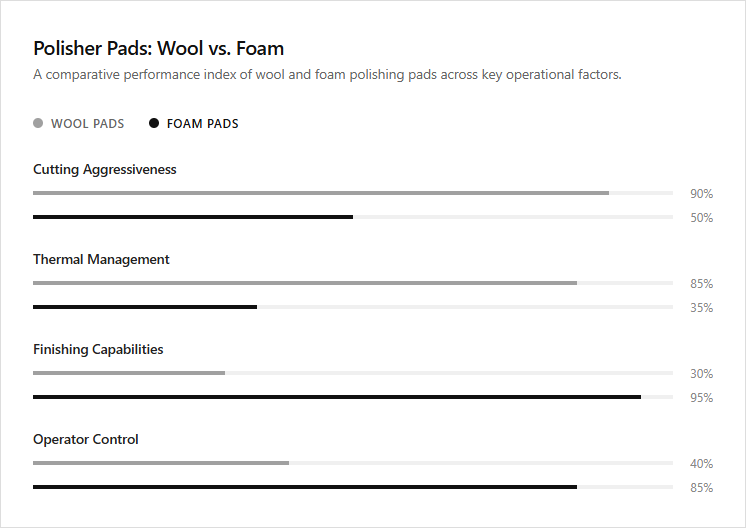
| Material Composition | Wool pads consist of natural or synthetic fibers that provide high mechanical abrasion, whereas foam pads utilize open-cell polyurethane structures to hold and distribute polishing compounds. |
| Cutting Aggressiveness | Wool pads offer rapid paint correction for deep scratch removal, while foam pads range from heavy-cutting to ultra-fine finishing profiles to allow for progressive surface refinement. |
| Thermal Management | The fibrous design of wool pads allows for better airflow to dissipate heat, whereas foam pads trap heat within their structure, which increases the risk of burning the clear coat. |
| Finishing Capabilities | Foam pads excel at high-gloss jeweling and removing holograms, whereas aggressive wool pads often leave micro-marring that requires a subsequent finishing step. |
| Operator Control | Foam pads conform easily to complex body panels, reducing the risk of rotational stalling when paired with a dual-action orbital polisher. |
Preventing Paint Strike-Through with Wool Pads
When performing heavy paint correction, selecting the appropriate polishing pad is critical for preserving the integrity of the clear coat. Wool pads excel in aggressive defect removal due to their natural fibers, which provide superior thermal dissipation compared to synthetic alternatives. This advanced heat management is essential during high-speed rotary compounding, as it prevents localized heat buildup and significantly reduces the risk of paint strike-through.
Foam pads restrict airflow and trap heat within their cell structure, making them more suitable for lower-speed dual-action polishing and delicate finishing steps. Experienced professional detailers tackling severe defects rely on the aggressive cutting power of wool pads, while hobbyists and refinishers aiming for a flawless, high-gloss finish utilize foam pads.
Aggressive Twisted Wool for Rapid Paint Correction
When selecting polishing pads, the choice between wool and foam determines the overall correction capability of the power tool. Wool pads, particularly those featuring twisted wool fibers, provide an aggressive mechanical cut to rapidly level deep paint defects and heavy sanding marks. The natural density of these fibers maximizes friction, making them highly efficient for the initial stages of heavy paint correction.
In contrast, foam pads offer a range of cell structures designed to distribute polish evenly, reducing heat and minimizing holograms during final finishing. Experienced restoration specialists requiring rapid defect removal benefit most from wool pads, while enthusiasts and detailers seeking a flawless, high-gloss finish are better suited to foam pads.
Foam Cell Structure Determines Absorption and Density
When selecting polishing pads, understanding material characteristics is essential for achieving optimal paint correction. Foam pads rely on their polyurethane cell structure, which directly determines the level of product absorption and overall pad density. Closed-cell configurations restrict compounds to the pad's surface for a more direct cut, while open-cell structures allow higher product absorption to facilitate smoother finishing and improved heat dissipation.
In contrast, wool pads utilize natural or synthetic fibers to provide aggressive, mechanical leveling of deep scratches. Wool pads are ideal for high-volume collision repair technicians requiring rapid, heavy defect removal, whereas foam pads are best suited for detailing enthusiasts and finishing specialists aiming for a swirl-free, high-gloss shine.
Foam Pads for a Hologram-Free, High-Gloss Finish
When restoring vehicle paint, selecting the correct polishing pad dictates the quality of the final result. Wool pads offer maximum cutting power to quickly level deep scratches and heavy oxidation, though this aggressive action frequently leaves behind fine compounding swirls and holograms that mar the paint's clarity.
To resolve these imperfections, transitioning to foam pads is essential. Foam pads are crucial for hologram elimination and achieving a brilliant, high-gloss finish after wool pad compounding. Their uniform cell structure allows for precise finishing, evenly distributing fine polishes to refine the paint surface to a mirror-like shine.
Wool pads are best suited for high-volume collision repair technicians needing rapid defect removal, whereas foam pads are ideal for precision detailers and enthusiasts demanding a flawless, showroom-grade finish.
How Wool Pads Minimize Rotational Friction
When selecting polishing pads for paint correction, understanding the physical interaction between the pad material and the vehicle surface is essential. Foam pads feature a flat, continuous contact area that generates heat through consistent friction, making them ideal for refining paint. In contrast, wool pads utilize individual, moving fibers that significantly reduce direct surface contact, which minimizes rotational friction and keeps the working temperature lower during aggressive cutting stages.
This reduction in friction allows wool pads to correct deep defects quickly without overheating the clear coat, while foam pads excel at leveling fine scratches and enhancing gloss. Professional detailers tackling severe paint defects and heavy oxidation will benefit most from the rapid leveling capabilities of wool pads, whereas enthusiasts and finishing specialists focusing on final-stage refinement should opt for foam pads.
Foam Pads Conform to Vehicle Curves for Even Pressure
When selecting polishing pads for automotive detailing, the choice between foam and wool significantly impacts the final finish. Foam pads excel in finishing phases due to their structural flexibility. They offer superior contour conformability, allowing even pressure distribution over complex vehicle curves and intricate body lines to prevent uneven paint wear.
Wool pads provide high-abrasive cutting power designed to rapidly remove deep scratches and heavy oxidation on flatter panels. Their dense fibers cut quickly but require careful technique to prevent compounding swirls.
Heavy-cut wool pads are best utilized by experienced technicians executing major paint restoration, whereas finishing foam pads are suited for detailers of all skill levels seeking a hologram-free, high-gloss shine.
How Capillary Action Controls Compound Release in Foam Pads
Selecting the appropriate pad for a power polisher is critical for achieving a flawless automotive finish. Foam pads are highly engineered for paint refinement, utilizing capillary action within their cellular pores to hold and systematically control the release of polishing compounds. This physical mechanism ensures a consistent, thin film of abrasive material remains between the pad and the paint surface, preventing premature drying and allowing for precise finishing work.
Conversely, wool pads leverage the natural abrasiveness of wool fibers to provide maximum cutting power, quickly leveling deep scratches and severe oxidation. While wool pads generate more heat and cut aggressively, foam pads offer the delicate touch required for final jeweling and hologram removal. Professional detailers tackling heavy paint correction rely on wool pads, whereas finishing specialists and enthusiasts aiming for a mirror-like gloss prefer foam pads.
Leave a comment