
Achieving a flawless, swirl-free finish during surface preparation is a notoriously frustrating challenge for refinishers and woodworkers alike, often derailed by subtle variances in tool performance. Before upgrading their arsenal, craftsmen typically evaluate traditional workshop power infrastructures, relying on standard electrical utility lines or pneumatic setups to support their finishing equipment.
However, selecting the optimal random orbital sander grants operators an immediate competitive edge in both ergonomic control and dust collection efficiency. It is important to stipulate, however, that even the highest-tier sander cannot compensate for incorrect grit progression or improper technique on delicate workpieces.
For example, high-volume cabinet makers require the relentless, uninterrupted output of traditional systems, whereas onsite trim carpenters benefit vastly from cordless portability. Below, we will analyze the critical trade-offs between corded and cordless random orbital sanders, evaluating power consistency, runtime, and maneuverability to help you make an informed decision for your workshop.
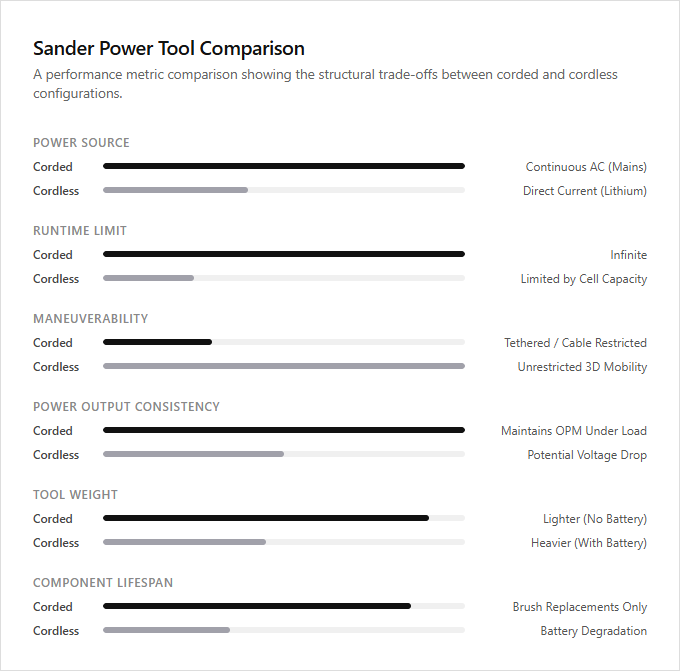
| Factor | Summary |
|---|---|
| Power Source | Corded sanders draw continuous alternating current (AC) from mains electricity, while cordless models rely on direct current (DC) from rechargeable lithium-ion battery packs. |
| Runtime Limit | Corded units offer infinite runtime for prolonged sanding sessions, whereas cordless sanders are strictly constrained by the milliampere-hour (mAh) capacity of their attached power cells. |
| Maneuverability | Cordless sanders excel in ergonomics and three-dimensional mobility because they lack a physical tether, whereas corded models can be restricted by cable length and potential snagging. |
| Power Output consistency | Corded sanders maintain a consistent rate of orbits per minute (OPM) under heavy load, while cordless sanders may experience voltage drop as the battery depletes. |
| Tool Weight | Corded sanders are typically lighter and reduce operator fatigue over time because they lack the heavy mass of an onboard battery pack. |
| Component Lifespan | Cordless sanders require periodic battery replacement due to electrochemical degradation cycles, whereas corded sanders mainly require occasional replacement of carbon brushes. |
Amperage vs. Voltage Decline in Material Removal Rates
Corded sanders rely on a continuous supply of alternating current, ensuring steady amperage delivery throughout operation. This constant power flow maintains a consistent material removal rate, allowing the motor to run at peak efficiency without torque drops during heavy-duty sanding sessions.
By comparison, cordless sanders experience a gradual decline in battery voltage as the charge depletes. This voltage drop directly reduces the tool's rotational speed and torque, progressively slowing the rate of material removal during extended use.
High-volume woodworkers requiring sustained power in a dedicated workshop benefit most from corded models, while mobile installers needing quick, agile maneuverability for onsite touch-ups are ideal candidates for cordless options.
Weight distribution and tool maneuverability determined by the power-to-weight ratio
Corded sanders offer an exceptional power-to-weight ratio because they lack a heavy onboard battery. With the weight concentrated primarily in the motor directly over the sanding pad, these tools provide highly stable, predictable pressure and effortless flat-surface maneuverability. The absence of battery bulk allows for a compact ergonomic design, reducing operator fatigue during prolonged vertical or overhead tasks.
Cordless sanders introduce a different dynamic, where the battery shifts the center of gravity upward or backward. While this alters the natural weight distribution, it eliminates cord drag, significantly enhancing free-roaming maneuverability in tight or awkward spaces. Modern cordless designs balance this offset with advanced ergonomics to maintain precise control without sacrificing power.
Constant-voltage corded models are ideal for workshop cabinetmakers requiring sustained, heavy-duty material removal, while agile cordless models best serve mobile contractors and DIYers prioritizing portability for quick, on-site touch-ups.
Sustained OPM vs. Electronic Speed Decay Under Load
Corded sanders excel in demanding sanding environments where sustaining high orbits per minute (OPM) is critical. Because they draw uninterrupted power directly from the electrical grid, these tools maintain their calibrated speed even under heavy downward pressure. Their variable electronic speed control resists performance decay, ensuring consistent material removal during prolonged operation.
In contrast, cordless sanders offer exceptional mobility but face inherent power limitations. Under heavy loads, battery-operated motors often experience voltage sag, resulting in a gradual decay of OPM as the battery drains or when resisting friction. Corded models are best suited for workshop professionals requiring continuous, high-volume stock removal, whereas cordless sanders are ideal for jobsite tradespeople who prioritize portability for quick touch-ups and remote installations.
Runtime limitations dictated by lithium-ion amp-hour (Ah) battery capacity
When selecting between corded and cordless sanders, power delivery and runtime are the primary differentiators. Corded sanders offer continuous, uninterrupted power, making them highly efficient for prolonged operations. In contrast, cordless models rely on lithium-ion batteries, where operational runtime is strictly dictated by the amp-hour (Ah) capacity. A standard 2.0Ah battery, while lightweight, depletes rapidly under the continuous resistance of sanding, requiring frequent recharges.
While higher capacity 5.0Ah batteries extend runtime, they add substantial weight, potentially causing user fatigue during detailed or overhead work. Corded sanders are ideal for high-volume workshop professionals needing constant power, whereas cordless sanders suit mobile contractors and DIYers prioritizing portability for quick, intermittent tasks.
Motor efficiency and heat dissipation optimized through brushless motor technology
When selecting between corded and cordless sanders, motor technology is a critical factor in performance longevity. Modern cordless sanders heavily leverage brushless motor technology, which eliminates carbon brushes to drastically reduce friction and internal heat generation. This engineering advancement ensures optimal energy conversion from the battery, allowing cordless models to deliver a highly efficient, consistent power output that closely rivals the relentless drive of traditional corded options.
Heat dissipation remains a key differentiator during extended operation. While corded sanders rely on continuous mains power and integrated fan systems to manage thermal loads over hours of use, cordless brushless units utilize intelligent electronic control boards to monitor temperatures and protect the battery cells from degradation. Stationary workshop professionals requiring uninterrupted runtime for heavy-duty stock removal benefit most from corded sanders, whereas mobile contractors and DIY enthusiasts seeking portability and precise control on diverse jobsites are better suited for cordless models.
Airflow and Pressure Requirements for Integrated Dust Ports
Corded sanders consistently deliver uninterrupted electrical power, allowing their integrated dust extraction ports to operate at peak efficiency. These tools maintain the high static pressure and continuous airflow velocity, often exceeding 4,000 feet per minute, necessary to pull fine dust and heavy debris through narrow onboard ports into external extraction systems without performance drops.
Cordless sanders must balance dust extraction efficiency with battery preservation. Because generating high static pressure demands significant energy, cordless models typically utilize optimized, lower-resistance ports designed for moderate airflow velocity to maximize runtimes while still capturing airborne particulates.
Corded models are ideal for high-volume woodworkers requiring continuous, maximum dust collection in a fixed workshop, whereas cordless sanders suit mobile contractors and installers prioritizing portability and quick cleanup on active jobsites.
Aggressiveness of surface preparation controlled by the orbit stroke diameter
Corded and cordless sanders differ significantly in how they maintain consistent power, which directly impacts surface preparation aggressiveness. The aggressiveness of a sander is heavily influenced by its orbit stroke diameter; larger diameters remove material rapidly, while smaller diameters yield a finer finish. Corded sanders deliver uninterrupted power, allowing the tool to maintain its maximum orbit stroke rate under heavy loads without stalling during intensive material removal.
In comparison, cordless sanders offer superior mobility but can experience a decline in orbital speed as the battery depletes, potentially reducing the efficiency of wider orbit strokes during demanding tasks. Professional woodworkers requiring sustained, high-volume stock removal often rely on corded models, while DIY enthusiasts and mobile installers prioritize cordless options for quick touch-ups and off-grid versatility.
Leave a comment