
Achieving a flawless, swirl-free finish while managing operator fatigue and escalating operational costs remains a persistent challenge in professional surface preparation. When balancing your capital expenditure budgets, navigating the technological divide between pneumatic and electric platforms often feels like a compromise. However, making the correct alignment grants facilities unprecedented duty-cycle longevity and consistent surface quality.
This operational advantage is subject to a vital stipulation: pneumatic systems demand a highly stable, dry compressed air infrastructure to realize their efficiency potential. For shops meeting this requirement, comparing industry benchmarks-such as the pneumatic Dynabrade Dynorbital against the electric Mirka DEROS-reveals how tooling selection directly impacts finish quality and throughput.
Below, we examine the critical distinctions between pneumatic and electric sanders, analyzing energy consumption, maintenance overhead, and ergonomic performance to guide your next procurement decision.
| Factor | Summary |
|---|---|
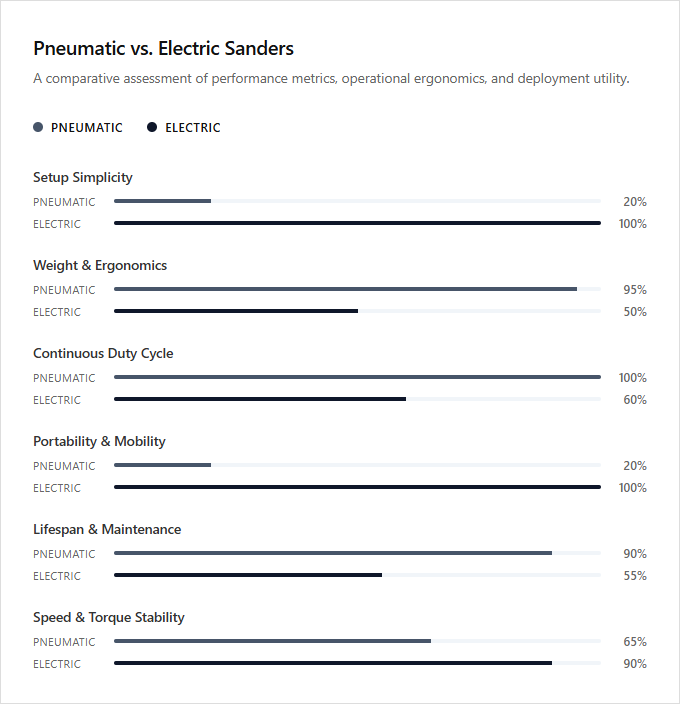
| Power Source | Pneumatic sanders rely on a compressed air system measured in cubic feet per minute (CFM), whereas electric sanders utilize alternating current (AC) or battery power to run an electric motor. |
| Weight and Ergonomics | Lacking a heavy internal motor, pneumatic sanders offer a superior power-to-weight ratio that reduces operator fatigue during extended operation. |
| Duty Cycle | Pneumatic sanders can run continuously without the risk of thermal overload because the expanding compressed air naturally cools the tool during operation. |
| Portability and Setup | Electric sanders provide immediate plug-and-play utility, whereas pneumatic sanders require a bulky air compressor unit and rigid pneumatic hoses that limit mobility. |
| Maintenance and Lifespan | Pneumatic sanders feature a simpler mechanical design requiring daily oil lubrication, while electric sanders require carbon brush replacements and are susceptible to electronic component failure. |
| Speed Control | Electric sanders utilize electronic speed control to maintain constant torque and revolutions per minute (RPM) under load, whereas pneumatic sanders regulate velocity via air throttle valves. |
Pneumatic Sanders: Maximum Power, Minimum Fatigue
When selecting surface preparation equipment, the choice between pneumatic and electric sanders hinges on operational efficiency and ergonomics. Pneumatic sanders excel by offering a superior power-to-weight ratio compared to electric models. Because they rely on an external compressed air source rather than a heavy internal motor, these tools remain remarkably lightweight while delivering high speed and torque. This physical advantage significantly minimizes operator fatigue during prolonged surface preparation tasks.
Electric sanders provide excellent portability and convenience, requiring no complex compressor infrastructure. Pneumatic models are highly suitable for high-volume industrial fabricators and automotive refinishers who require continuous, heavy-duty operation, whereas electric models are best suited for mobile contractors and woodworkers seeking portability and quick setup.
Brushless Sanders Maintain Consistent Speed Under Load
When selecting between pneumatic and electric sanders, power consistency and facility infrastructure are key considerations. Traditional pneumatic sanders rely on a stable compressed air supply, offering lightweight durability but requiring a robust compressor setup. Modern electric sanders utilizing brushless motor technology provide highly consistent orbits per minute under varying load conditions. This advanced electronic regulation maintains constant speed even when downward pressure is applied, ensuring a uniform surface finish.
While pneumatic models excel in continuous-duty industrial environments, electric options offer plug-and-play convenience. Pneumatic sanders are ideal for high-volume automotive collision technicians with established air systems, whereas brushless electric sanders are best suited for independent woodworkers and mobile refinishers who require precise speed control and portability.
Pneumatic Sanders: Safe for Volatile Refinishing Environments
When selecting between pneumatic and electric sanders, environmental safety and power sources are critical decision factors. Pneumatic sanders are intrinsically safe in volatile refinishing environments containing combustible dust or chemical solvent vapors. Because these units operate solely on compressed air rather than electricity, they eliminate the risk of internal electrical sparking that could otherwise ignite airborne hazards.
Electric sanders offer superior plug-and-play convenience and high energy efficiency without requiring an expensive air compressor infrastructure. Pneumatic models are highly recommended for industrial automotive refinishers operating in hazard-prone spray booths, whereas electric sanders are best suited for independent woodworkers and onsite contractors who require maximum portability and quick setup.
Pneumatic Tools Bypass Electric Sander Overheating Risks
When selecting industrial sanding equipment, the distinction between pneumatic and electric power sources centers on duty cycle limits. Pneumatic sanders operate via compressed air, allowing for a continuous duty cycle without the risk of overheating. In contrast, electric sanders rely on internal armatures and motors that generate significant heat during prolonged use, creating susceptibility to thermal overload and premature tool failure under heavy, uninterrupted workloads.
Because air-driven tools lack delicate electrical components, they remain cool to the touch even during multi-shift operations. This thermal resilience ensures consistent performance in high-production environments. Pneumatic sanders are best suited for high-volume industrial fabricators requiring continuous, all-day operation, while electric sanders are ideal for independent contractors and woodworkers who value mobility and plug-and-play convenience for intermittent tasks.
Pneumatic Rotary-Vane Motor CFM and Lubrication Requirements
Choosing between pneumatic and electric sanders requires a clear understanding of their respective power delivery systems. Pneumatic sanders utilize rotary-vane motors, which deliver an exceptional power-to-weight ratio but demand a continuous supply of clean, compressed air. To prevent premature vane wear and maintain peak torque, these pneumatic systems require high CFM capacity and reliable inline lubrication. Without consistent oiling and sufficient air volume, the internal vanes degrade, leading to a significant loss of operational efficiency.
Electric sanders offer plug-and-play convenience, running directly from standard wall outlets without the need for auxiliary air compressors. While they lack the continuous high-torque output of industrial pneumatic units under heavy loads, they require virtually no maintenance. High-volume industrial fabricators with dedicated air infrastructure benefit most from pneumatic sanders, while independent contractors and DIY enthusiasts are better suited to the portability of electric models.
Electric Sanders: Precise, Regulator-Free Speed Control
When selecting professional finishing equipment, the choice between pneumatic and electric sanders depends on your shop infrastructure and control preferences. Electric sanders utilize advanced electronic speed controllers for precise RPM adjustments without the need for external air regulators. This internal circuitry ensures consistent power delivery and allows operators to fine-tune speed settings directly on the tool, adapting instantly to different materials.
Conversely, pneumatic sanders rely on a constant supply of compressed air, requiring a dedicated compressor and air lines to function. While air-powered tools offer a superior power-to-weight ratio and cooler operation during extended use, they lack the self-contained electronic precision of their electric counterparts.
Pneumatic sanders are ideal for industrial manufacturers and automotive refinishers who require continuous, spark-free operation in dedicated booths, whereas electric sanders are best suited for cabinetmakers and mobile installers who demand precise speed control and easy portability across various jobsites.
Pneumatic Tool Exhaust Prevents Abrasive Disc Loading
When selecting between pneumatic and electric sanders, thermal management is a critical factor for surface integrity. Pneumatic sanders utilize compressed air, which naturally cools the tool during operation. This cool exhaust air is directed across the work surface, preventing thermoplastic loading on the abrasive disc when finishing heat-sensitive substrates. Conversely, electric sanders generate internal motor heat that can transfer to the workpiece, potentially melting sensitive materials and clogging the sandpaper.
Electric sanders offer excellent portability and consistent power without requiring a dedicated air compressor infrastructure. Pneumatic models are highly suited for industrial manufacturers requiring continuous, cool-running operation on delicate composites, whereas electric sanders are best for mobile contractors and independent woodworkers seeking versatile, plug-and-play performance.
Leave a comment