
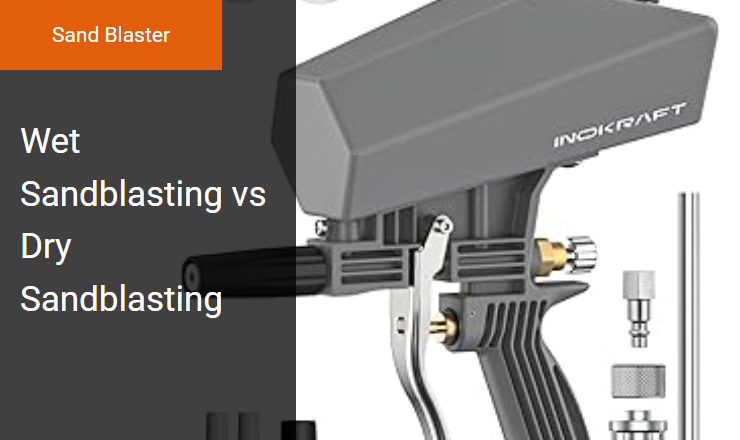
Achieving the perfect profile during surface preparation is a persistent challenge for industrial operators, who often struggle to balance aggressive rust removal with the risks of substrate warping and hazardous airborne dust. While standard equipment financing and workshop capital budgets typically limit operators to traditional dry-blasting setups, modern sandblasting technology offers highly adaptable alternatives.
Selecting the right sand blaster grants operators the ability to drastically reduce dust emissions and heat friction. However, this versatility comes with the strict stipulation that wet blasting systems require precise rust-inhibitor integration to avoid flash rusting. Industry applications demonstrate this balance, where techniques range from delicate automotive panel restorations to heavy-duty steel bridge descaling.
Below, we provide a comprehensive comparative analysis of wet versus dry sandblasting, detailing their respective mechanics, media compatibility, and ideal applications to help you optimize your blasting operations.
| Factor | Summary |
|---|---|
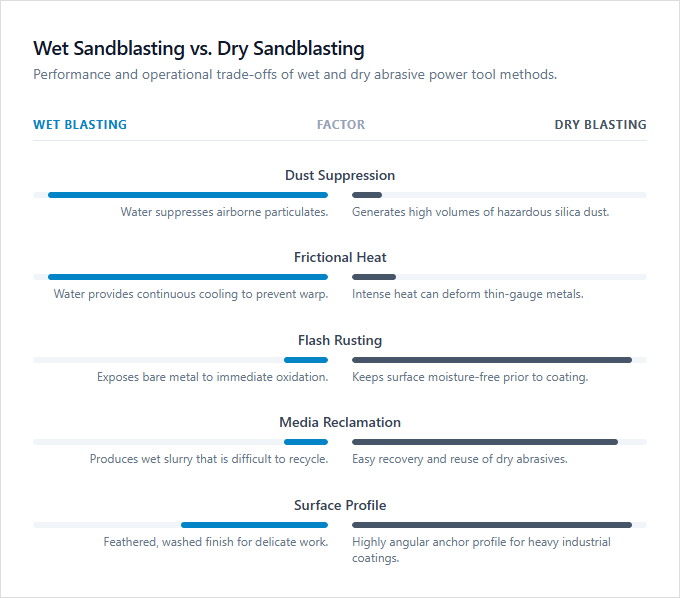
| Dust Suppression | Wet sandblasting utilizes a water-injection nozzle to suppress airborne particulates, whereas dry sandblasting generates high volumes of hazardous respirable crystalline silica. |
| Frictional Heat | The aqueous mixture in wet blasting provides continuous cooling to prevent substrate warping, while dry blasting generates intense frictional heat that can deform thin-gauge metals. |
| Flash Rusting | Wet sandblasting exposes bare metal to immediate oxidation, necessitating the application of flash rust inhibitors, whereas dry sandblasting keeps the surface moisture-free prior to coating. |
| Media Reclamation | Dry sandblasting allows for the easy recovery and reuse of abrasives via a media reclaimer, whereas wet blasting produces a wet slurry that is difficult to recycle. |
| Surface Profile | Dry blasting creates a highly angular anchor profile optimal for heavy-duty industrial coatings, while wet blasting produces a feathered, washed finish ideal for delicate restoration. |
Wet blasting suppresses fugitive dust emissions through water encapsulation
Choosing between wet and dry sandblasting depends on the operating environment and safety requirements. Wet sandblasting introduces water into the abrasive stream, which encapsulates the dust particles upon impact. This process successfully suppresses fugitive dust emissions, drastically improving visibility and reducing inhalation hazards on the job site without requiring complex containment systems.
Dry sandblasting relies solely on pressurized air and media, offering faster material removal but generating significant airborne particulates. Dry blasting is ideal for industrial facilities with dedicated containment systems and professional operators who require rapid surface preparation, while wet blasting is best suited for urban contractors and restorers needing to comply with strict environmental dust regulations.
Dry Blasting Causes Thermal Warping on Thin Substrates
Choosing between wet and dry sandblasting requires a careful assessment of the substrate material and project environment. Dry sandblasting is highly efficient for rapid material removal, but the intense friction between the abrasive media and the target surface generates significant thermal energy. On thin metal substrates or delicate components, this localized frictional heat can lead to severe thermal warping and surface distortion, compromising the structural integrity of the workpiece.
Wet sandblasting introduces water into the abrasive stream, which acts as a natural coolant and dust suppressant. This liquid barrier dramatically reduces surface temperatures, eliminating the risk of thermal deformation while providing a smoother finish. Dry blasting is ideal for industrial fabricators working on heavy-duty, thick steel structures, whereas wet blasting is best suited for automotive restorers and precision machinists handling delicate or thin-gauge metals.
Why Wet Blasting Requires Rust Inhibitors
Choosing between wet and dry sandblasting depends largely on the project environment and the material being treated. Dry sandblasting uses high-pressure air and abrasive media, generating significant dust but keeping the surface moisture-free. In contrast, wet sandblasting mixes water with the abrasive to suppress dust and reduce heat. Because water accelerates oxidation on ferrous metals, wet blasting requires the immediate application of post-treatment rust inhibitors to prevent flash rusting before a protective coating can be applied.
Each method serves specific operational needs based on the workspace. Dry blasting is best suited for industrial shop technicians with dedicated containment booths, while wet blasting is preferred by mobile restoration contractors and outdoor operators prioritizing dust control.
Dry Blasting Creates Deeper Industrial Coating Profiles
Selecting the proper abrasive blasting method depends heavily on the project's coating requirements. While wet blasting excels at dust suppression, dry sandblasting remains the superior choice for heavy-duty surface preparation. Specifically, dry blasting creates a deeper, more aggressive surface anchor profile, which is essential for the permanent adhesion of high-performance industrial coatings on steel and heavy machinery.
Wet blasting utilizes water to cushion the abrasive impact, effectively reducing friction heat and preventing substrate warping on delicate materials. Industrial contractors requiring maximum coating adhesion on heavy steel structures favor dry blasting, while restoration specialists operating in dust-sensitive or urban environments prefer the clean containment advantages of wet blasting.
Wet Blasting: Cushioned Media Impact
Wet sandblasting and dry sandblasting represent two distinct approaches to professional surface preparation. Wet blasting utilizes a pressurized hydro-abrasive slurry to cushion the media impact. This liquid envelope surrounds the abrasive particles, reducing friction and preventing heat buildup, which preserves the structural integrity of delicate substrates and eliminates the risk of metal warping.
Dry sandblasting relies entirely on high-velocity compressed air to propel dry abrasive media. This method delivers aggressive material removal and is highly effective for heavy rust, though it generates significant airborne dust. Dry blasting is suited for industrial technicians requiring rapid, heavy-duty stripping in open environments, while wet blasting is ideal for precision restorers and refinishers working on delicate components where dust suppression is critical.
Wet blasting eliminates hazardous electrostatic discharge in volatile environments
In industrial surface preparation, choosing between wet and dry sandblasting depends heavily on the working environment and safety requirements. Wet sandblasting introduces water into the abrasive stream, which drastically suppresses dust and eliminates hazardous electrostatic discharge. In volatile environments-such as chemical plants, refineries, or areas with combustible gases-this prevention of static sparks is critical to preventing catastrophic explosions.
Dry sandblasting offers high-velocity impact and rapid material removal, making it highly efficient for heavy-scale rust removal where water contamination must be avoided. Dry blasting is ideal for outdoor steel fabricators requiring rapid, high-volume rust removal, while wet blasting is best suited for safety-conscious technicians operating in spark-sensitive, hazardous environments.
Wet Blasting Removes Corrosive Salts From Substrates
When selecting a sandblasting method, the choice between wet and dry techniques significantly impacts the longevity of the finished substrate. Wet sandblasting introduces water into the abrasive stream, which suppresses dust and cools the surface. Crucially, wet blasting simultaneously washes away corrosive soluble salts from the substrate, preventing premature coating failure and ensuring a pristine, chemically clean surface.
In contrast, dry sandblasting relies purely on pressurized air and abrasive media to strip surfaces, making it highly effective for heavy paint and rust removal in controlled environments. Industrial operators requiring rapid, high-volume material removal on heavy steel structures typically opt for dry blasting, whereas marine and automotive restoration professionals prioritizing salt-free surface preparation are better suited for wet blasting.
Leave a comment