
Achieving perfectly dimensioned lumber is a constant struggle for woodworkers, often leading to wasted material and misaligned joinery. Traditionally, makers rely on sourcing expensive pre-surfaced (S4S) timber or spending hours hand-planing rough stock to size. However, investing in a dedicated thickness planer grants you complete control over your lumber inventory, unlocking massive cost savings by allowing you to mill rough-sawn wood yourself.
Before deciding, we must establish an important educational stipulation: a thickness planer excels at making opposing faces parallel, but it cannot flatten severely cupped boards without a jointing sled. Selecting the right machine-whether a portable benchtop model like the DeWalt DW735 or a heavy-duty stationary unit like a Grizzly 15-inch cabinet planer-defines your workshop's workflow and capabilities.
This comparison examines the critical differences between benchtop and stationary planers, analyzing footprint, power, and cutterhead designs to help you choose the ideal tool for precision dimensioning.
| Factor | Summary |
|---|---|
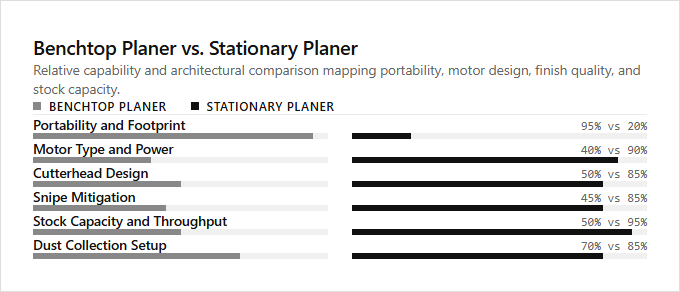
| Portability and Footprint | Benchtop planers feature a compact, lightweight design optimized for jobsite mobility, whereas stationary planers require a permanent workshop footprint due to their heavy cast-iron construction. |
| Motor Type and Power | Benchtop models typically utilize high-RPM universal motors that are brush-dependent, while stationary planers rely on quieter, continuous-duty induction motors driven by poly-V belts. |
| Cutterhead Design | While both types can use straight knives, stationary planers more commonly feature heavy-duty helical cutterheads with indexable carbide inserts for superior surface finish and noise reduction. |
| Snipe Mitigation | Stationary planers minimize board snipe through rigid cast-iron tables and robust feed rollers, whereas benchtop planers often require manual carriage locks to prevent cutterhead movement. |
| Stock Capacity and Throughput | Stationary planers offer wider cutterhead capacities and faster feed rates measured in feet per minute to handle high-volume timber processing. |
| Dust Collection | Benchtop planers often rely on integrated fan-assisted chip ejectors, while stationary planers require dedicated high-CFM dust collection systems connected to standard four-inch ports. |
Induction vs. Universal Motors in Planers
Benchtop planers typically utilize universal motors to maximize portability. These motors are lightweight and compact, enabling a smaller machine footprint, though they operate at high decibels and require regular brush maintenance under heavy use. In contrast, stationary planers employ heavy-duty induction motors. These brushless systems run significantly quieter, maintain consistent torque under load, and offer superior thermal efficiency for prolonged operation.
The structural differences between these motor designs dictate their optimal work environments and duty cycles. Portable benchtop models suit hobbyists and mobile contractors needing occasional dimensioning on the go, while stationary induction planers are ideal for professional woodworkers requiring continuous, high-volume daily production.
Helical cutterheads with indexable carbide inserts compared to straight-knife cutterheads
When choosing between a benchtop and a stationary planer, the cutterhead technology is a critical factor. Benchtop models often utilize traditional straight-knife cutterheads to maintain affordability and portability, whereas heavy-duty stationary planers frequently feature helical cutterheads with indexable carbide inserts.
Helical cutterheads cut wood at a shear angle, which significantly reduces noise, minimizes tear-out on figured grain, and decreases maintenance downtime because individual inserts can be rotated when dull. Straight-knife systems are simpler and less expensive initially, but they require precise, time-consuming alignment and complete replacement when nicked.
Benchtop planers with straight knives suit hobbyists seeking cost-effective, occasional wood dimensioning, while stationary planers equipped with helical heads are ideal for high-volume professionals requiring superior surface finishes and continuous operation.
Reducing Snipe with Cast Iron Structural Mass
During lumber dimensioning, snipe remains a persistent challenge directly mitigated by machine mass. Stationary planers excel here; their heavy cast iron beds and substantial structural weight absorb vibrations and maintain a rigid, unyielding feed path. Benchtop planers, prioritizing portability, feature lighter construction that can flex under heavy stock, increasing the risk of cutterhead movement and subsequent snipe.
The immense physical mass of a stationary unit dampens motor harmonics to ensure precise, flat cuts. In contrast, benchtop models rely on manual locking mechanisms to compensate for their lack of natural dampening. While the lightweight benchtop planer serves hobbyists and mobile contractors needing jobsite portability, the heavy stationary planer is the ideal investment for professional woodworkers requiring daily, high-volume precision.
Dual-speed gearboxes regulating feed rate in FPM (Feet Per Minute)
When selecting between benchtop and stationary planers, the integration of a dual-speed gearbox is a critical factor in material preparation. These gearboxes regulate the feed rate, measured in Feet Per Minute (FPM), to optimize surface finish quality. A faster FPM rate is highly efficient for rapid dimensioning, while a slower FPM rate increases the cuts-per-inch ratio, delivering an ultra-smooth finish that minimizes tear-out on figured hardwoods.
While benchtop planers offer dual-speed versatility in a portable footprint, stationary planers utilize heavy-duty multi-speed gearboxes paired with powerful induction motors for continuous, vibration-free operation. Benchtop models are ideal for DIY hobbyists and mobile contractors requiring jobsite portability, whereas stationary planers are best suited for professional woodworkers managing high-volume production and dimensioning thick, wide stock.
How Motor Horsepower Affects Duty Cycle
Benchtop planers typically feature universal motors ranging from 1.5 to 2 horsepower (HP). These smaller motors are designed for intermittent use, meaning their duty cycle is limited to prevent overheating during prolonged thicknessing operations on hard woods.
In contrast, stationary planers utilize heavy-duty induction motors, often starting at 3 HP and reaching 5 HP or more. This substantial increase in horsepower supports a continuous duty cycle, enabling the machinery to run constantly under heavy loads without thermal overload or performance degradation.
This variance in motor design directly dictates the volume of lumber a workshop can process daily. Lightweight benchtop models suit hobbyists and mobile carpenters with limited space and occasional surfacing needs, while stationary planers are designed for professional woodworkers and commercial shops requiring continuous, high-volume material removal.
Spring-loaded segmented infeed rollers versus solid rubber rollers
Stationary planers typically feature spring-loaded segmented infeed rollers. These metal rollers apply independent pressure across the width of the cutterhead, allowing operators to feed multiple boards of slightly varying thicknesses simultaneously without slippage. Conversely, benchtop planers generally utilize solid rubber rollers, which offer a non-marring grip on delicate surfaces but require uniform stock thickness for consistent feeding.
While segmented rollers provide the robust feed force necessary for heavy-duty lumber dimensioning, rubber rollers excel in finish-carpentry applications where preventing surface indentation is paramount. Stationary planers with segmented rollers are best suited for high-production woodworking shops processing rough lumber, whereas benchtop models with rubber rollers are ideal for hobbyists and contractors requiring portability and a mar-free finish on pre-surfaced stock.
Dust Hood Design and CFM Extraction Requirements
Benchtop planers typically feature integrated dust hoods with 2.5-inch or 4-inch ports. Because these compact machines generate a high volume of chips in a confined space, they require an external extraction system delivering a minimum of 400 CFM. Utilizing a dedicated dust collector rather than a standard shop vacuum is highly recommended to prevent internal clogging and maintain optimal surface finishes.
In contrast, stationary planers utilize heavy-duty, built-in 4-inch or 5-inch metal hoods designed for maximum aerodynamic airflow. Processing wider boards at faster feed rates requires a robust dust collection system capable of delivering at least 800 to 1,000 CFM to clear the massive volume of debris safely. Benchtop models suit hobbyists and mobile contractors prioritizing portability, while stationary units are ideal for dedicated professional woodworkers requiring continuous, high-volume production.
Leave a comment