
Achieving perfectly uniform board thickness without wasting valuable lumber or enduring hours of physical fatigue is a persistent challenge for woodworkers striving for seamless joinery. While standard workshop investments, such as heavy stationary jointer-planers, offer automated thicknessing, their high cost and massive footprint often force craftsmen to seek more versatile, handheld alternatives.
Selecting the appropriate handheld tool grants you the capability to achieve mill-spec precision on a fraction of the budget. However, as an essential educational stipulation, one must recognize that an electric planer is designed for rapid stock removal, whereas a manual bench plane is engineered for micro-tolerances. For example, flattening a twisted white oak slab requires a fundamentally different mechanical approach than shaving a cherry drawer front to a piston-fit finish.
Below, we examine the critical differences between electric and manual hand planers, analyzing speed, surface quality, and user control to help you determine the optimal tool for your thicknessing workflow.
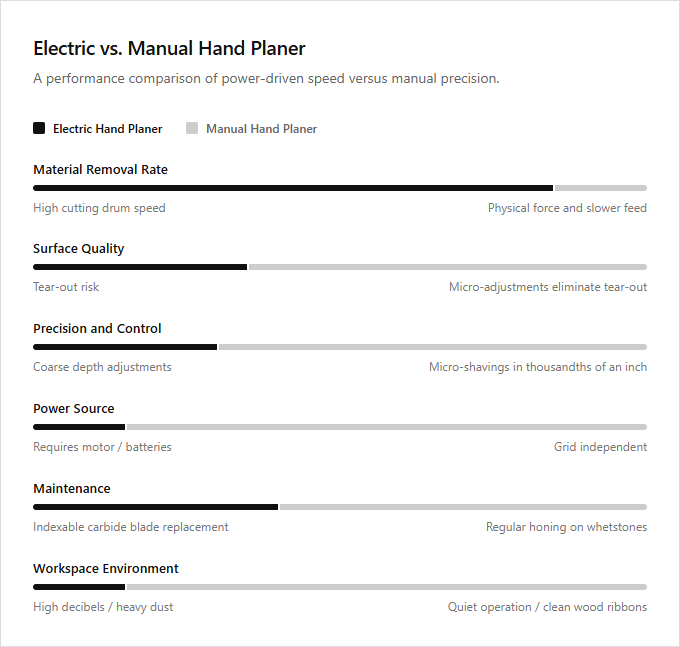
| Factor | Summary |
|---|---|
| Material Removal Rate | Electric hand planers maximize the material removal rate through high cutting drum rotational speed, whereas manual planers depend entirely on physical force and slower user feed rates. |
| Surface Quality | Manual hand planers utilize precise micro-adjustments of the mouth opening and chipbreaker to virtually eliminate wood tear-out, achieving a smoother finish than electric models. |
| Precision and Control | The sensitive lateral adjustment lever on manual planers allows for micro-shavings measured in thousandths of an inch, while electric planers rely on coarser, indexed depth-adjustment knobs. |
| Power Source | Electric planers require high motor wattages or lithium-ion batteries to drive the cutter head, whereas manual planers operate independently of any electrical power grid. |
| Maintenance | Maintenance for manual planers involves regular blade honing on whetstones, whereas electric planers frequently utilize indexable carbide-tipped blades that must be completely replaced when dull. |
| Workspace Environment | Electric planers generate high decibel levels and require an active dust collection port to manage wood shavings, while manual planers are quiet and produce easily manageable wood ribbons. |
Micro-depth adjustment mechanism vs indexable front shoe settings
Electric hand planers rely on indexable front shoe settings for depth control. This mechanism allows operators to quickly adjust the cutting depth via a stepped dial, making it highly efficient for rapid material removal and consistent leveling across large timber surfaces. While highly productive, these pre-set increments prioritize speed over minute calibration.
In contrast, manual hand planers utilize a micro-depth adjustment mechanism, often controlled by a threaded wheel or lever. This system permits incredibly precise, microscopic alterations to the blade projection, enabling the woodworker to shave paper-thin wisps of wood for a flawless, tear-out-free finish.
Electric planers with indexable shoes suit carpenters needing fast, repetitive dimensioning on construction sites, whereas manual planers with micro-adjustments are ideal for fine furniture makers requiring ultimate precision and surface control.
Rotary cutterhead RPM vs linear blade shearing angle
Electric hand planers utilize a high-speed rotary cutterhead, typically operating between 10,000 and 16,000 RPM. This rapid rotational speed allows the dual-blade system to make thousands of cuts per minute, quickly removing bulk material with minimal physical effort. While highly efficient for dimensioning and flattening large surfaces, the rotary action can sometimes leave minute scallop marks on the wood.
Manual hand planers rely on a single, stationary blade set at a precise linear shearing angle, usually between 45 and 60 degrees. This geometry shears wood fibers cleanly, producing a micro-smooth finish that often eliminates the need for subsequent sanding. Electric planers suit construction contractors needing rapid stock removal and framing adjustments, whereas manual planers appeal to fine furniture makers seeking precision joinery and flawless surface finishes.
Establishing True Reference Planes with Sole Plates
Establishing a true reference plane depends heavily on sole plate flatness and bed length. Manual jointer planers, with their precision-ground, exceptionally flat soles and long beds, excel at flattening warped stock by bridging high spots. Conversely, electric hand planers typically feature shorter shoe lengths and multi-piece sole configurations designed for rapid material removal rather than absolute flatness over long spans.
While the electric planer's adjustable front shoe allows quick depth changes, any misalignment between the front and rear plates can compromise precision on fine workpieces. Precision-oriented woodworkers and furniture makers rely on the manual planer for flawless jointing, whereas construction carpenters and renovators benefit most from the rapid, powerful stock removal of the electric planer.
Cap iron proximity adjustment for tearout mitigation on figured grain
Mitigating tearout on highly figured grain requires precise control over wood fibers during the cut. Manual hand planers excel in this area due to the micro-adjustability of the cap iron. Setting the cap iron extremely close to the cutting edge-often within 0.1 millimeters-forces the wood fibers to bend and break immediately upon cutting, preventing the splits from propagating downward into the figured grain.
In contrast, electric hand planers lack a traditional adjustable cap iron, relying instead on high-speed rotating cutterheads and shallow pass depths to minimize tearout. While this mechanical action is highly efficient, it offers far less precision when navigating wild, interlocked grain patterns. Manual planers are the choice for fine furniture makers executing precision surface preparation on figured hardwoods, whereas electric planers are ideal for general contractors and carpenters requiring rapid, high-volume stock removal.
Reversible tungsten carbide blades vs honable high-carbon steel plane irons
Electric hand planers leverage high-speed, reversible tungsten carbide blades designed for rapid material removal. These durable blades excel at flattening rough lumber and resizing doors, offering a plug-and-play solution where dull blades are simply flipped or replaced rather than sharpened. This system prioritizes efficiency and consistent performance in demanding construction environments.
Conversely, manual hand planers utilize honable high-carbon steel plane irons, which require traditional sharpening to achieve an ultra-sharp edge. This design allows for micro-adjustments and produces whisper-thin shavings, leaving an exceptionally smooth finish that electric alternatives cannot replicate. Professionals seeking rapid stock removal and job-site speed benefit most from the electric planer, while fine woodworkers and furniture makers requiring precision control and flawless finishes are best suited for the manual hand planer.
Rapid material removal rate vs micro-shaving thickness tolerance control
Electric hand planers excel in rapid material removal, making them highly efficient for dimensioning rough lumber and flattening wide boards. Equipped with high-speed rotating cutterheads, these power tools effortlessly hog off large quantities of wood in a single pass, significantly reducing labor during heavy-duty construction projects.
Manual hand planers, by comparison, provide superior micro-shaving thickness tolerance control. These precision instruments allow woodworkers to shave off whisper-thin wood ribbons down to thousandths of an inch, achieving glass-smooth surfaces and perfect alignment without the risk of gouging or tear-out.
The high-power electric planer is best suited for framing contractors and carpenters focused on fast stock reduction, while the manual planer remains the tool of choice for fine furniture makers and luthiers requiring absolute precision and flawless joinery.
Adjustable mouth opening vs fixed aperture chip clearance
Manual hand planers often feature an adjustable mouth opening, allowing operators to precisely control the throat width. Narrowing this aperture minimizes tear-out on highly figured wood by supporting the wood fibers immediately before the cutting edge, though it requires careful calibration to prevent shaving buildup.
Electric hand planers utilize a fixed-aperture chip clearance system optimized for high-speed material removal. This non-adjustable opening prevents clogging by allowing waste to exit rapidly through a dedicated ejection chute, sacrificing fine tear-out control for sheer operational efficiency.
Fine furniture makers requiring precision surface finishes benefit from the manual planer's adjustable mouth, whereas carpenters and renovators focusing on rapid stock removal are ideal candidates for the electric planer's high-capacity fixed clearance.
Leave a comment