
Achieving a flawless, swirl-free finish is a notoriously frustrating challenge for automotive detailers. Choosing between a rotary and a dual-action (DA) polisher often leads to costly analysis paralysis, risking either permanent clear-coat burn-through or underwhelming paint correction results.
Traditionally, shops rely on hand-polishing or low-power orbital waxers as their baseline equipment investments. However, these entry-level approaches quickly hit a ceiling when confronting deep defects. Upgrading to a professional machine grants you the precise control needed to level imperfections and restore deep, reflective gloss efficiently. Still, we must stipulate that even the most advanced tool requires a firm understanding of paint temperature, pad pairing, and downward pressure to avoid damage.
Using industry benchmarks like the Flex PE14 Rotary and the Rupes LHR21 Dual Action as our guides, this article will compare cutting power, safety thresholds, and user learning curves to help you select the ideal polisher for your workflow.
| Factor | Summary |
|---|---|
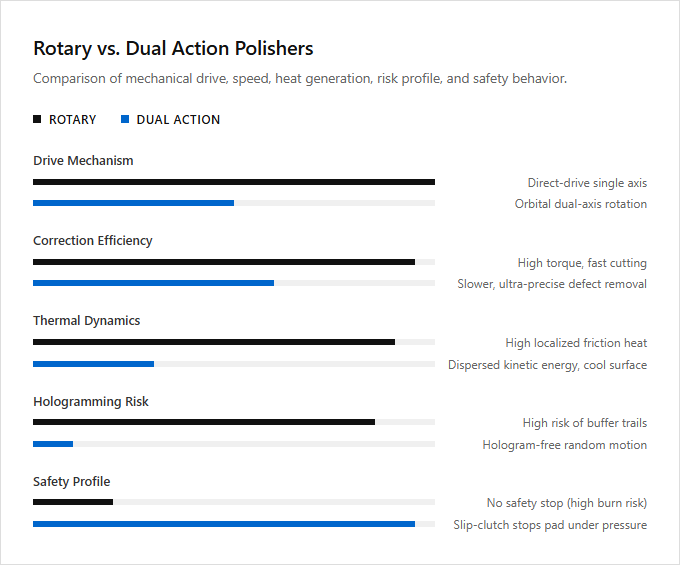
| Drive Mechanism | Rotary polishers utilize a direct-drive spindle to spin the pad on a single axis, whereas dual-action polishers feature an orbital mechanism that rotates and oscillates simultaneously. |
| Correction Efficiency | Rotary machines deliver high torque for rapid paint correction and heavy compounding, while dual-action polishers are slower but safer when removing paint defects. |
| Thermal Dynamics | The concentrated friction of a rotary tool generates significant localized heat, whereas the dual-action orbital pattern distributes kinetic energy to maintain cooler surface temperatures. |
| Hologramming Risk | Rotary polishers can easily leave micro-marring or buffer trails if handled improperly, while dual-action polishers naturally produce a hologram-free finish due to their random motion. |
| Safety Profile | Dual-action polishers feature a safety slip-clutch effect that stops pad rotation under excess pressure, unlike rotary polishers which will continue spinning and can quickly burn through the clear coat. |
Rotary (Circular) vs. Dual Action (Orbital) Polishers
Rotary polishers operate using a direct-drive circular rotation, where the pad spins rapidly on a single, fixed axis. This direct mechanical connection delivers high torque and generates significant heat, making the tool highly efficient for rapid paint correction and heavy defect removal. In contrast, dual action polishers utilize orbital oscillation, combining a central rotation with a secondary orbital path to distribute friction evenly and minimize the risk of paint damage.
Selecting the right machine depends entirely on your technical expertise and project goals. Rotary polishers are best suited for seasoned collision repair professionals requiring aggressive cutting power, while dual action polishers are ideal for DIY enthusiasts seeking a safe, forgiving tool for regular vehicle maintenance and finishing.
Rotary Polishers Risk Clear Coat Strike-Through
When selecting a paint correction machine, understanding the mechanical differences between rotary and dual-action polishers is essential. Rotary polishers spin on a single axis, generating rapid, concentrated friction heat. While this direct drive action delivers powerful cutting capabilities to eliminate deep scratches, it presents a significant risk of clear coat strike-through. Without precise technique, the intense heat can quickly burn through the paint's protective layer, causing permanent damage.
Dual-action polishers mitigate this hazard by combining spinning and oscillating movements. This dual motion distributes heat across a wider area, drastically reducing the risk of paint damage. Because of these distinct operational profiles, rotary units are best suited for experienced collision repair professionals undertaking heavy correction, while dual-action polishers are ideal for enthusiasts and detailers seeking a safer, user-friendly tool for general paint refinement.
How Dual Action Polishers Prevent Paint Damage
Choosing between a rotary and a dual-action (DA) polisher is a critical decision in automotive paint correction. Rotary polishers feature a direct-drive, fixed rotation that delivers high cutting power but carries a risk of burning through clear coats. In contrast, dual-action polishers employ an oscillating motion alongside a free-spinning rotation. This design prevents paint damage because the pad stalls and stops rotating when excess pressure is applied, eliminating dangerous friction and heat buildup.
This fundamental difference in safety and power dictates user compatibility. Rotary polishers are best suited for experienced professionals tackling severe defects, while dual-action polishers are ideal for enthusiasts and beginners seeking a forgiving tool for safe swirl removal.
Rotary Polishers: Faster Removal of Deep Paint Defects
When selecting a paint correction power tool, understanding the operational differences between rotary and dual-action polishers is essential for achieving optimal results. Rotary polishers operate on a single axis of rotation, concentrating heat and friction to deliver an aggressive cutting action. This direct drive mechanism offers a significantly faster paint defect removal rate, making rotary machines highly effective for eliminating deep scratches, heavy swirl marks, and severe paint oxidation.
In contrast, dual-action polishers combine rotation with an orbital oscillation, distributing heat more evenly across the surface to minimize the risk of paint burn-through. Rotary polishers are best suited for experienced automotive refinishing professionals who require rapid correction on severely damaged clear coats, while dual-action polishers are ideal for hobbyists and detailing beginners seeking a safer, more forgiving tool for light to moderate paint enhancement.
Why Rotary Polishers Require Secondary Refinement
Rotary polishers operate on a direct, single axis of rotation, providing high cutting power for rapid defect removal. This intense, concentrated friction makes rotary machines highly prone to leaving holograms and buffer trails. These microscopic circular scratches typically require a secondary refinement step with a finer pad and compound to achieve a flawless finish.
Dual-action polishers combine rotation with an orbital oscillation, distributing heat and pressure more evenly across the paintwork. This random orbital movement prevents paint burn-through and hologram creation, ensuring a safer application. Rotary polishers are best suited for experienced restoration professionals who require maximum cutting power, whereas dual-action polishers are ideal for detailing enthusiasts and beginners seeking a forgiving, high-quality finish.
How Orbit Throw Affects Polisher Coverage
Selecting the right polishing tool requires a clear understanding of the mechanical differences between rotary and dual action (DA) machines. While rotary polishers spin on a single axis to generate direct friction, dual action polishers employ an orbital motion. A dual action polisher relies on its orbit throw, measured in millimeters, to determine its cutting power and finishing coverage. A larger throw, such as 15mm or 21mm, covers more surface area for faster defect removal, whereas a shorter throw provides the precise control needed for tight curves and intricate panels.
In contrast, rotary polishers deliver continuous, high-torque rotation that corrects severe paint defects quickly but increases the risk of paint burn. Rotary polishers are best suited for experienced collision repair technicians who require rapid, heavy-duty paint correction, while dual action polishers are ideal for detailing enthusiasts and refinishing professionals seeking a safer, user-friendly tool for flawless finishing.
Dual Action Polishers for Swirl-Free Paint Jeweling
In the automotive detailing industry, selecting the appropriate polishing tool is critical for achieving optimal paint correction. Rotary polishers feature a direct, fixed-axis rotation that delivers high cutting power, making them highly efficient at removing deep scratches and severe paint defects. Conversely, dual-action polishers combine rotation with an orbital motion, distributing heat and pressure more evenly across the surface to prevent paint damage.
Because of this oscillating movement, dual-action polishers excel at ultra-fine paint jeweling to achieve a completely swirl-free finish. This precise action eliminates holograms and allows the clear coat to reach its maximum reflective potential safely. Rotary units are best suited for experienced collision repair professionals requiring rapid, heavy defect removal, while dual-action polishers are ideal for both hobbyists and detailing specialists seeking a safer, flawless finishing tool.
Leave a comment