
Woodworkers often struggle with warped, twisted, or cupped boards that compromise joinery precision and ruin final assemblies. Achieving flat faces and perfectly square 90-degree edges is a constant challenge in the shop. While many makers initially rely on costly pre-milled lumber or slow, makeshift router sleds, these standard methods ultimately limit your efficiency and design freedom.
Transitioning to a dedicated shop jointer grants you absolute control over stock preparation, unlocking the ability to purchase budget-friendly rough-sawn lumber. However, we must stipulate that a jointer's utility is strictly bound by its physical limits; choosing an incorrect bed length or cutterhead width can bottleneck your workflow. For example, flattening wide walnut slabs for a dining tabletop demands significantly more capacity than edge-jointing narrow oak stiles for cabinet doors.
To help you make the right investment, this article compares 6-inch and 8-inch jointers. We will analyze the critical differences in cutterhead capacity, bed length, and motor power, providing a clear roadmap to the best machine for your specific face-flattening and edge-jointing needs.
| Factor | Summary |
|---|---|
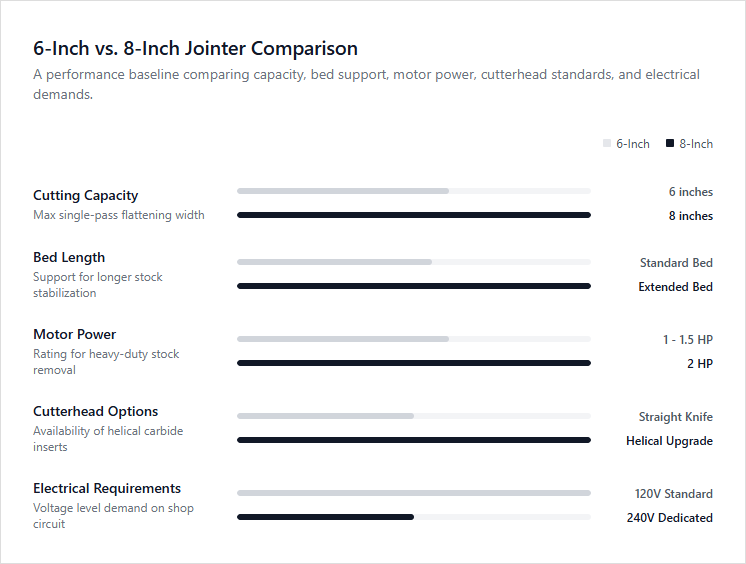
| Cutting Capacity | An eight-inch jointer provides greater cutting capacity than a six-inch model, allowing users to flatten wider face-grain stock in a single pass. |
| Bed Length | Eight-inch machines feature longer cast-iron infeed and outfeed tables to better support extended workpieces and prevent snipe. |
| Motor Power | Six-inch jointers usually utilize a 1 to 1.5 horsepower motor, whereas eight-inch models upgrade to a 2 horsepower induction motor for heavy-duty stock removal. |
| Cutterhead Options | Both sizes offer straight knives, but eight-inch models more frequently implement a helical cutterhead with carbide inserts for a smoother finish on figured wood. |
| Electrical Requirements | While a six-inch jointer runs on standard 120V household current, an eight-inch jointer typically requires a dedicated 240V single-phase power supply. |
Maximum cutting width capacity for face flattening
When selecting a jointer for face flattening, the maximum cutting width capacity is the defining performance metric. A six-inch jointer offers a compact and accessible solution, limiting the user to flattening boards up to six inches wide. This restriction often requires woodworkers to pre-rip wider stock or use alternative flattening methods for larger panels.
An eight-inch jointer increases face-flattening capacity by over thirty percent, allowing the processing of wider boards. This extra width preserves the natural grain continuity of the wood and generally comes with a longer bed, which provides superior stability when milling heavy stock.
The six-inch model serves hobbyists and DIY enthusiasts working on smaller crafts, while the eight-inch machine is ideal for professional cabinetmakers and serious woodworkers who regularly mill wide rough-sawn lumber.
Infeed and outfeed table length for edge jointing long stock
When edge jointing long lumber, the primary differentiator between six-inch and eight-inch jointers is the physical length of the infeed and outfeed tables. Six-inch models typically feature shorter beds, often ranging from 46 to 56 inches, which safely support stock up to approximately twice the bed length. In contrast, eight-inch jointers boast significantly longer beds, frequently exceeding 70 inches, providing the critical registration surface required to prevent sagging and ensure perfectly straight edges on long, heavy boards.
The extended bed of an eight-inch jointer offers superior stability, making it much easier to achieve flat, true edges on stock exceeding six feet in length without relying on awkward external roller stands. The compact six-inch jointer is best suited for hobbyists and DIYers working on smaller furniture projects in limited workshop spaces, while the robust eight-inch model is ideal for professional woodworkers and commercial cabinetry shops regularly processing long, heavy, rough-cut lumber.
Motor horsepower and voltage requirements
When comparing six-inch and eight-inch jointers, motor horsepower and electrical requirements represent the most critical technical distinctions. Six-inch models typically feature 1 to 1.5 horsepower motors designed to operate on standard 110V or 120V household outlets, making them highly convenient for standard workspaces. Conversely, eight-inch jointers require more robust performance, generally utilizing 2 to 3 horsepower motors that demand a dedicated 220V or 240V electrical circuit to handle the increased load during operation.
The choice between these two power profiles dictates the overall capacity and efficiency of your woodworking setup. The accessible six-inch jointer is ideal for hobbyists and DIY enthusiasts working on standard furniture projects in residential garages, whereas the heavy-duty eight-inch jointer is best suited for professional craftsmen and high-production commercial shops processing wide, dense lumber.
Helical cutterhead versus straight knife options
Choosing between a six-inch and an eight-inch jointer involves balancing capacity with cutterhead technology. Six-inch models are compact and highly accessible, often utilizing traditional straight knives that are economical but require precise manual alignment. Larger eight-inch jointers provide the necessary bed length and stability for substantial stock, and they frequently feature helical cutterheads. These helical heads employ indexable carbide inserts that shear wood fibers at an angle, significantly reducing noise and tearout.
While straight knives offer a lower initial cost, helical cutterheads deliver superior surface finishes and simplified maintenance. Budget-conscious hobbyists working primarily with narrow softwoods typically find the six-inch straight-knife jointer sufficient, whereas professional furniture makers and production shops require the heavy-duty capacity and flawless finish of an eight-inch helical machine.
Parallelogram bed design for table adjustment
When selecting between a six-inch and an eight-inch jointer, the table adjustment mechanism dictates long-term accuracy. Modern high-end models in both capacities employ a parallelogram bed design. This setup allows the tables to adjust along a pivoting arc, maintaining a constant, minimal gap between the table lip and the cutterhead. This alignment ensures safer operation, smoother cuts, and easier calibration than traditional wedge-bed alternatives.
The primary distinction lies in bed length and cutting width capacity. The compact six-inch jointer suits hobbyists and DIY enthusiasts working with smaller lumber in limited workshop spaces, whereas the heavier eight-inch jointer is the standard choice for professional woodworkers and production shops requiring the capacity to flatten wide, heavy hardwood boards.
Cast iron fence length and stability
When selecting between a six-inch and an eight-inch jointer, the dimensions and stability of the cast iron fence are critical factors. An eight-inch jointer typically features a significantly longer and taller cast iron fence compared to its six-inch counterpart. This added physical mass and length provide superior stability and vibration dampening, ensuring highly precise 90-degree edge jointing over longer workpieces.
While six-inch jointers offer rigid fences suitable for standard workshop tasks, they can struggle with the leverage exerted by heavy, oversized timber. The robust fence mounting systems on eight-inch models minimize deflection, maintaining absolute squareness during heavy passes. Casual hobbyists working on smaller furniture projects will find the compact six-inch jointer ideal, whereas professional furniture makers handling long, heavy lumber require the superior capacity and stability of the eight-inch model.
Total machine footprint and weight for workshop stability
A six-inch jointer features a compact footprint and lighter weight, making it highly mobile and suitable for smaller workshops where floor space is at a premium. In contrast, an eight-inch jointer is a heavy-duty machine with a substantially larger cast-iron bed and a robust cabinet base, offering superior vibration damping and workshop stability during operation.
The increased mass of the eight-inch model ensures the machine remains completely stationary when processing dense hardwood stock, while the lighter six-inch version is easier to maneuver but offers less resistance to heavy feed forces. The mobile six-inch jointer is ideal for hobbyists and weekend DIYers with limited garage space, whereas the heavy eight-inch machine is best suited for professional woodworkers managing high-volume, wide timber projects.
Leave a comment