
Achieving a perfectly flat, tearout-free face on highly figured hardwood is a persistent challenge for woodworkers relying on traditional straight-knife jointers. While standard high-speed steel (HSS) replacements and tedious magnetic alignment jigs are the traditional methods for maintaining cut quality, they require frequent, time-consuming calibration.
Upgrading to a segmented cutterhead grants a flawless, shear-cut surface finish and a significantly quieter workshop environment. However, this upgrade requires a clear stipulation: the higher initial cost of these heads must be balanced against the long-term savings of rotatable carbide inserts. Industry-proven upgrades like the Byrd Shelix or Grizzly helical heads demonstrate the immense value of this investment for both hobbyists and professionals.
Below, we will break down the engineering distinctions between spiral and true helical cutterheads, evaluate their cutting angles, and guide you through selecting the ideal upgrade for your workshop.
| Factor | Summary |
|---|---|
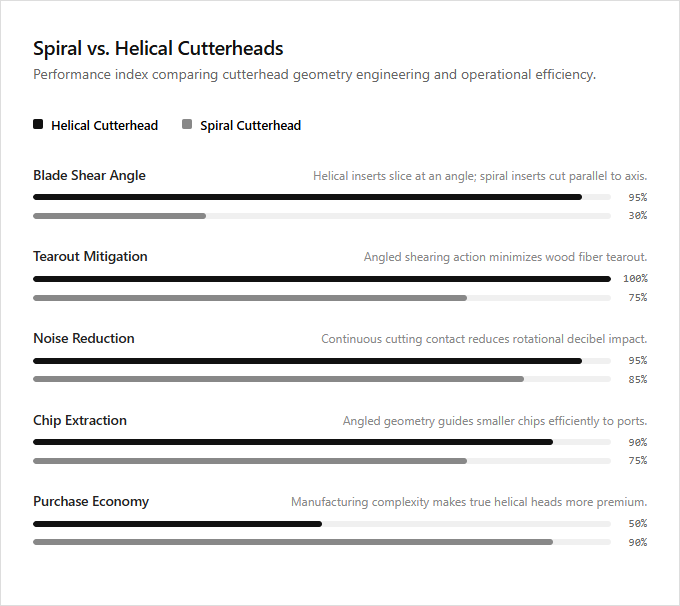
| Blade Alignment | Helical cutterheads feature indexable carbide inserts positioned at a shear angle relative to the workpiece, whereas spiral cutterheads align their inserts parallel to the cutterhead axis. |
| Cutting Action | The progressive shearing action of angled helical inserts slices wood fibers gradually to minimize tearout, whereas spiral inserts make a more direct, perpendicular contact with the wood. |
| Noise Emission | Both configurations dramatically reduce decibel levels compared to straight knives, but helical designs are slightly quieter due to continuous, non-interrupted cutter contact. |
| Chip Extraction | The helical spiral pattern optimizes waste clearance by producing smaller, uniform wood chips that easily pass through standard dust collection ports. |
| Maintenance and Tooling | Both systems utilize four-sided indexable carbide inserts that can be individually rotated when dulled, eliminating the downtime associated with grinding and jointing traditional high-speed steel knives. |
| Initial Cost | True helical cutterheads command a higher retail premium than standard spiral cutterheads due to the complex precision machining required for the angled insert seats. |
Helical Cutterheads Deliver True Shear Angles
When selecting a jointer, understanding the distinction between spiral and helical cutterheads is essential for achieving optimal stock preparation. While spiral cutterheads feature inserts aligned parallel to the cutterhead axis, helical cutterheads position their carbide inserts at a true shear angle relative to the feed direction of the wood. This angled orientation allows each cutter to slice through wood fibers progressively rather than chopping them straight on, which significantly reduces tear-out on challenging wood grain and lowers noise levels during operation.
This slicing motion of the helical design also requires less horsepower and produces a superior finish on highly figured hardwoods. Traditional spiral cutterheads offer a valuable upgrade over straight knives, providing clean cuts on straight-grained lumber at a more accessible price point. Budget-conscious hobbyists working primarily with standard softwood and hardwood species typically benefit from the value of spiral cutterheads, whereas professional woodworkers requiring flawless finishes on highly figured exotic grains require the precision of helical cutterheads.
How Helical Inserts Prevent Figured Hardwood Tear-Out
When upgrading a jointer, choosing between a spiral and a helical cutterhead significantly impacts machining quality. While both utilize indexable carbide inserts, a helical cutterhead positions these inserts at a shear angle relative to the workpiece. This specific alignment creates a continuous slicing motion rather than a straight-on chopping cut. The slicing action of helical inserts is highly effective at preventing grain tear-out on figured hardwoods, yielding an exceptionally smooth finish on complex grain patterns.
Standard spiral cutterheads feature inserts aligned perpendicular to the cutterhead rotation, which perform well but can struggle with highly figured timber. Standard spiral jointers are highly suitable for DIY hobbyists working primarily with straight-grained utility woods, whereas helical cutterheads are the preferred choice for professional furniture makers and craftsmen demanding flawless results on premium, highly figured hardwoods.
Four-Sided Indexable Carbide Inserts
Both spiral and helical cutterheads represent a significant advancement over traditional straight-knife jointers, primarily due to their use of four-sided indexable carbide inserts. When a single insert becomes dull or nicked, woodworkers can individually rotate that specific cutter 90 degrees to expose a fresh, razor-sharp edge. This design minimizes machine downtime and eliminates the tedious task of aligning long, traditional knives.
While both systems utilize these indexable inserts, the key difference lies in the blade orientation. Spiral cutterheads align the carbide teeth straight along the head, whereas helical cutterheads position them at a slight shear angle to slice progressively through wood fibers. Standard spiral cutterheads are highly suitable for budget-conscious DIYers seeking low-maintenance operation, while helical cutterheads are ideal for professional woodworkers requiring ultra-smooth finishes on highly figured or difficult hardwoods.
Staggered insert configurations significantly reduce overall decibel output during operation.
When upgrading a jointer, choosing between spiral and helical cutterheads often comes down to noise and surface quality. Both designs employ indexable carbide inserts that replace traditional straight knives. The staggered insert configurations significantly reduce overall decibel output during operation. By making sequential, interrupted cuts rather than a single continuous impact, these cutterheads eliminate the harsh scream of traditional jointers, creating a much quieter workshop environment.
While spiral heads align teeth perpendicular to the board, helical cutterheads seat inserts at an angle for a true shearing cut. Helical cutterheads are suited for professional woodworkers handling highly figured hardwoods daily, while spiral cutterheads are perfect for serious hobbyists seeking quiet operation and easy maintenance on a budget.
Optimized Cutterhead Geometry Prevents Dust Port Clogging
When selecting a jointer, the distinction between spiral and helical cutterheads lies primarily in their insert alignment and the resulting chip evacuation efficiency. Spiral cutterheads feature rows of inserts wrapped around the head, while helical cutterheads position the carbide inserts at a slight shear angle. This angled geometry optimizes the cutting motion, shearing the wood fibers smoothly and generating smaller, more uniform wood chips.
This advanced helical design significantly improves chip evacuation, allowing debris to flow effortlessly into the extraction system without packing together. Standard spiral configurations can sometimes produce larger shavings that risk clogging the dust port during heavy stock removal. Helical cutterheads are best suited for high-volume woodworking professionals requiring maximum efficiency and minimal downtime, while spiral cutterheads are ideal for serious hobbyists seeking a significant upgrade over traditional straight knives.
Continuous Cutting Minimizes Joint Scallop Height
When upgrading a jointer, choosing between a spiral and a helical cutterhead significantly impacts the finished surface quality of your lumber. True helical cutterheads feature inserts aligned at an angle to the feed direction, creating a slicing shear cut. This continuous cutting engagement minimizes scallop height on the jointed workpiece, yielding an exceptionally smooth surface that requires minimal sanding. In contrast, standard spiral cutterheads arrange their teeth straight across the cutterhead axis, which can result in slightly more pronounced scallop marks.
Both options drastically reduce noise levels and simplify maintenance compared to traditional straight knives. Budget-conscious hobbyists seeking a massive upgrade in efficiency and ease of maintenance will find the spiral cutterhead highly capable, while professional furniture makers working frequently with highly figured hardwoods will benefit most from the flawless, tear-out-free performance of a true helical system.
Shear-Cutting Design Reduces Motor Load and Amperage
When comparing spiral and helical cutterheads for jointers, the primary distinction lies in the alignment of the carbide inserts. Helical cutterheads feature inserts angled relative to the workpiece, creating a true shear cut. This slicing motion allows the tool to engage the wood gradually rather than striking the entire width at once. This shear-cutting design reduces motor resistance and amperage draw during stock removal, which prolongs motor life and ensures smoother operation under heavy loads.
Spiral cutterheads, while also utilizing segmented carbide inserts, typically align them straight across the head. Both options offer significant noise reduction and easier maintenance compared to traditional straight-knife jointers. High-volume woodworkers requiring flawless finishes on figured grain benefit most from the advanced shear of helical cutterheads, whereas budget-conscious DIY enthusiasts seeking a durable, low-maintenance upgrade will find the spiral cutterhead highly suitable for standard square-up tasks.
Leave a comment