
Selecting the wrong rotary hammer system often leads to stalled jobsite progress, premature tool failure, and wasted labor. Contractors and masonry professionals frequently struggle to balance tool weight with the raw impact energy required for heavy concrete penetration.
While standard equipment budgets and traditional procurement channels typically favor buying one-size-fits-all machinery, optimizing your fleet requires a more strategic approach. Investing in the correct interface grants operators maximum drilling efficiency and significant long-term cost savings.
As an important educational stipulation, however, these two systems are physically incompatible; choosing incorrectly will halt work immediately. For instance, using a heavy-duty Bosch SDS Max rotary hammer to drill light 1/4-inch anchor holes is as inefficient as demanding a compact SDS Plus unit to core-drill a 3-inch pipe penetration.
In this guide, we will analyze the key differences in shank design, impact energy, and application capacity to help you select the ideal concrete tool for your specific drilling demands.
| Factor | Summary |
|---|---|
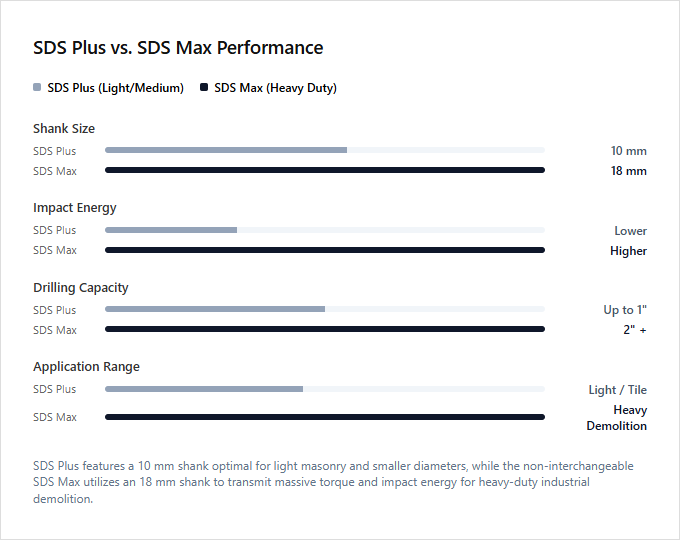
| Shank Size | SDS Plus utilizes a 10 mm shank with two open and two closed grooves, whereas SDS Max features an 18 mm shank designed for heavy-duty torque transmission. |
| Impact Energy | SDS Max hammers deliver significantly higher impact energy, measured in Joules, compared to the lower electro-pneumatic output of SDS Plus rotary hammers. |
| Drilling Capacity | SDS Plus is optimized for drilling smaller holes up to 1 inch, while SDS Max is engineered to drive large-diameter carbide-tipped core bits past 2 inches. |
| Chuck Compatibility | The two shank designs are non-interchangeable due to their physical dimensions, though SDS Max tools can accept SDS Plus bits via a specialized adapter chuck. |
| Primary Applications | SDS Plus is ideal for light masonry drilling and tile removal, whereas SDS Max is the industry standard for heavy demolition, chiseling, and deep concrete penetration. |
SDS Plus (10mm) vs. SDS Max (18mm) Shank Diameters
When selecting concrete rotary hammers, understanding the distinction between SDS Plus and SDS Max shank systems is crucial for tool performance. The primary differentiator lies in the shank diameter. SDS Plus features a 10mm shank designed for lighter, high-speed drilling in masonry. SDS Max utilizes a much heavier 18mm shank, engineered to withstand the extreme torque and impact required for large-scale concrete penetration.
This physical difference dictates the scale of work each system can safely support. The 10mm SDS Plus system excels in precision anchoring, while the 18mm SDS Max system provides the necessary strength to prevent bit breakage during heavy demolition. SDS Plus is ideal for residential electricians and remodelers requiring fast, small-diameter holes, whereas SDS Max is suitable for heavy utility contractors performing deep-hole drilling and structural demolition.
Electro-pneumatic impact energy measured in Joules
SDS rotary hammers utilize an electro-pneumatic mechanism to deliver impact energy, which is measured in Joules (J). This measurement directly defines the tool's capacity to fracture tough concrete. SDS Plus systems typically deliver between 1.5 and 4 Joules of impact energy, making them highly efficient for drilling smaller anchor holes and performing light chiseling.
For demanding applications, SDS Max hammers leverage larger internal pistons to generate between 5 and over 20 Joules of impact energy. This superior force enables rapid penetration through reinforced concrete and facilitates heavy-duty demolition work.
Lightweight SDS Plus models are ideal for electricians and HVAC installers performing precision anchoring, whereas high-joule SDS Max machines are built for heavy commercial contractors and masonry specialists executing large-scale structural demolition.
Maximum carbide-tipped drilling diameter capacity
When selecting concrete rotary hammers, understanding the maximum carbide-tipped drilling diameter capacity is crucial for efficiency and tool longevity. SDS Plus systems are engineered for lighter, precision tasks, typically supporting solid carbide drill bits with maximum diameters ranging from 1 inch to 1-1/8 inches.
In contrast, heavy-duty SDS Max systems accommodate significantly larger capacities, easily driving carbide-tipped bits with diameters from 1-1/2 inches up to 2 inches. This robust system delivers the high impact energy required to penetrate dense concrete at wider diameters without stalling. SDS Plus is ideal for residential installers and electricians performing light anchoring, while SDS Max is suited for commercial contractors and demolition crews undertaking heavy-duty structural drilling.
Chuck locking mechanism incompatibility preventing direct shank interchangeability
SDS Plus and SDS Max represent two distinct standards in concrete drilling, defined primarily by their chuck locking mechanisms. Although both systems utilize a slide-and-click design for secure retention, their physical dimensions differ significantly. An SDS Plus shank measures 10mm in diameter with two open and two closed grooves, whereas an SDS Max shank is 18mm with three open grooves. This size disparity makes the locking mechanisms entirely incompatible, preventing users from directly interchanging the drill bits between the two power tool platforms.
This physical barrier ensures safety and tool longevity, as the smaller SDS Plus chuck cannot support the high-torque, heavy-impact forces of an SDS Max rotary hammer. Light-duty contractors and remodelers typically benefit from the agility and precision of SDS Plus, while industrial demolition specialists and heavy masonry professionals require the high-impact endurance of SDS Max.
Suitability differences for concrete anchoring versus heavy-duty demolition chiseling
When selecting concrete rotary hammers, understanding the distinction between SDS Plus and SDS Max shank systems is essential for project efficiency. SDS Plus systems are engineered for precision, making them ideal for drilling smaller anchor holes, mounting hardware, and setting concrete fasteners. These tools operate at higher speeds with lower impact energy, preserving the structural integrity of the concrete immediately surrounding the anchor point.
In contrast, SDS Max systems are built for high-impact, heavy-duty demolition and deep excavation. Utilizing larger shanks and heavier internal pistons, these machines deliver the massive impact energy required for extensive chiseling, breaking up reinforced slabs, and drilling large-diameter holes. Residential installers and electricians typically rely on the lightweight precision of SDS Plus, whereas structural demolition crews and commercial masonry contractors require the heavy-duty endurance of SDS Max.
Tool weight class specifications of the rotary hammer
SDS Plus rotary hammers are engineered for lighter-duty applications, typically occupying the 4 to 10-pound weight class. These compact power tools offer high maneuverability and ease of use during overhead drilling. Their lighter frame is optimized for drilling anchor holes up to 1 inch in diameter, minimizing operator fatigue during prolonged use.
SDS Max rotary hammers represent a much heavier class of concrete tools, generally weighing between 12 and 30 pounds. This substantial weight is structurally necessary to house the robust internal cylinders that generate high impact energy for drilling holes up to 2 inches and executing demolition tasks.
SDS Plus is best suited for residential remodelers and electricians performing light anchoring, whereas SDS Max is the standard for heavy commercial contractors and masonry professionals undertaking intensive structural drilling and concrete removal.
Multi-cutter core bit and concrete percussion drilling thresholds
SDS Plus and SDS Max systems serve distinct roles in concrete penetration, defined by their performance thresholds during percussion drilling. SDS Plus is optimized for lighter applications, typically handling solid carbide bits up to 1-1/8 inches and light-duty multi-cutter core bits for shallow penetrations. In contrast, SDS Max is engineered for heavy-duty demands, efficiently driving larger multi-cutter core bits well over 4 inches through reinforced concrete without stalling.
The operational threshold between these systems lies in the impact energy; SDS Plus operates at lower Joules for precision, whereas SDS Max delivers the high-impact force necessary for deep, large-diameter drilling. SDS Plus is ideal for residential installers and electricians performing light anchoring, while SDS Max is suited for commercial contractors and masons undertaking heavy structural installations.
Leave a comment