
For trade professionals and DIY enthusiasts alike, few experiences are as frustrating as an oscillating multi-tool that bogs down and loses momentum mid-cut. To combat this drop in efficiency, operators traditionally rely on standard manual variable speed dials to pre-set their Oscillations Per Minute (OPM) based on the material at hand. However, demanding applications require advanced internal circuitry that grants electronic feedback control-automatically supplying additional power to the motor to maintain consistent speed under resistance.
To manage operational expectations, we must stipulate that while this constant speed technology prevents stalling, its performance is still ultimately bound by the tool's raw motor amperage and thermal limits. Nevertheless, when plunge-cutting seasoned oak or scraping hardened adhesive, this continuous power compensation is invaluable. Below, we will contrast manual variable speed dials against electronic constant speed systems, evaluate their OPM retention under heavy load, and help you select the optimal configuration for your jobsite.
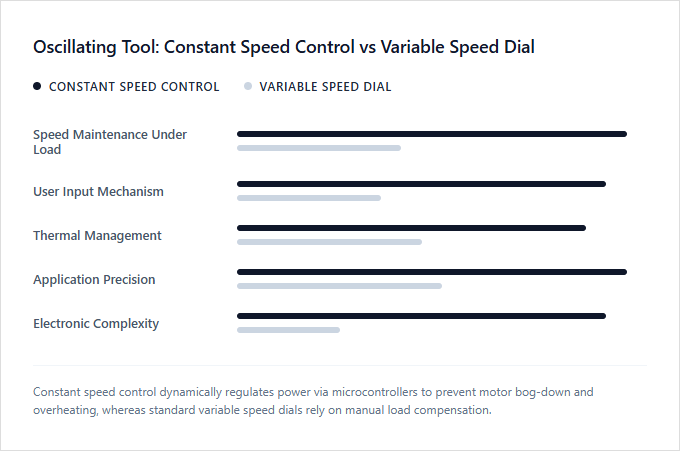
| Factor | Summary |
|---|---|
| Speed Maintenance Under Load | Constant speed control utilizes electronic feedback circuitry to maintain consistent oscillations per minute (OPM) under load, whereas a standard variable speed dial may bog down without manual adjustment. |
| User Input Mechanism | A variable speed dial uses a rotary potentiometer to set the baseline power limit, while constant speed control dynamically adjusts the electrical current to maintain that target speed. |
| Thermal Management | Constant speed control optimizes the motor's duty cycle to reduce heat buildup, whereas variable speed dials can cause thermal overload if the tool is run at low speeds under high resistance. |
| Application Precision | Constant speed control prevents blade binding during deep plunge cuts by maintaining torque, whereas a variable speed dial requires the operator to manually modulate pressure to avoid stalling. |
| Electronic Complexity | Tools featuring constant speed control rely on integrated microcontrollers to monitor armature speed, while basic variable speed dials utilize simpler phase-fired control circuits. |
Closed-loop electronic feedback circuitry vs open-loop potentiometer control
Variable speed dials on oscillating tools typically rely on open-loop potentiometer control, which adjusts the initial voltage but allows the motor to slow down under load. In contrast, constant speed control utilizes closed-loop electronic feedback circuitry. This advanced system continuously monitors motor rotation and dynamically increases power input to maintain a consistent oscillation rate, preventing stalling when cutting through dense materials.
While open-loop systems offer a simpler design, closed-loop feedback ensures uniform efficiency and cleaner cuts under pressure. Budget-conscious DIYers undertaking light, intermittent sanding projects will find open-loop potentiometer tools sufficient, whereas trade professionals requiring relentless, precise performance across diverse, tough materials will benefit most from closed-loop constant speed control.
Dynamic pulse-width modulation adjustment under mechanical load
Standard variable speed dials on oscillating multi-tools allow users to manually set a static motor speed by adjusting the basic pulse-width modulation (PWM) duty cycle. However, when the accessory encounters mechanical load, physical resistance naturally decreases the motor's RPM, which can stall the tool or reduce cutting efficiency unless the operator manually alters their technique.
In contrast, constant speed control utilizes an internal feedback sensor to actively monitor motor rotation. When resistance increases, the electronic controller dynamically widens the PWM duty cycle to deliver more voltage, instantly compensating for the mechanical load to maintain a consistent oscillation rate.
Manual variable speed models are suited for budget-conscious DIY enthusiasts performing light, intermittent sanding, while tools featuring dynamic constant speed control are essential for trade professionals requiring uninterrupted precision during heavy-duty plunge cutting.
Tachometer generator real-time OPM monitoring and correction
Standard variable speed dials allow users to set a static rate, but tool speed often bogs down under heavy loads. In contrast, advanced oscillating tools feature Constant Speed Control driven by an internal tachometer generator. This electronic feedback system monitors the oscillations per minute (OPM) in real time, instantly delivering more power to correct any speed drops when encountering resistance and ensuring consistent cutting efficiency.
While a manual variable speed dial offers straightforward adjustments for lighter tasks, it lacks the automated compensation of a tachometer system. Constant speed technology maintains uniform material removal rates regardless of the applied pressure. Standard variable speed dials are ideal for hobbyists tackling delicate, intermittent sanding tasks, whereas tools equipped with constant speed control are suited for trade professionals demanding continuous, high-torque performance under heavy workloads.
Torque compensation to prevent motor slip and speed drop
An oscillating tool's performance under load depends heavily on its speed regulation mechanism. While a standard variable speed dial allows users to set a baseline frequency, the motor can suffer speed drop when encountering dense materials. In contrast, systems with constant speed control utilize electronic sensors to monitor resistance, automatically applying torque compensation to prevent motor slip and maintain consistent oscillation under pressure.
This active power regulation ensures cleaner cuts and prevents blade binding during demanding tasks. Standard variable speed dials are suitable for occasional DIYers performing light sanding, whereas constant speed control is essential for trade professionals requiring consistent power for heavy-duty plunging and cutting.
Thermal regulation of the armature during high-impedance cutting
During high-impedance cutting, such as plunging into dense hardwoods, oscillating tools experience significant mechanical resistance. Traditional variable speed dials allow manual frequency adjustment, but under heavy loads, motor RPM can drop. This reduction in speed diminishes the internal cooling fan's airflow, leading to rapid thermal buildup within the armature windings and risking premature motor failure.
Constant speed control systems mitigate this risk by utilizing electronic feedback loops to maintain consistent RPM under load. By automatically adjusting power delivery to sustain speed, the system ensures the integrated fan continues operating at peak efficiency, effectively regulating armature temperatures during demanding tasks. Manual variable speed models suit budget-conscious DIYers undertaking intermittent, light-duty tasks, whereas tools featuring constant speed electronics are designed for trade professionals requiring sustained durability during high-intensity applications.
Maintenance of consistent oscillation amplitude regardless of material density
When selecting an oscillating multi-tool, understanding the distinction between a standard variable speed dial and electronic constant speed control is critical for demanding applications. While a variable speed dial allows users to manually set a baseline speed, the tool's oscillation amplitude can degrade when encountering dense materials. In contrast, constant speed control utilizes internal electronic feedback to automatically increase power under load, ensuring the tool maintains its set oscillation rate and amplitude regardless of material resistance.
This difference in power delivery directly impacts cutting efficiency and tool control. Standard variable speed dials are ideal for light-duty DIY enthusiasts performing occasional, delicate sanding, whereas constant speed control is suited for trade professionals requiring sustained, high-performance execution across diverse, high-density remodeling materials.
Back-electromotive force detection for automatic voltage regulation
Oscillating multi-tools utilize either standard variable speed dials or advanced constant speed control to manage motor output. While a basic variable speed dial relies on manual user input to set the baseline frequency, constant speed control integrates back-electromotive force (back-EMF) detection. As the blade encounters resistance, the motor slows, which reduces back-EMF. The control electronics detect this voltage drop and immediately increase voltage regulation to maintain consistent oscillations under load.
This automatic adjustment prevents stalling and ensures uniform material removal. Manual dials require operators to anticipate material density and adjust settings to prevent bogging down. Variable speed dials are ideal for casual DIY hobbyists performing delicate detail work, whereas constant speed control with back-EMF regulation is suited for trade professionals requiring sustained torque for heavy-duty demolition.
Leave a comment