
Navigating the complex ecosystem of oscillating multi-tool accessories can be highly frustrating, especially when blades slip under heavy load or fail to fit your specific machine on a busy job site. While standard equipment funding sources typically cover basic, universal-fit OIS systems, upgrading to professional-grade platforms requires a more strategic approach to tool compatibility.
The revolutionary Starlock system, pioneered by industry leaders Bosch and Fein, grants users unmatched torque transfer, zero-play engagement, and rapid, hands-free blade changes. However, adopting this high-performance platform comes with an important stipulation: while Starlock Max multi-tools are backward-compatible with all Starlock accessories, Starlock Plus power tools cannot physically accept the heavy-duty Max blades.
This article provides an executive comparison of Starlock Plus versus Starlock Max, analyzing key differences in power transmission, cutting depths, and tool compatibility to ensure you select the optimal interface for your operational needs.
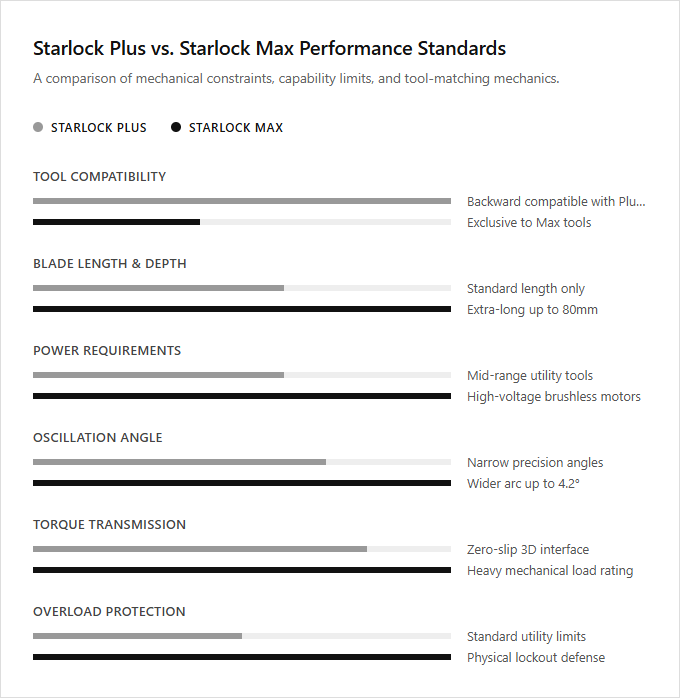
| Factor | Summary |
|---|---|
| Tool Compatibility | Starlock Plus accessories are backward compatible with both Plus and Max power tools, whereas Starlock Max blades feature a restrictive recess pattern designed exclusively for high-performance Starlock Max-rated machines. |
| Blade Length & Depth | Starlock Max supports extra-long blades up to 80 millimeters for deep plunge cutting, while Starlock Plus is restricted to standard-length blades to prevent excessive spindle deflection. |
| Power Requirements | Starlock Max is engineered for heavy-duty, high-torque applications powered by high-voltage brushless motors, whereas Starlock Plus targets mid-range utility tools. |
| Oscillation Angle | Starlock Max tools utilize a wider oscillation arc of up to 4.2 degrees for rapid material removal, compared to the narrower, high-precision angles standard in Starlock Plus systems. |
| Torque Transmission | Both standards utilize a three-dimensional star-shaped interface that ensures maximum torque transfer and zero-slip engagement, though Max handles significantly higher mechanical load. |
| Overload Protection | The physical coding on Starlock Max blades acts as a mechanical lockout to prevent mounting them on lower-wattage Starlock Plus tools, mitigating the risk of motor burn-out. |
Starlock Max Blades Incompatible With Starlock Plus Tools
The Starlock interface standardizes oscillating multi-tool accessories into distinct performance tiers, primarily Starlock Plus and Starlock Max. A critical distinction lies in their backward compatibility constraints. While a Starlock Max tool can accept Starlock Plus blades, Starlock Max blades are engineered with a deeper physical recess that prevents them from mounting onto Starlock Plus tool heads. This mechanical restriction serves as a safety and performance safeguard, preventing users from overloading the lower-torque motors of Starlock Plus tools with heavy-duty Max accessories.
Understanding these limitations ensures both operator safety and tool longevity on the job site. Starlock Plus tools are best suited for general contractors needing a versatile, agile tool for routine trimming and detail sanding, while Starlock Max systems are ideal for heavy-duty demolition specialists who regularly cut through thick metal, masonry, and dense timbers.
Starlock Max's 3D Connection Maximizes Torque Transfer
The Starlock mounting system revolutionized oscillating multi-tools by establishing a highly rigid, standardized interface. While both Starlock Plus and Starlock Max feature a secure, hands-free snap-in design, they are engineered to accommodate different levels of power and application intensity.
Torque transfer efficiency is maximized in Starlock Max through a deeper three-dimensional recessed connection. This increased depth allows the tool to deliver maximum power from the motor directly to the blade, virtually eliminating slippage and reducing energy loss during demanding operations. Conversely, Starlock Plus utilizes a shallower recess, offering excellent stability for standard applications but restricting compatibility to medium-duty accessories to protect the tool from overloading.
Starlock Plus is ideal for general contractors and DIY enthusiasts performing routine remodeling and sanding tasks, whereas Starlock Max is engineered for heavy-duty demolition professionals requiring maximum power for continuous, high-intensity cutting.
Starlock Max: Longer Blades for Deeper Plunge Cuts
The Starlock mounting system revolutionized oscillating multi-tools by optimizing torque transfer and simplifying accessory changes. When comparing Starlock Plus and Starlock Max, the primary distinction lies in power capacity and maximum blade length. Starlock Max tools are engineered specifically to handle significantly longer blades, allowing operators to execute deep, precise plunge cuts that standard Starlock Plus systems cannot accommodate.
While Starlock Plus provides ample performance for standard renovation tasks, the Max system utilizes high-output motors to drive heavy-duty accessories through dense materials. The robust interface of the Max system prevents slippage and power loss under extreme loads. DIY enthusiasts and general contractors benefit from the versatile, everyday capability of Starlock Plus, whereas heavy-duty remodelers and demolition professionals require the extreme plunge depths and raw power of Starlock Max.
Starlock Max Accessories: Built for High-Power, Heavy-Duty Use
The Starlock system standardizes oscillating multi-tool interfaces, with Starlock Plus and Starlock Max representing distinct performance tiers. While Starlock Plus serves standard-to-heavy applications, Starlock Max is engineered specifically for extreme tasks. The critical difference lies in the structural integrity of Starlock Max accessories, which feature reinforced mounting geometries to withstand high torque and intense vibrational stress.
These heavy-duty Starlock Max blades are rated for severe duty cycles and high-wattage motors, typically exceeding 400 watts, preventing accessory deformation under continuous, heavy loads. Starlock Plus is ideal for general contractors and remodelers performing standard renovation tasks, whereas Starlock Max is suited for heavy-duty demolition specialists who demand maximum material removal under extreme jobsite conditions.
Starlock Max: Higher Oscillation and Speed Tolerances
The Starlock mounting system standardizes oscillating multi-tool accessories, with Starlock Plus and Starlock Max representing two distinct performance tiers. Starlock Max systems are engineered to withstand significantly greater physical demands than their Plus counterparts. This distinction is most evident in their handling of oscillation angle thresholds and high oscillations per minute (OPM) tolerances, where the Max interface is robustly reinforced to prevent slippage and energy loss during heavy-duty applications.
While Starlock Plus tools efficiently manage moderate angles and speeds, Starlock Max tools utilize wider oscillation angles and higher OPM limits to maximize material removal rates under extreme loads. This superior tolerance prevents premature wear on both the accessory and the tool's motor during continuous operation. Starlock Plus is ideal for finish carpenters and remodelers engaged in precise, standard-duty cutting, whereas Starlock Max is best suited for heavy-duty demolition specialists and masonry contractors requiring maximum power and speed.
Starlock Max: Reinforced Flange Prevents High-Load Slip
The Starlock system represents a significant advancement in oscillating multi-tool interfaces, with the Starlock Plus and Starlock Max tiers catering to distinct operational demands. The primary difference lies in their mechanical retention security under load. Starlock Max features a reinforced locking flange engineered to prevent slip during high-torque applications, whereas Starlock Plus utilizes a standard interface optimized for medium-duty tasks.
This structural enhancement allows Starlock Max tools to drive longer blades through dense materials without sacrificing precision or safety. Starlock Plus is ideal for remodelers and dedicated DIY enthusiasts undertaking standard finish carpentry, while Starlock Max is suited for heavy-duty demolition professionals requiring maximum power transfer and tool reliability under extreme conditions.
Starlock Max Carbide Blades Offer Superior Heat Dissipation
In oscillating multi-tools, the distinction between Starlock Plus and Starlock Max interfaces directly impacts performance under heavy loads. Starlock Max systems are engineered for heavy-duty applications, utilizing advanced carbide-tipped blades that offer vastly superior heat resistance compared to the standard bi-metal blades typically associated with the Starlock Plus range.
The enhanced thermal dissipation properties of Starlock Max carbide blades allow the tool to maintain cutting efficiency during prolonged operations in dense materials. This superior thermal management prevents premature tooth wear and blade deformation, whereas Starlock Plus bi-metal alternatives are more susceptible to heat build-up during intense, continuous cutting tasks.
Starlock Plus is ideal for light remodeling contractors and DIY enthusiasts undertaking precise finish work, while Starlock Max is best suited for heavy demolition specialists and industrial tradespeople requiring maximum endurance for repetitive, high-intensity cutting.
Leave a comment