
Achieving repeatable precision in metalworking and woodworking often hinges on a component many operators overlook: the worktable geometry. Machinists frequently struggle with workpiece deflection and awkward clamping setups when transitioning between diverse stock profiles, leading to critical alignment errors.
When procuring shop machinery, standard equipment funding sources and capital budgets often restrict operations to default, off-the-shelf drill press configurations, forcing operators to adapt to standard-issue surfaces. Yet, intentionally selecting the right table geometry-square versus round-grants operators unparalleled control over setup rigidity, surface area utilization, and angular alignment.
We analyze this selection with the stipulation that table geometry must align directly with your primary material types and clamping fixtures to yield any noticeable improvement in accuracy. For example, high-precision facilities utilizing industrial-grade machines like the Jet J-2500 or Powermatic PM2800B rely on specific table profiles to maintain strict tolerances during production runs.
In this guide, we will compare the mechanical advantages, clamping configurations, and ideal use-cases of square and round worktables, providing a clear roadmap for optimizing your workshop's machining precision.
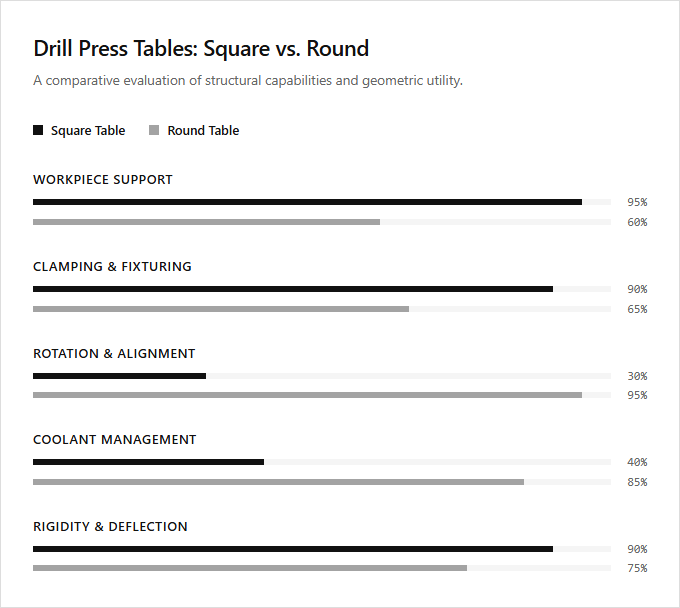
| Factor | Summary |
|---|---|
| Workpiece Support | Square tables offer more surface area at the corners, which maximizes the load-bearing capacity for rectangular stock compared to round tables. |
| Clamping and Fixturing | Square tables typically feature parallel T-slots, whereas round tables often utilize radial slots, impacting the fixturing geometry of your workholding devices. |
| Rotation and Alignment | Round tables can often rotate 360 degrees around the column arm to allow complex angular drilling without altering the axis alignment of the spindle. |
| Coolant Management | Many round tables feature an outer catch trough designed for flood coolant containment during metalworking, a feature less common on standard utility square tables. |
| Rigidity and Deflection | Heavy-duty square tables often possess thicker cast-iron ribbing to minimize structural deflection under high feed-pressure drilling operations. |
Square tables provide precise orthogonal datum alignment along straight edges.
When selecting a drill press, the geometry of the worktable significantly influences both setup efficiency and machining accuracy. Square tables excel in applications requiring high repeatability, as their flat, straight edges provide precise orthogonal datum alignment. This structural design allows operators to easily secure fences, clamps, and jigs parallel or perpendicular to the spindle axis, minimizing measurement errors during linear operations.
Round tables offer distinct advantages in rotational versatility, allowing operators to swivel workpiece setups and access various angles without relocating the entire table assembly. Square tables are ideal for cabinetmakers and precision fabricators executing repetitive, straight-line production runs, while round tables suit general-purpose hobbyists and repair technicians requiring maximum angular flexibility for irregular workpieces.
Round tables utilize radial T-slots for concentric clamping setups.
When selecting a drill press, the choice between a square and a round table significantly impacts workpiece positioning and securing methods. Square tables offer flat, straight edges that align easily with fences and vices, making them highly efficient for standard rectangular stock and repetitive linear setups.
Round tables excel in specialized machining tasks due to their unique geometry. These tables utilize radial T-slots that branch outward from the center, enabling precise concentric clamping setups for round or irregularly shaped workpieces. This design allows operators to rotate the table easily without losing center alignment.
Square tables are ideal for general woodworkers and fabrication shops handling straight-edged materials, whereas round tables are best suited for machinists and gunsmiths who frequently require complex, rotational clamping configurations.
Square Tables with Parallel Vise Slots
When selecting a drill press, the configuration of the worktable significantly influences machining efficiency and alignment precision. Square tables are highly favored for traditional woodworking and metalworking applications because they feature parallel linear slots. These straight channels are engineered specifically for aligning and securing standard machine vises, ensuring rigid clamping and highly repeatable drilling along straight axes.
Round tables offer different advantages, often featuring radial slots that allow for versatile clamping angles and easier rotation of irregular workpieces. The circular geometry facilitates quick positioning adjustments when working on complex, multi-angled projects. Demanding machinists requiring precise, straight-line vise setups will benefit most from a square table, while fabricators handling odd-shaped components or rotational work will find the round table more suitable.
Round tables allow 360-degree circumferential indexing around the column axis.
When selecting a drill press, the choice between a square table and a round table significantly impacts workshop versatility. Square tables provide straight edges that simplify clamping and aligning rectangular workpieces. In contrast, round tables offer a distinct mechanical advantage by allowing 360-degree circumferential indexing around the column axis. This capability enables operators to rotate the work surface smoothly to access various angles without losing center alignment.
The circular design facilitates precise radial positioning, making it easier to drill circular hole patterns or handle awkwardly shaped materials. Square tables are ideal for traditional woodworkers performing repetitive, straight-line operations, while round tables are best suited for metalworkers and precision machinists requiring frequent, multi-angle setups.
Square table geometry minimizes workpiece cantilever deflection at the corners.
When selecting a drill press, the geometry of the work table significantly influences machining accuracy. Square tables offer distinct structural advantages, particularly when supporting larger or rectangular workpieces. The extended corner geometry of a square table minimizes workpiece cantilever deflection, ensuring the material remains perfectly perpendicular to the spindle even at its outer edges.
Round tables facilitate easier rotation and angular adjustments, making them highly efficient for repetitive, off-center drilling tasks. The choice between these configurations depends on the specific demands of your projects. Woodworkers and metal fabricators handling large, heavy sheet goods benefit most from the stability of a square table, whereas general operators prioritizing quick, multi-angle positioning find the round table ideal.
Efficient Spindle Tramming Using Square Tables
When selecting a drill press, table geometry significantly impacts setup precision. Square tables offer a distinct advantage for operators requiring frequent calibration. Tramming the spindle axis is highly efficient on a square table because its flat, parallel edges provide reliable reference lines for dial indicators and squaring blocks. This linear design simplifies measuring perpendicularity, enabling rapid and precise alignment along both axes.
Round tables provide superior rotational flexibility, allowing workpieces to pivot easily around the column. While these circular designs offer excellent angular versatility, the lack of straight edges makes precise tramming a more meticulous process. Square tables are best suited for precision machinists requiring rigorous, repeatable accuracy, whereas round tables are ideal for general fabricators who prioritize versatile, multi-angle positioning.
Square tables offer superior compatibility with Cartesian cross-slide coordinates.
When selecting a drill press, the geometry of the table significantly influences machining accuracy and workflow efficiency. Square tables align naturally with the Cartesian coordinate system, making them highly compatible with cross-slide vises and X-Y coordinate tables. This orthogonal design simplifies parallel alignment, allowing operators to secure workpieces and execute sequential, linear drilling patterns with high precision.
Round tables, by comparison, offer excellent rotational flexibility, making them ideal for angular drilling and working with irregular, radial workpieces. They often feature 360-degree rotation around the column, which facilitates quick adjustments for non-linear tasks. Production machinists requiring precise, repetitive grid-aligned layouts will benefit most from a square table, while general woodworkers and fabricators handling diverse, multi-angled components are better served by a round table.
Leave a comment