
Selecting the correct spindle speed on a drill press remains a persistent frustration for operators. Achieving clean, precise cuts without burning workpieces or destroying expensive bits requires exact RPM control, yet navigating manual adjustments often stalls workshop production. Historically, acquiring high-quality workshop machinery relies on standard capital equipment funding sources or facility setup grants, requiring buyers to meticulously justify their equipment expenditures.
Fortunately, selecting the optimal speed-control mechanism grants operators a superior return on investment by drastically reducing tool wear and improving workpiece quality. However, maximizing this value comes with the stipulation that the chosen drive system must align with your specific material workflows. For example, transitioning from boring 1/4-inch structural steel plates to drilling delicate hardwoods demands highly contrasting speed thresholds.
To help you optimize your machinery procurement, this article compares step pulley systems against mechanical variable speed drives, analyzing their maintenance profiles, cost differences, and operational efficiencies.
| Factor | Summary |
|---|---|
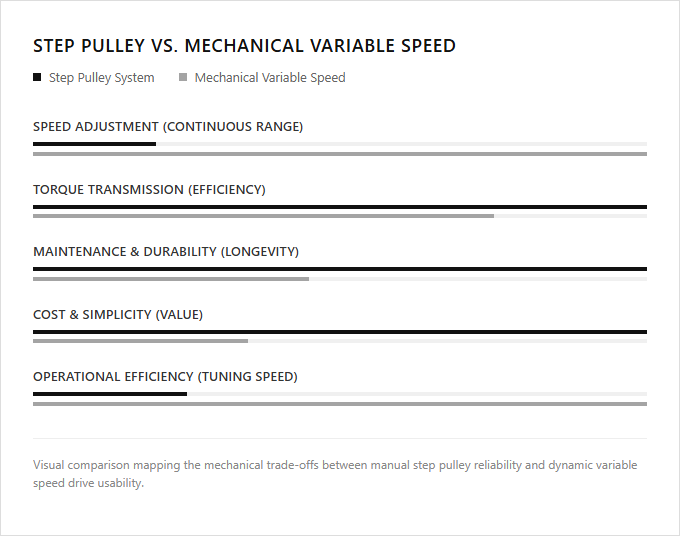
| Speed Adjustment Method | Step pulley systems require manual belt repositioning across fixed-diameter sheaves, whereas mechanical variable speed systems utilize a split-pulley Reeves drive to continuously adjust spindle speed while the motor is running. |
| Torque Transmission | Step pulleys offer highly efficient, positive torque transmission with minimal belt slippage, whereas mechanical variable speed systems can experience slight power loss due to friction within the variable-pitch sheaves. |
| Maintenance and Durability | Step pulley systems feature high mechanical reliability due to fewer moving parts, whereas mechanical variable speed mechanisms require frequent lubrication of the speed-change pulleys to prevent wear and binding. |
| Cost and Complexity | Step pulley drill presses are inexpensive and mechanically simple, whereas mechanical variable speed models involve complex linkages and split-pulley assemblies that increase the initial retail cost. |
| Operational Efficiency | Mechanical variable speed allows rapid, on-the-fly RPM tuning to match specific workpiece drill-bit diameters, while step pulleys require downtime to halt the spindle and manually change belt configurations. |
Reeves Drive vs. Stepped Sheaves: Continuous vs. Manual
When selecting a drill press, the spindle drive system dictates the efficiency of speed adjustments. Traditional step pulley systems require the operator to manually reposition the drive belt across paired, stepped sheaves to alter spindle speeds, delivering highly reliable torque at fixed intervals. In contrast, mechanical variable speed systems utilize a Reeves drive to enable continuous RPM adjustments while the motor is running, varying the split-pulley diameter to achieve precise speed control without workflow interruption.
While the step pulley excels in power transmission efficiency and mechanical simplicity, the Reeves drive prioritizes speed flexibility across diverse materials. The manual step pulley design is best suited for budget-conscious hobbyists or production facilities working with consistent materials, while the mechanical variable speed system is ideal for dynamic workshops and operators requiring frequent, on-the-fly RPM tuning.
Torque Efficiency at Low Pitch Diameters Under Heavy Loads
When operating at low pitch diameters under heavy chip loads, step pulley systems deliver superior torque transmission efficiency compared to mechanical variable speed (MVS) drives. The fixed, positive engagement of a V-belt within a solid step pulley minimizes belt deflection and slippage under high resistance. In contrast, MVS systems utilize adjustable split-sheave pulleys; under extreme loads, the spring-loaded sheaves can experience micro-slippage and frictional losses, reducing the effective power transferred to the spindle.
While MVS offers seamless speed adjustments, the rigid connection of a step pulley ensures maximum energy conservation during heavy-duty drilling. Traditional step-pulley machines are best suited for industrial metalworkers performing heavy, repetitive boring, while mechanical variable-speed models cater to maintenance technicians who prioritize rapid speed changes for varied, light-to-medium tasks.
Belt tensioner wear versus lateral friction on variable-pitch V-belts
Step pulley drill presses rely on manual belt repositioning, which puts periodic stress on the belt tensioner mechanism during speed adjustments. In contrast, mechanical variable speed systems utilize adjustable pulleys that change width on the fly. This dynamic adjustment subjects the variable-pitch V-belt to continuous lateral friction as it wedges into shifting pulley sheaves, leading to accelerated belt degradation and heat buildup.
While step pulley tensioners experience wear primarily during manual lock-and-release cycles, the mechanical variable-speed drive demands more frequent belt replacements due to constant side-wall friction. Step pulley models suit traditional woodworkers who maintain consistent speeds for long runs, whereas mechanical variable speed is ideal for multi-material machinists requiring rapid, frequent RPM adjustments.
Speed adjustment on-the-fly under power versus static spindle reconfiguration
Step pulley drill presses require static spindle reconfiguration, meaning the operator must shut down the motor, release belt tension, and manually shift the drive belt across different pulley steps to alter the RPM. In contrast, mechanical variable speed systems allow seamless speed adjustment on-the-fly under power. By utilizing split-sheave pulleys that expand or contract dynamically via an external lever, these systems adjust the effective driving diameter without interrupting the workflow.
While the step pulley design offers a simpler, highly durable mechanical path with minimal maintenance, variable speed mechanisms provide immediate, precise RPM tuning for optimal cutting conditions. Traditional step pulleys are ideal for production shops performing repetitive drilling in uniform materials, whereas mechanical variable speed systems suit versatile craftsmen and machinists who frequently transition between diverse hole diameters and varying stock types.
Lubrication maintenance of sliding pulley flanges versus fixed-axis keyways
Step pulley drill presses utilize fixed-axis pulleys secured to shafts via standard keyways. This design requires virtually no ongoing lubrication maintenance, as the pulleys remain locked in a static axial position. In contrast, mechanical variable speed systems rely on a split-pulley design where one flange must slide continuously along the shaft to alter speed ratios. This sliding movement requires regular application of specialized grease to the internal splines or keyways to prevent binding, fretting corrosion, and costly pulley wear.
Neglecting to lubricate the moving flanges in variable speed units leads to rapid mechanism failure, whereas step pulley systems remain resilient even under minimal upkeep. Standard step pulley models are ideal for utility workshops and occasional users who prefer a low-maintenance machine, while mechanical variable speed models suit dedicated machinists who require rapid speed transitions and commit to scheduled preventative maintenance.
Digital tachometer integration for precise spindle RPM monitoring
When selecting a drill press, the choice between step pulley and mechanical variable speed systems significantly impacts speed management. Step pulley models require manual belt adjustments to alter speeds, where a digital tachometer serves as a valuable diagnostic tool to confirm true spindle RPM under load. Conversely, mechanical variable speed systems utilize a split-pulley mechanism to adjust speed dynamically while the motor runs. Integrating a digital tachometer into this variable setup provides real-time feedback, allowing operators to dial in exact RPMs to match specific material requirements precisely.
Step pulley systems with basic tachometers are best suited for traditional woodworkers who value mechanical simplicity and perform repetitive drilling at standard speeds, whereas mechanical variable speed presses with integrated digital readouts are ideal for precision metalworkers and commercial fabricators who constantly adapt to diverse material hardnesses.
Mechanical linkage complexity and vibration harmonics at high speeds
Step pulley drill presses utilize a simple, direct belt-to-pulley configuration, minimizing mechanical linkage complexity. This straightforward design limits moving parts, resulting in excellent dampening of vibration harmonics even at high spindle speeds. In contrast, mechanical variable speed systems rely on split-sheave pulleys and adjustable speed-control linkages. While this design allows for rapid speed adjustments, the additional moving components introduce more points of potential wear and increase the likelihood of vibration harmonics at high RPMs.
Traditional step pulley models suit production environments where reliability and low maintenance are paramount, whereas mechanical variable speed units are ideal for dynamic workshops where operators frequently transition between different materials and hole diameters.
Leave a comment