
For assembly plant managers and precision engineers, achieving consistent torque control is a persistent struggle; even minor fastening variances often lead to stripped threads, component damage, and costly product recalls. When planning upgrades, procurement teams typically look to standard capital equipment budgets or operational tool-replacement funds to finance these acquisitions.
Yet, choosing the correct power medium is what ultimately grants your production line unmatched joint repeatability and zero-defect quality assurance. As a crucial stipulation, however, the effectiveness of either technology is highly dependent on your facility's existing utility infrastructure-a factor heavily weighed in high-precision sectors like medical device manufacturing.
This comparative guide evaluates pneumatic and electric screw guns across key performance indicators, including torque accuracy, operational ergonomics, and total cost of ownership, providing the strategic framework you need to select the optimal tool for your facility.
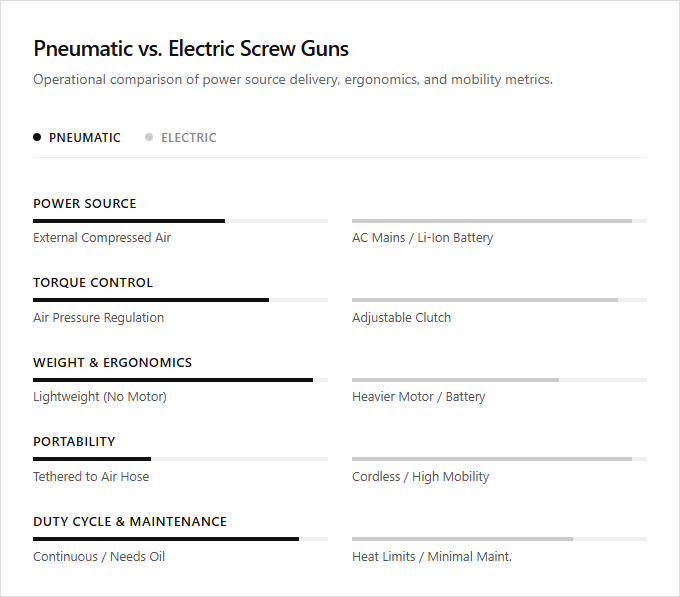
| Factor | Summary |
|---|---|
| Power Source | Pneumatic screw guns rely on compressed air generated by an external compressor, whereas electric models utilize a direct connection to AC mains or a DC lithium-ion battery pack. |
| Torque Control | Electric screw guns regulate fastening force using an adjustable mechanical clutch, while pneumatic variants control torque limits through precise air pressure regulation. |
| Weight and Ergonomics | Lacking an internal heavy motor, pneumatic tools offer a superior power-to-weight ratio that minimizes operator fatigue during high-volume assembly line tasks. |
| Portability | Cordless electric screw guns provide maximum spatial mobility, whereas pneumatic tools are permanently tethered to rigid air hoses. |
| Duty Cycle and Maintenance | Pneumatic units boast a continuous duty cycle with minimal heat buildup, though they require regular pneumatic oil lubrication to protect internal vanes. |
Transducerized closed-loop feedback in electric models vs pneumatic mechanical clutches
Electric screw guns equipped with transducerized closed-loop feedback offer superior torque precision. These advanced systems continuously measure torque and angle in real time during the fastening process, instantly adjusting motor power to meet exact specifications while recording critical data for quality assurance.
In contrast, pneumatic screw guns rely on mechanical clutches to interrupt drive power once a preset torque threshold is reached. Operating on compressed air, these mechanical systems are highly durable and fast for high-volume repetition, though they lack the digital tracking, easy calibration, and dynamic adjustability found in electric alternatives.
Pneumatic tools are best suited for high-throughput assembly operators requiring rugged, low-maintenance equipment, whereas transducerized electric models are ideal for precision aerospace or electronics technicians who demand strict torque documentation and zero-defect quality control.
Air shut-off clutch sensitivity vs electronic current-control torque limiters
In precision assembly, choosing between pneumatic and electric screw guns depends largely on their torque control mechanisms. Pneumatic screw guns utilize mechanical air shut-off clutches that physically disengage the air motor upon reaching the target torque. This design offers exceptional sensitivity and repeatability, reacting instantly to resistance without thermal buildup, which is crucial for maintaining torque integrity during rapid, continuous fastening cycles.
Electric screw guns, by contrast, employ electronic current-control torque limiters. These systems monitor motor current draw to cut power at a preset limit, providing digital programmability and assembly data integration. High-volume industrial assembly operators benefit most from the durable, rapid-fire repeatability of pneumatic tools, whereas electronics manufacturers and mobile field technicians require the precise, programmable control of electric models.
BLDC Speed Profiling vs. Pneumatic Vane Throttling
Electric screw guns leverage brushless DC (BLDC) motors equipped with sophisticated electronic speed profiling. Integrated microprocessors continuously monitor torque resistance and adjust electrical current to maintain precise RPM steps throughout the fastening cycle. This digital, closed-loop feedback loop allows operators to program multi-stage driving profiles, effectively preventing strip-out and protecting delicate workpieces.
Pneumatic screw guns rely on rotary air vane motors utilizing mechanical variable throttling. Gradual depression of the trigger valve directly regulates the volume of compressed air entering the chambers, delivering immediate, highly tactile torque response and an exceptional power-to-weight ratio. This analog modulation provides robust, continuous performance under load without the risk of thermal degradation.
Electric models suit high-precision assembly technicians requiring digital torque calibration and data logging, while pneumatic units are ideal for industrial fabricators prioritizing continuous-duty reliability and lightweight tools for high-volume production lines.
Torque repeatability variances driven by pneumatic air pressure fluctuations
When evaluating pneumatic and electric screw guns for high-precision assembly, torque repeatability is a critical performance differentiator. Pneumatic screw guns rely entirely on compressed air delivery systems, making them inherently susceptible to torque output variances caused by localized air pressure fluctuations. When multiple pneumatic tools operate simultaneously on a shared line, or when compressor cycling occurs, the resulting pressure drops can lead to inconsistent fastening depths and joint integrity issues.
Electric screw guns mitigate these variances by utilizing brushless motors and digital electronic clutches to maintain constant torque control. This design ensures highly repeatable fastening cycles that remain unaffected by external power supply fluctuations, providing superior quality control across high-volume production runs.
Pneumatic models are well-suited for heavy industrial assembly workers who require lightweight, durable tools for continuous operation in environments with stable, dedicated air supply systems, while electric screw guns are ideal for precision electronics manufacturers and calibration technicians demanding exact, traceable torque repeatability.
Torque Logging and Traceability in Smart Electric Tools
While pneumatic screw guns offer robust, high-power performance in traditional assembly environments, modern electric screw guns have revolutionized precision manufacturing through smart technology. Electric models increasingly feature digital torque data logging and seamless traceability integration. These smart tools connect directly to factory networks, recording the exact torque and angle applied to every fastener. This real-time data collection ensures strict quality control and simplifies compliance auditing in high-stakes industries.
In contrast, pneumatic options lack these advanced communication capabilities, relying instead on manual calibration and external regulators. Pneumatic screw guns are ideal for assembly line workers performing high-volume, repetitive tasks where simple mechanical durability is paramount, whereas electric smart screw guns are best suited for quality assurance technicians and aerospace or medical manufacturers requiring absolute data integrity and precise process verification.
Intrinsic safety and ATEX compliance of spark-free pneumatic drive systems
When comparing pneumatic and electric screw guns, the choice often hinges on the operating environment's safety requirements. Electric screw guns contain internal electrical components that can generate sparks during operation, posing an ignition risk in volatile atmospheres. In contrast, pneumatic screw guns utilize compressed air to drive the motor, eliminating electrical circuitry entirely. This inherently spark-free design provides intrinsic safety, making pneumatic tools highly compliant with ATEX directives for hazardous zones.
While electric models offer greater mobility and precise electronic torque control, pneumatic systems excel in continuous-duty applications where flammable gases or dust are present. Electric screw guns are ideal for benchtop assembly technicians working in standard, dry electronics facilities, whereas pneumatic screw guns are the necessary choice for industrial operators working in hazardous petrochemical plants and paint-spraying environments.
Power-to-weight ratio optimization for manual high-torque assembly operations
In high-torque manual assembly, optimizing the power-to-weight ratio is critical to reducing operator fatigue and maintaining productivity. Pneumatic screw guns excel in this environment by utilizing external compressed air, which eliminates the need for heavy internal motors and batteries. This design yields an exceptional power-to-weight ratio, delivering high torque output in a lightweight, compact chassis ideal for continuous industrial duty.
Conversely, electric screw guns integrate the power source directly into the tool, which increases weight but offers precise digital torque control and superior mobility free from air lines. Advanced brushless electric models continually close the performance gap, though they remain heavier during sustained high-torque operations. High-volume industrial assembly line workers benefit most from the lightweight endurance of pneumatic models, whereas field installation technicians requiring mobility and precise torque calibration are best served by electric variants.
Leave a comment