
Selecting the wrong drill can stall a project before the first hole is bored, leaving craftsmen frustrated by bits that slip or simply won't fit. While standard tool-buying guides focus heavily on baseline considerations like battery voltage or brushless motor upgrades, these traditional metrics overlook a critical operational bottleneck: shank compatibility.
Understanding chuck size is the true key to versatility, as a larger capacity grants you the freedom to run specialized, high-torque accessories without upgrading your entire tool platform. However, as a crucial educational stipulation, a larger chuck size does not automatically yield higher motor torque; rather, it simply dictates physical compatibility with heavy-duty accessories like 3-inch hole saws or thick masonry bits.
Below, we will break down the mechanical differences between 3/8-inch and 1/2-inch chucks, evaluate their performance across common materials, and help you choose the optimal capacity for your upcoming projects.
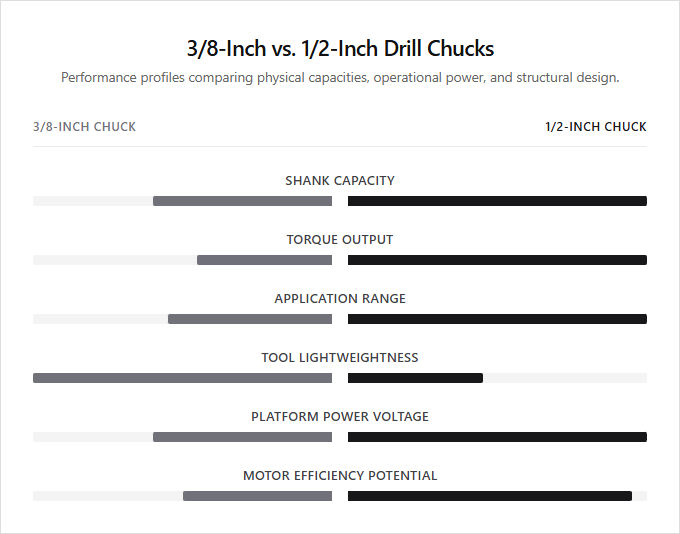
| Factor | Summary |
|---|---|
| Shank Capacity | A 1/2-inch chuck accommodates larger drill bit shank diameters for heavy-duty boring, whereas a 3/8-inch chuck is restricted to smaller, standard-sized accessories. |
| Torque Output | Drills with 1/2-inch chucks typically utilize high-torque planetary gear systems to overcome resistance in dense materials, while 3/8-inch drills deliver lower rotational force optimized for fast, light-duty fastening. |
| Application Range | The 1/2-inch chuck is ideal for high-resistance tasks like driving large spade bits or hole saws, whereas the 3/8-inch chuck is best suited for precision woodworking and general maintenance. |
| Tool Weight and Ergonomics | Incorporating a smaller gearbox makes 3/8-inch drills significantly lighter and more compact, reducing operator fatigue during prolonged overhead use compared to their heavier 1/2-inch counterparts. |
| Power Supply and Voltage | Heavy-duty 1/2-inch drills are commonly integrated into high-voltage cordless platforms or high-amperage corded designs, while 3/8-inch drills often feature ultra-compact 12-volt battery configurations. |
| Motor Type Compatibility | Premium 1/2-inch drills frequently pair with high-efficiency brushless motors to maximize runtime under heavy loads, whereas budget-friendly 3/8-inch models often utilize traditional brushed motor technology. |
3/8-Inch Chuck Shank Capacity Limits
The primary distinction between a 3/8-inch and a 1/2-inch drill chuck lies in their maximum shank diameter capacity. A 3/8-inch chuck limits the tool from accepting larger drill bits directly, requiring specialized reduced-shank bits for larger-diameter drilling. Conversely, a 1/2-inch chuck accommodates a wider range of heavy-duty bits without modification, allowing for greater versatility in demanding applications.
This physical capacity usually correlates with the tool's overall motor power and torque output. A 3/8-inch drill is ideal for DIY enthusiasts performing light household maintenance and furniture assembly, while a 1/2-inch drill is suited for professional contractors and heavy-duty users tackling dense materials and large-scale construction.
Why 1/2-Inch Chucks Require Powerful Motors
When selecting between a 3/8-inch and a 1/2-inch drill chuck, the primary differentiator lies in the tool's capacity and internal power system. Torque output requirements dictate that 1/2-inch chucks are typically paired with more powerful motors for heavy-duty drilling. These larger drills are engineered to handle high-resistance tasks, such as boring large-diameter holes in dense timber or masonry, without stalling the motor under load.
In contrast, 3/8-inch chucks operate with smaller, lighter motors optimized for speed and precision rather than sheer force. These tools are highly efficient for everyday fastening and general-purpose drilling in softer materials. The compact 3/8-inch model is best suited for DIY enthusiasts tackling light home repairs, whereas the heavy-duty 1/2-inch version is designed for professional contractors requiring high-torque structural drilling.
Carbide Inserts Prevent Slippage in Keyless Chucks
Selecting the appropriate drill chuck size depends on task requirements and the necessary holding power. While 3/8-inch chucks are highly efficient for light to medium-duty applications, 1/2-inch chucks are engineered for more demanding, high-torque tasks. To handle this increased stress, the keyless chuck mechanism in 1/2-inch models often incorporates integrated carbide inserts. These specialized inserts provide superior grip on the bit shank, preventing slippage under heavy loads and ensuring reliable performance during rigorous drilling operations.
The choice between these two capacities aligns directly with the user's specific application needs. Homeowners and casual DIY enthusiasts undertaking routine household repairs find the compact 3/8-inch drill ideal, whereas professional contractors and heavy-duty fabricators require the robust gripping power of a 1/2-inch drill for boring large holes in dense materials.
Precision Drilling: 1/2-Inch Drills Ensure Superior Alignment
When selecting between a 3/8-inch and a 1/2-inch drill chuck, the decision centers on precision and spindle runout tolerances. Spindle runout-the deviation from the true axis of rotation-is critical for precision drilling tasks. Professional-grade 1/2-inch drills are engineered with stricter manufacturing tolerances, offering superior coaxial alignment that minimizes drill bit wobble and ensures clean, accurate holes.
Smaller 3/8-inch chucks are typically housed in compact bodies designed for light-duty tasks where extreme precision is secondary to tool maneuverability. The robust construction of 1/2-inch drills supports larger shank accessories and withstands high-torque demands without compromising axial stability. The compact 3/8-inch model is best suited for homeowners tackling basic household repairs, while the high-precision 1/2-inch drill is necessary for trade professionals executing demanding, heavy-duty installations.
How to Fit Large Hole Saws into 3/8-Inch Chucks
When selecting between a 3/8-inch and a 1/2-inch drill chuck, the primary distinction lies in the maximum shank diameter the tool can accept. While 1/2-inch chucks are designed for heavy-duty applications, 3/8-inch chucks offer surprising capability. Through the integration of reduced-shank drill bits, a 3/8-inch chuck can drive larger accessories like hole saws, effectively overcoming its physical size limitations for standard projects.
The larger 1/2-inch chuck remains the standard for high-torque operations, preventing bit slippage when drilling through dense materials. Conversely, the 3/8-inch option allows for lighter, more compact tool designs. The 3/8-inch drill is ideal for homeowners and DIY enthusiasts performing routine maintenance, while the robust 1/2-inch model is best suited for commercial contractors and tradespeople tackling demanding construction tasks.
Why 1/2-Inch Drills Have Higher Voltage and Amperage
When selecting a handheld power drill, the distinction between a 3/8-inch and a 1/2-inch chuck size represents a fundamental difference in tool capability. The chuck capacity dictates the maximum bit shank diameter, which directly influences the machine's overall power profile and application range.
Motor amperage rating and battery voltage are typically higher in drills equipped with 1/2-inch chucks to support high-resistance applications. These robust internal configurations deliver the necessary torque for boring large-diameter holes and driving heavy fasteners into dense substrates, whereas 3/8-inch models prioritize compact, lighter-duty performance.
Homeowners and DIY enthusiasts undertaking light maintenance tasks are best served by the maneuverability of a 3/8-inch drill, while professional contractors and heavy-duty builders require the high-torque capacity of a 1/2-inch model.
1/2-Inch Chucks Reduce Spindle Bearing Wear
When selecting between a 3/8-inch and a 1/2-inch drill chuck, the decision extends beyond shank capacity to critical internal engineering standards. Notably, the radial load capacity is significantly greater in 1/2-inch chuck assemblies, reducing wear on internal spindle bearings during high-torque and lateral drilling operations. This robust construction ensures long-term tool durability and maintains precise alignment under demanding workloads.
In contrast, 3/8-inch chucks prioritize compact efficiency, utilizing smaller bearings optimized for high-speed, lower-torque applications. A 3/8-inch drill is ideal for casual DIYers focused on light household maintenance and assembly, whereas a 1/2-inch drill is suited for professional contractors and heavy-duty users requiring maximum power for timber, metal, and masonry boring.
Leave a comment