
Contractors and trade professionals frequently battle the costly inefficiencies of sluggish penetration rates and premature tool burnout when drilling into high-PSI concrete. While many attempt to solve this by relying on standard motor wattage ratings as their primary benchmark for equipment procurement, this baseline specification alone rarely translates to real-world drilling speed.
Optimizing the internal mechanism's impact energy grants operators a massive leap in material removal efficiency without increasing physical exertion. We must stipulate, however, that harnessing this high impact energy requires a precise match between the tool's drive system and the specific application-such as utilizing SDS-Plus systems for light anchoring versus heavy-duty SDS-Max configurations for deep concrete penetration.
This article delivers a comprehensive technical comparison of pneumatic versus mechanical hammering mechanisms. By examining how each system transfers kinetic energy to the bit, we provide the engineering insights necessary to optimize your fleet's drilling performance.
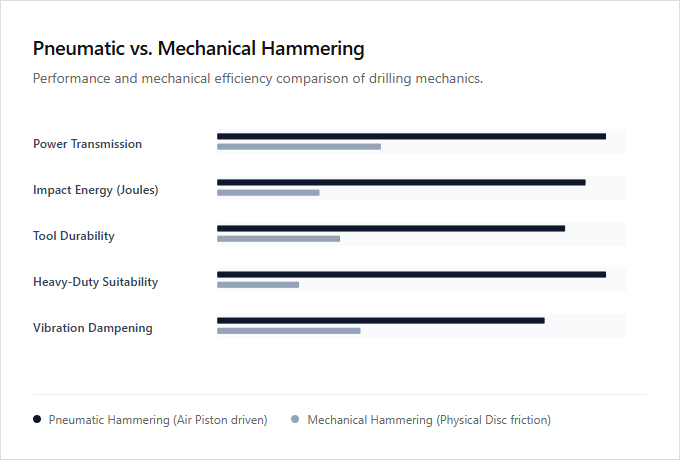
| Factor | Summary |
|---|---|
| Power Transmission | Pneumatic hammering utilizes an internal piston driven by compressed air to deliver high-impact force, whereas mechanical hammering relies on the physical friction and collision of spinning ridged discs. |
| Impact Energy | Pneumatic systems generate substantially higher blow energy measured in Joules, making them highly efficient for heavy masonry, while mechanical systems produce lower energy vibrations suitable only for light brickwork. |
| Tool Durability | Mechanical hammer drills suffer from rapid mechanical wear due to constant metal-on-metal friction within the clutch, whereas pneumatic hammer mechanisms experience less wear because the driving air pocket cushions the internal components. |
| Application Suitability | Pneumatic hammering is designed for heavy-duty chiseling and rotary hammer drilling in reinforced concrete, whereas mechanical hammering is limited to high-RPM, low-impact drilling in softer materials like mortar. |
| Vibration and Ergonomics | Pneumatic tools deliver superior drilling speed with less operator exertion due to active decoupling systems, whereas mechanical hammering transmits intense, high-frequency vibrations directly through the tool casing. |
Electro-Pneumatic vs. Cam-Action: Superior Impact Energy
When selecting a hammering drill, the mechanism driving the impact force determines the tool's performance. Electro-pneumatic mechanisms utilize a piston and air cushion to generate high-velocity blows, delivering significantly higher impact energy measured in Joules. In contrast, mechanical hammering relies on a cam-action system, where two ridged discs slip past each other to create rapid but low-energy vibrations.
Because the pneumatic system does not require physical pressure to engage the hammer, it minimizes operator fatigue and easily fractures dense concrete and stone. Mechanical systems, while lighter and more affordable, depend heavily on the user pressing down to drill through masonry.
Mechanical hammer drills are ideal for DIY homeowners performing occasional light masonry tasks, whereas pneumatic rotary hammers are the standard for professional contractors engaging in heavy-duty demolition and concrete construction.
Air-Cushion Compression Optimizes Floating Striker Velocity
In rotary hammer drills, pneumatic hammering offers superior efficiency compared to traditional mechanical hammering. Mechanical systems rely on physical metal-on-metal impact, utilizing a ramp-and-roller mechanism that delivers rapid but lighter blows. In contrast, pneumatic systems employ a piston where the compression of an internal air cushion drives the free-floating striker to optimize impact velocity and maximize energy transfer to the drill bit.
This air cushion design reduces tool wear and dampens vibration feedback to the operator, allowing for smoother penetration through dense concrete and masonry. Mechanical hammers are best suited for DIY enthusiasts performing light, occasional drilling into brick, while pneumatic hammers are ideal for professional contractors requiring high-performance demolition and heavy-duty masonry work.
Operator Feed Force Engages Hammering Ratchets
Mechanical hammering systems, commonly found in standard hammer drills, utilize two interlocking ratchet plates to generate the impact force. This mechanism relies heavily on the operator's manual feed force; the user must apply significant physical pressure to keep the plates engaged and producing the hammering action. Without this sustained force, the tool functions merely as a standard rotary drill.
In contrast, pneumatic hammering systems utilize a piston and a cushion of compressed air to propel the striker. This internal air pressure delivers a much higher impact energy independent of the operator's physical effort. Mechanical hammers are best suited for DIY enthusiasts tackling light masonry, while pneumatic hammers are ideal for professional contractors requiring high-efficiency drilling in hard concrete.
High-Torque Percussion via Pneumatic Pistons
In rotary hammer drills, the distinction between pneumatic and mechanical hammering lies in the mechanism of impact generation. Pneumatic systems utilize the mass-velocity relationship of a heavy piston to generate high-torque percussion. An internal motor drives a piston to compress air, which launches a steel striker directly against the drill bit. This fluid air cushion minimizes user fatigue and component wear while maximizing kinetic energy transfer into the workpiece.
Mechanical hammering, by contrast, relies on the physical friction of two slipping, ridged discs to produce high-frequency, low-energy vibrations. Industrial contractors and masonry specialists requiring rapid penetration in cured concrete find pneumatic tools indispensable, whereas DIY hobbyists performing light-duty drilling in brick or mortar are best served by the precision and lower cost of mechanical hammer drills.
Decoupled Housing Reduces Pneumatic Hammer Vibration
In heavy-duty drilling applications, the distinction between pneumatic and mechanical hammering mechanisms dictates both tool performance and user ergonomics. Mechanical hammering relies on physical impact plates and drive gears, which generate high-frequency vibrations that transfer directly through the tool structure. In contrast, pneumatic hammering utilizes a reciprocating piston to compress air, creating an air cushion that drives the striker and inherently absorbs a significant portion of the initial impact energy.
High-end pneumatic drills further isolate these forces through decoupled housing dampening, a design where the internal hammer mechanism is physically separated from the outer handle by shock-absorbing suspensions. This structural decoupling drastically reduces vibration transmission to the operator, minimizing physical fatigue and long-term strain during extended use. Mechanical drills are highly suitable for DIY homeowners performing occasional, light-duty masonry tasks, while pneumatic systems are designed for professional contractors who require continuous, high-impact concrete demolition.
Thermal Degradation in High-Speed Mechanical Hammers
In the selection of hammering drills, understanding the distinction between mechanical and pneumatic mechanisms is essential for optimal tool performance. Mechanical hammering systems utilize physical impact discs to generate force, allowing them to operate at significantly higher blows per minute. This continuous metal-on-metal contact subjects the internal components to rapid friction-induced thermal degradation, which limits their prolonged use under continuous load.
Pneumatic hammering relies on a piston driven by compressed air, cushioning the internal mechanism and drastically reducing heat buildup. This design maintains consistent impact energy over extended periods of demanding operation. Light-duty DIY enthusiasts benefit most from the high-speed, intermittent action of mechanical hammers, whereas professional contractors undertaking heavy-duty masonry or concrete drilling require the durable, high-energy output of pneumatic systems.
How SDS Chucks Enable Pneumatic Hammering
Hammering mechanisms in drill power tools differ fundamentally in their engineering and efficiency. Mechanical hammering relies on physical ridged discs slipping over one another, requiring significant manual pressure and yielding lower impact energy. In contrast, pneumatic hammering utilizes a piston and ram system to compress air, delivering a much harder blow with minimal operator effort. SDS-plus and SDS-max chuck systems are designed specifically to facilitate the unrestricted axial movement required by pneumatic hammering, allowing the bit to slide freely and maximize kinetic energy transfer directly to the material.
Mechanical hammers are best suited for DIY enthusiasts performing light, occasional masonry tasks, while pneumatic systems with SDS chucks are ideal for professional contractors engaged in heavy-duty concrete drilling and demolition.
Leave a comment