
Selecting the wrong impact wrench drive size often leads to stripped fasteners or stalled progress, a frustrating bottleneck for technicians and DIYers alike. Before allocating workshop capital or tool-allowance funding-the standard funding sources for professional gear procurement-one must strategically evaluate their tool fleet. Investing in the correct drive size grants operators the perfect balance of high-torque delivery and maneuverability, ensuring projects are completed efficiently without damaging components.
With the critical stipulation that drive size dictates maximum torque thresholds and tool dimensions rather than just socket compatibility, choosing between these two standards requires careful planning. For instance, heavy-duty tasks like removing stubborn wheel lug nuts or subframe bolts demand a rugged 1/2-inch drive, while delicate tasks in cramped engine bays, such as valve cover bolts, are best served by a compact 3/8-inch model.
This article provides a comprehensive comparison of 1/2-inch and 3/8-inch impact wrenches, analyzing their torque output, physical size constraints, and specific applications to help you choose the optimal tool for your project needs.
| Factor | Summary |
|---|---|
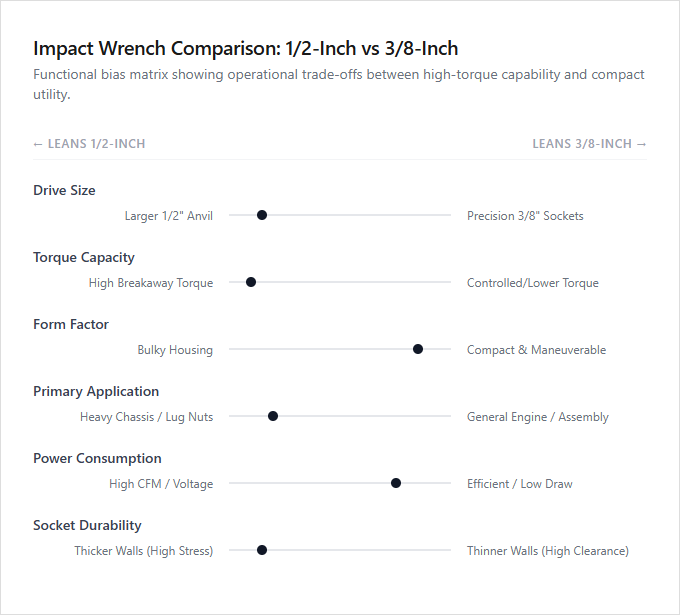
| Drive Size | The drive size refers to the square anvil dimensions, with the 1/2-inch variant accepting larger impact sockets and the 3/8-inch model accommodating smaller, precision sockets. |
| Torque Capacity | 1/2-inch impact wrenches deliver substantially higher breakaway torque and fastening torque, whereas 3/8-inch models prioritize lower, controlled torque to prevent over-tightening. |
| Form Factor | The compact ergonomics and reduced footprint of a 3/8-inch tool allow for superior maneuverability in tight engine bays compared to the bulkier 1/2-inch housing. |
| Primary Application | 1/2-inch models are engineered for heavy-duty automotive chassis work and lug nut removal, while 3/8-inch models excel at general engine maintenance and assembly. |
| Power Consumption | Pneumatic 1/2-inch wrenches require higher CFM ratings and cordless variants demand more battery voltage compared to the highly efficient, lower-draw 3/8-inch counterparts. |
| Socket Durability | Sockets for 1/2-inch drives are designed with thicker walls to withstand higher rotational stress and shear forces, whereas 3/8-inch sockets are optimized for clearance. |
Breakaway torque capacity differences
The primary differentiator between 1/2-inch and 3/8-inch impact wrenches lies in their breakaway torque capacity. A 1/2-inch impact wrench is engineered to deliver substantially higher torque, often exceeding 1,000 foot-pounds, which is essential for loosening seized, rusted, or highly torqued fasteners. In contrast, 3/8-inch models typically max out between 150 and 400 foot-pounds of breakaway torque, prioritizing rotational speed and control over raw loosening power.
This performance gap stems from the anvil size, as the larger drive of the 1/2-inch model accommodates heavier internal hammers that generate greater kinetic energy. Heavy equipment technicians and diesel mechanics require the extreme breakaway torque of the 1/2-inch wrench for suspension and drivetrain work, whereas light duty automotive technicians and DIY hobbyists are best served by the compact agility and moderate power of the 3/8-inch model.
Impact-rated socket drive size compatibility
When selecting between a 1/2-inch and a 3/8-inch impact wrench, socket drive size compatibility is the primary consideration. Impact-rated sockets are engineered to withstand concussive forces, meaning their drive ends must match the tool anvil to maintain safety and efficiency. A 1/2-inch anvil pairs with robust 1/2-inch drive impact sockets designed to handle extreme torque without splitting. In contrast, a 3/8-inch anvil utilizes smaller 3/8-inch drive sockets, offering a compact profile for confined spaces.
Mixing sizes with adapters can reduce torque transfer and risk accessory breakage. The nimble 3/8-inch tool is ideal for automotive technicians performing light engine work, whereas the high-torque 1/2-inch model is suited for heavy equipment mechanics and structural construction workers.
Tool head profile and clearance constraints
When selecting between a 1/2-inch and a 3/8-inch impact wrench, the tool head profile and physical clearance constraints are critical deciding factors. The 3/8-inch impact wrench features a significantly more compact head, allowing operators to maneuver the tool into tight engine bays, suspension assemblies, and confined machinery spaces where access is limited. In contrast, the 1/2-inch variant possesses a larger, heavier anvil and housing to accommodate higher torque loads, which inherently restricts its usability in obstructed environments.
While the larger 1/2-inch drive excels in open areas requiring maximum fastening power, its bulk can hinder precision work. The 3/8-inch drive serves as the ideal choice for automotive technicians and DIY enthusiasts working on intricate assemblies, whereas the high-torque 1/2-inch model is best suited for heavy equipment mechanics and industrial operators tackling stubborn, heavy-duty fasteners.
Anvil shear stress and durability limits
The core mechanical difference between a 1/2-inch and a 3/8-inch impact wrench lies in the anvil's cross-sectional area, which directly dictates its resistance to rotational shear stress. Under high torque loads, a 3/8-inch anvil faces significantly higher stress concentration, limiting its safe torque threshold to prevent premature metal fatigue or shear failure. The 1/2-inch anvil distributes these rotational forces over a larger surface area, offering superior durability limits and sustained performance during high-torque applications.
Choosing the correct drive size requires balancing physical clearance constraints against the torque demands of the application. Professional automotive technicians working on heavy suspensions benefit most from the robust 1/2-inch tool, whereas precision assemblers and light-duty mechanics find the compact 3/8-inch model ideal for tight engine bays.
Rotational speed measured in revolutions per minute
In the selection of impact wrenches, the distinction between 1/2-inch and 3/8-inch drive sizes heavily influences rotational speed, measured in revolutions per minute (RPM). Generally, 3/8-inch impact wrenches are engineered to deliver higher rotational speeds, often exceeding 2,500 RPM. This increased velocity allows for the rapid fastening and removal of smaller bolts, prioritizing speed over maximum torque.
In contrast, 1/2-inch impact wrenches typically operate at lower speeds, generally ranging between 1,500 and 2,000 RPM. These larger tools trade speed for power, utilizing robust internal mechanisms designed to generate substantial torque for heavy-duty applications.
The high-speed 3/8-inch model is ideal for automotive technicians performing precision work in tight engine bays, whereas the high-torque 1/2-inch variant is best suited for industrial mechanics and construction professionals handling large structural fasteners.
Tightening torque specifications for fastener sizes
Selecting the appropriate impact wrench drive size depends on the torque requirements of your fasteners. A 3/8-inch impact wrench is engineered for precision, typically delivering 50 to 150 foot-pounds of torque. This range is ideal for smaller fasteners, such as M6 to M10 bolts, where over-tightening risks damaging the threads.
Conversely, a 1/2-inch impact wrench provides the power needed for heavy-duty applications, generating 300 to over 1,000 foot-pounds of torque. This output is necessary for securing larger M12 to M20 fasteners, such as suspension bolts and lug nuts. Diagnostic mechanics and interior installers benefit most from the compact 3/8-inch tool, whereas heavy-duty diesel technicians and structural builders rely on the high-torque 1/2-inch model.
Pneumatic air consumption measured in cubic feet per minute
A key difference between 1/2-inch and 3/8-inch pneumatic impact wrenches is air consumption, measured in cubic feet per minute (CFM). Standard 3/8-inch models typically operate efficiently between 3 to 4 CFM. This lower demand allows them to run effectively on smaller, portable air compressors.
The larger 1/2-inch pneumatic wrenches require more volume to deliver higher torque, pushing air consumption to 4.5 to 6 CFM. Operating these tools requires robust air systems with larger tanks to prevent pressure drops during sustained use.
Selecting the correct drive size depends on your existing compressor and workload. The 3/8-inch tool is perfect for light-duty hobbyists working on motorcycles, whereas the heavy-duty 1/2-inch tool is essential for industrial technicians servicing commercial vehicles.
Leave a comment