
Finding the perfect bond for diverse DIY projects often leads to frustration, as makers frequently battle either scorched materials or weak, failing joints. While standard adhesive sources-such as traditional liquid glues and epoxies-offer basic utility, they often lack the immediacy required for precision assembly. Upgrading to a professional hot melt applicator grants users the immediate, high-strength structural hold necessary for flawless execution.
However, achieving these results consistently stipulates a clear understanding of thermal dynamics and substrate compatibility. For instance, bonding delicate lace or foam requires vastly lower temperatures than adhering dense wood, metal, or ceramics. To help you make an informed decision, this article will analyze the critical distinctions between dual-temperature and single-temperature glue guns, comparing their melt rates, safety profiles, and versatility.
| Factor | Summary |
|---|---|
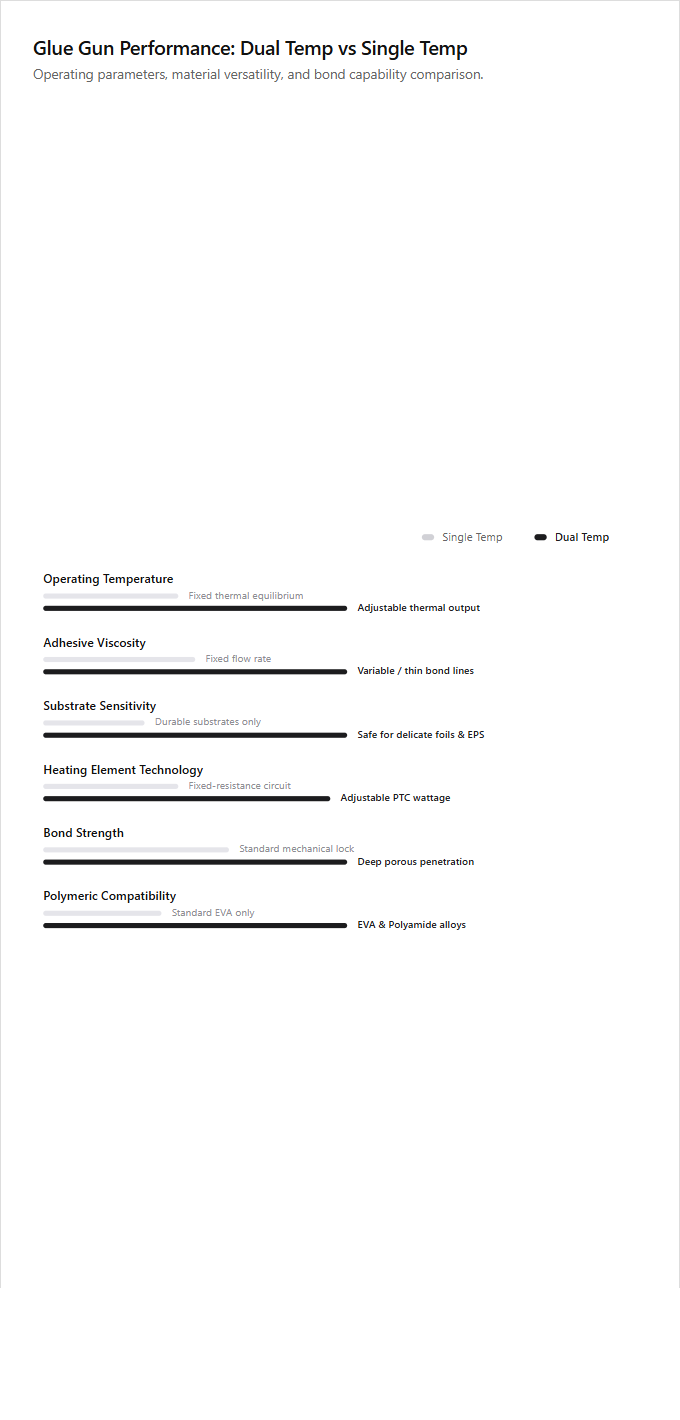
| Operating Temperature | Dual-temp models feature a switch to adjust thermal output, whereas single-temp models run at a fixed thermal equilibrium optimized for a specific adhesive type. |
| Adhesive Viscosity | High-temperature settings significantly lower the viscosity of the thermoplastic polymer, allowing for a thinner bond line and an extended open time. |
| Substrate Sensitivity | Low-temperature mode is crucial for bonding delicate substrates like expanded polystyrene or thin foils without causing thermal degradation. |
| Heating Element Technology | Dual-temperature glue guns utilize adjustable PTC (Positive Temperature Coefficient) heating elements to regulate wattage, while single-temperature units rely on a fixed-resistance circuit. |
| Bond Strength | The high-temperature setting provides superior tensile strength and mechanical interlocking on porous materials by allowing the molten glue to penetrate deeper before solidifying. |
| Polymeric Compatibility | Single-temp guns are generally limited to standard ethylene-vinyl acetate (EVA) formulations, whereas dual-temp guns can accommodate both low-melt and high-melt polyamide adhesives. |
Dual-Temperature Applicators with Adjustable Wattage
When selecting a professional glue gun, the choice between dual-temperature and single-temperature models depends on the diversity of your applications. Single-temperature tools operate at a fixed wattage, providing a consistent heat level optimized for specific, uniform tasks. These standard applicators offer reliable, straightforward performance when working with consistent materials that do not require thermal sensitivity.
In contrast, dual-temperature applicators feature adjustable wattage regulation for switching between high and low operating modes. This capability allows operators to safely bond delicate substrates like foam and fabric at lower temperatures, or switch to high-heat mode to ensure maximum adhesion on dense materials like wood and metal. Single-temperature models are ideal for operators performing repetitive, single-material assemblies, while dual-temperature units are best suited for versatile tradespeople and multi-media crafters who require adaptability across various projects.
Heat Enhances Adhesive Penetration in Porous Substrates
Selecting the appropriate professional glue gun involves evaluating the operational demands of single-temperature versus dual-temperature models. High-temperature settings reduce adhesive viscosity, which allows the liquefied hot melt to flow efficiently and achieve deeper penetration into porous substrates like unfinished wood, heavy fabrics, and ceramics for a highly resilient mechanical bond.
In contrast, lower temperatures prevent delicate materials such as craft foam, paper, and thin plastics from melting or warping during application. Single-temperature models are ideal for industrial operators requiring consistent high-heat output for structural bonding, while dual-temperature units are best suited for multi-disciplinary technicians and crafters who frequently transition between sensitive materials and heavy-duty substrates.
Low-Temperature Protection for Delicate Materials
Selecting between a dual-temperature and a single-temperature glue gun depends on the thermal sensitivity of the working materials. Single-temperature models operate at a constant high heat, which is ideal for robust bonding but risks damaging sensitive items. Dual-temperature models offer a low-temperature setting that operates at a reduced wattage. This lower heat level protects delicate materials such as thin plastics, fabrics, and foils from thermal degradation and substrate warping.
High-temperature settings provide strong adhesion for wood, metal, and ceramics by allowing the adhesive to penetrate deeply. Dual-temperature versatility prevents the melting of heat-sensitive substrates while still offering high-heat capabilities when required. Single-temperature units are best suited for specialists focused on high-volume industrial packaging or heavy crafting, whereas dual-temperature models are ideal for hobbyists, florists, and precision repair technicians who work with diverse materials.
Temperature Dictates Hot Melt Open Time
When selecting a professional glue gun, the choice between dual-temperature and single-temperature models depends heavily on your specific application needs. The selected temperature setting directly dictates the open time of the extruded hot melt. High-temperature settings keep the adhesive liquefied longer, extending the assembly window for complex alignments, whereas low-temperature settings promote rapid cooling and immediate bonding on delicate substrates.
Single-temperature units operate at a fixed heat level, optimized either for high-strength structural adhesion or sensitive materials. Dual-temperature models offer the versatility to toggle between these thermal states, allowing operators to adjust the adhesive's viscosity and open time to suit diverse tasks.
Single-temperature guns are ideal for high-volume production workers performing repetitive, uniform tasks, while dual-temperature units are best suited for versatile craftspeople and maintenance technicians who frequently transition between different materials.
PTC Heating Elements Ensure Stable Thermal Recovery
Selecting the right glue gun requires a clear understanding of thermal management. Single-temperature models operate at a fixed heat level, while dual-temperature variants offer versatility by switching between high and low settings. Advanced applicators in both categories utilize Positive Temperature Coefficient (PTC) heating elements. These self-regulating components ensure rapid heating and stable thermal recovery, preventing the temperature drops that can compromise adhesive bond strength during continuous operation.
This thermal stability is crucial when matching heat levels to specific substrates, as high temperatures secure dense materials like wood and metal, while lower temperatures protect delicate surfaces from melting. Single-temperature units are ideal for industrial assembly workers requiring consistent, high-volume bonding of uniform materials, whereas dual-temperature models are best suited for versatile tradespeople and hobbyists working with a diverse range of sensitive and robust mediums.
Matching Glue Sticks to Polymer Melting Points
When selecting a professional hot melt applicator, the choice between dual-temperature and single-temperature models dictates substrate compatibility. Adhesive performance relies on precise thermal calibration; glue stick selection must align with the melting point of specific polymer formulations. High-temperature settings liquefy heavy-duty polymers like polyamides for high-strength structural bonds, while low-temperature settings prevent thermal damage to delicate materials like electronics and foam by utilizing low-melt polymers.
Single-temperature units offer consistent thermal output for dedicated applications, whereas dual-temperature models provide operational flexibility across various bonding tasks. Single-temperature tools are best suited for industrial operators performing repetitive, single-material assembly, while dual-temperature units are ideal for general contractors and creative professionals who regularly transition between diverse materials and varying polymer densities.
Dual-Temp Versatility for Diverse Adhesive Chemistries
Selecting a glue gun requires understanding how temperature influences adhesive performance. Single-temperature models operate at a fixed thermal point, ideal for standard hot-melts. In contrast, dual-temperature glue guns offer the versatility needed to accommodate the differing rheological properties of various adhesive chemistries. Lower temperatures prevent viscosity breakdown in delicate, low-melt polymers, while higher settings ensure optimal flow and bonding strength for heavy-duty polyamides.
This thermal control ensures clean application and robust structural adhesion across diverse substrates. Single-temperature tools are best suited for high-volume production workers performing repetitive, single-material bonding, whereas dual-temperature models are ideal for versatile craftspeople, prototype designers, and technicians who transition between delicate and heavy-duty materials.
Leave a comment