
In heavy-duty industrial assembly and maintenance, selecting an inefficient fastening tool inevitably leads to stalled workflows, stripped threads, and severe operator fatigue. While standard cordless electric impact wrenches offer convenient portability for light-duty tasks, high-torque rotary fastening demands a far more robust, continuous power delivery system.
Transitioning to specialized fluid-power systems grants operations unmatched torque-to-weight ratios and indefinite duty cycles that electric alternatives simply cannot sustain. However, integrating these high-performance systems requires a clear understanding of infrastructure limitations, as both pneumatic and hydraulic tools stipulate significant investments in auxiliary compressors or fluid power units.
For instance, in demanding environments like structural steel erection and heavy equipment repair, the choice between these two mediums directly dictates job site safety and throughput. This article analyzes the critical trade-offs between hydraulic and pneumatic impact wrenches, comparing their torque profiles, utility requirements, and operational lifetimes to help you select the optimal tool for your high-torque applications.
| Factor | Summary |
|---|---|
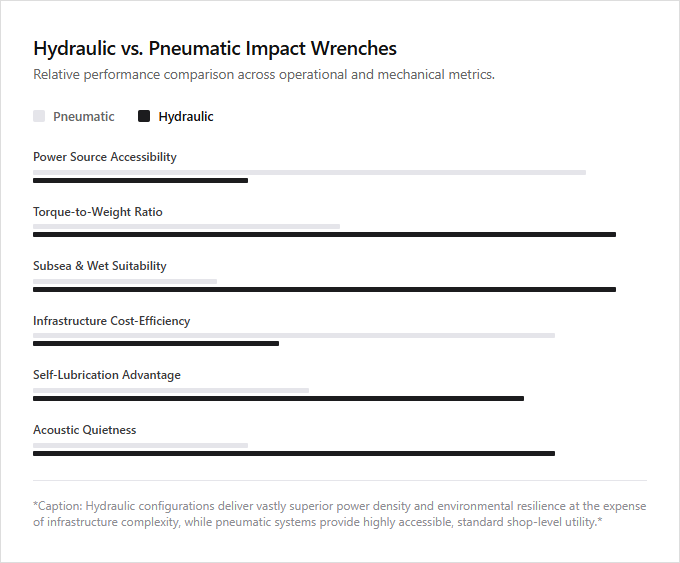
| Power Source | Pneumatic impact wrenches rely on compressed air managed by a pneumatic compressor, whereas hydraulic alternatives utilize pressurized, non-compressible hydraulic fluid from a dedicated pump. |
| Torque Density | Hydraulic impact wrenches deliver a vastly superior torque-to-weight ratio because hydraulic fluids operate under much higher operating pressures than standard pneumatic air lines. |
| Environmental Suitability | Hydraulic tools excel in underwater operations and subsea engineering due to their closed-loop system, whereas pneumatic tools suffer from performance degradation due to exhaust backpressure under water. |
| Infrastructure Requirements | Pneumatic setups utilize standard, cost-effective shop compressors, while hydraulic wrenches demand a specialized, high-pressure hydraulic power unit (HPU) to function. |
| Maintenance Overhead | Pneumatic wrenches require regular maintenance via inline mist lubricators to prevent vane wear, whereas hydraulic units are self-lubricating but require periodic checks for fluid contamination and seal integrity. |
| Acoustic Output | Hydraulic impact wrenches operate at a significantly lower decibel level because they do not produce the loud exhaust noise associated with rapid compressed air expansion. |
Fluid incompressibility versus pneumatic air compressibility
In industrial impact wrenches, the fundamental distinction between hydraulic and pneumatic systems lies in fluid dynamics. Hydraulic wrenches utilize incompressible liquid, transferring energy instantly to yield exceptionally high, consistent torque without any power loss. Pneumatic wrenches rely on compressed air, which is highly compressible, resulting in a slight delay in peak torque delivery and a more cushioned, spring-like impact action.
This physical difference dictates their operational efficiency and environmental suitability. Hydraulic systems deliver relentless power under extreme resistance, whereas pneumatic setups offer rapid, lightweight, and cost-effective versatility. Heavy-duty industrial technicians requiring maximum torque in underwater or high-pressure environments benefit most from hydraulic tools, while automotive mechanics and assembly line workers prefer pneumatic tools for high-speed, repetitive fastening.
Power-to-weight ratio and torque density capabilities
Hydraulic impact wrenches deliver unparalleled power-to-weight ratios and torque density. By utilizing incompressible hydraulic fluid, these tools generate immense torque within a compact, lightweight motor housing. This high torque density allows operators to handle demanding industrial fastening tasks without the physical strain associated with heavier equipment.
Pneumatic impact wrenches rely on compressed air, offering a highly reliable but slightly less torque-dense alternative. While air tools require larger housings to match the sheer rotational force of hydraulic systems, they remain the industry standard for consistent, high-speed performance in facilities with existing air compressor infrastructure.
Pneumatic models are ideal for automotive technicians and shop mechanics seeking accessible, everyday assembly tools, whereas hydraulic units are best suited for heavy utility workers and marine contractors requiring extreme torque in remote or underwater environments.
System operating pressure differentials in PSI and bar
The primary distinction between pneumatic and hydraulic impact wrenches lies in their operating pressures. Pneumatic impact wrenches rely on compressed air, typically functioning within a standard range of 90 to 120 PSI (6.2 to 8.3 bar). Conversely, hydraulic impact wrenches utilize pressurized fluid to achieve much higher operating thresholds, commonly ranging from 1,000 to 2,000 PSI (69 to 138 bar). This substantial pressure differential enables hydraulic tools to deliver superior torque-to-weight ratios without relying on large air displacement systems.
Infrastructure requirements also differ significantly between these two power sources. Pneumatic tools require high-volume air compressors, whereas hydraulic tools operate via closed-loop fluid systems that maintain consistent performance in extreme environments. Pneumatic models are ideal for automotive technicians in established service bays, while hydraulic variants are suited for utility workers and heavy industrial divers requiring maximum torque in remote environments.
Hydraulic Power Unit GPM flow rate versus compressor CFM output
When selecting industrial impact wrenches, the core distinction lies in how energy is delivered to the tool. Hydraulic impact wrenches rely on Gallons Per Minute (GPM) of fluid flow from a hydraulic power unit, which ensures consistent, massive torque output without suffering from power drops under heavy load. Pneumatic impact wrenches require a specific Cubic Feet per Minute (CFM) of airflow from an air compressor, utilizing pressurized air to achieve rapid rotational speeds and quick impact cycles.
The choice between these two power sources depends heavily on the operating environment and available infrastructure. Heavy-duty utility contractors and marine divers benefit from the weather-resistant, extreme-torque performance of hydraulic tools, while automotive technicians and shop assembly workers are ideally suited for the lightweight, high-speed versatility of pneumatic tools.
Adiabatic expansion and exhaust freezing versus hydraulic thermal management
Pneumatic impact wrenches rely on compressed air, which undergoes rapid adiabatic expansion as it exits the tool. This thermodynamic process causes a dramatic drop in temperature, often leading to moisture condensation and exhaust freezing during prolonged operation. Technicians must actively manage this thermal drop to prevent ice build-up from restricting airflow and degrading tool performance.
In contrast, hydraulic impact wrenches utilize pressurized fluid, which retains heat rather than cooling the mechanism. Effective hydraulic thermal management relies on continuous fluid circulation to prevent overheating during demanding duty cycles. This system maintains consistent torque output without freezing risks, although it requires monitoring fluid temperatures to protect internal seals.
Pneumatic systems are ideal for automotive technicians seeking lightweight, high-speed tools in indoor shops, while hydraulic models suit heavy utility contractors requiring continuous, high-torque performance in extreme outdoor environments.
Torque repeatability and volumetric efficiency of closed-loop systems
Hydraulic impact wrenches leverage closed-loop systems to deliver superior volumetric efficiency and precise torque repeatability. Because hydraulic fluid is virtually incompressible, these systems maintain consistent energy transfer with minimal pressure drops, ensuring highly predictable torque output across consecutive cycles. Conversely, pneumatic impact wrenches rely on compressed air, which is highly compressible. This inherent compressibility reduces volumetric efficiency and introduces thermal fluctuations, leading to variance in torque repeatability during heavy-duty fastening operations.
Pneumatic systems offer rapid, lightweight performance for standard assembly, while hydraulic units excel in heavy-duty, continuous-duty industrial applications. Maintenance technicians requiring high-precision fastening in demanding, spark-free environments will benefit most from hydraulic tools, whereas automotive service mechanics seeking speed and agility in high-throughput shops are ideal candidates for pneumatic models.
Hydraulic fluid contamination risk versus pneumatic inline lubrication needs
Hydraulic impact wrenches deliver exceptional torque but present a distinct risk of fluid contamination. A breached seal can introduce abrasive debris into the closed hydraulic loop, leading to severe internal component damage or hazardous fluid leaks on the job site. In contrast, pneumatic impact wrenches rely on a continuous supply of compressed air, which demands diligent inline lubrication. Without proper, consistent oil misting, pneumatic motors quickly suffer from friction wear and moisture-induced corrosion.
Choosing the correct tool depends on the operational environment and infrastructure. Hydraulic models are suited for utility crews and marine salvagers requiring submersible, high-torque performance in harsh conditions, while pneumatic models are ideal for automotive technicians and assembly line workers with access to regulated air systems and daily maintenance routines.
Leave a comment