
Achieving uniform linear stock removal on complex profiles often presents a frustrating bottleneck, frequently resulting in gouged workpieces and wasted shop hours. When addressing these efficiency losses, production managers traditionally look to standard equipment funding sources, such as capital machinery budgets, to resolve throughput issues. However, identifying the correct specialized hand tool grants operators an immediate boost in precision and material removal rates without the overhead of heavy machinery.
This analysis is presented with the stipulation that tool efficiency is entirely dependent on workpiece geometry; for example, blending weld seams in tight channels requires a completely different physical approach than flattening wide timber stock. To guide your procurement, this article evaluates the technical specifications, physical footprints, and optimal use cases of both file sanders and belt sanders, establishing a clear comparative framework for your next tooling investment.
| Factor | Summary |
|---|---|
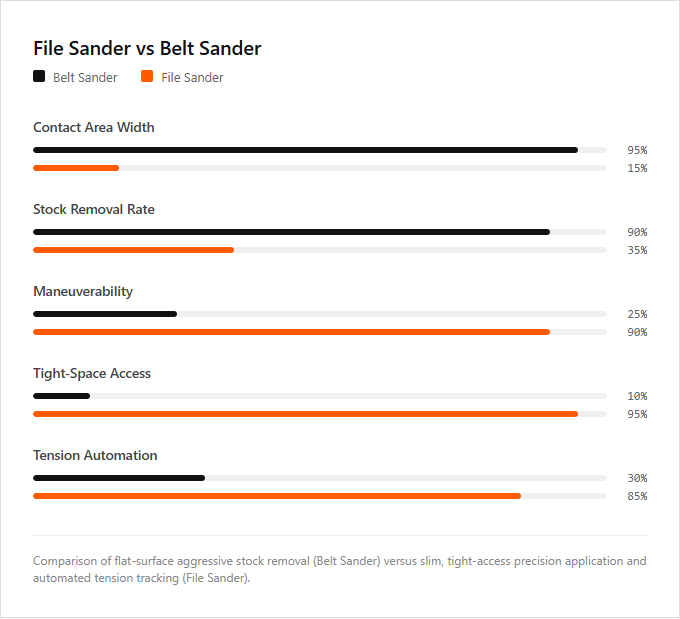
| Contact Area Width | While belt sanders utilize a wide, continuous abrasive loop for broad surfaces, file sanders feature a narrow, finger-like contact arm designed to access tight spaces. |
| Stock Removal Rate | Belt sanders offer an aggressive stock removal rate suited for rapid leveling of large timber workpieces, whereas file sanders provide localized, high-precision abrasion. |
| Primary Application | Belt sanders are ideal for smoothing expansive flat wooden surfaces, while file sanders excel at deburring metal welds, shaping contours, and spot-sanding intricate joints. |
| Tension and Tracking | Belt sanders rely on robust manual tracking adjustment knobs to align the wide belt, whereas file sanders employ automatic spring-loaded tensioning along a slim guide arm. |
| Maneuverability | The bulky chassis of a belt sander requires two-handed operation for stable control, while the lightweight, ergonomic design of a file sander allows for agile, single-handed manipulation. |
Belt Sanders vs. File Sanders: Flatness vs. Flexibility
Belt sanders and file sanders serve distinct roles in material processing, distinguished primarily by their contact mechanisms. Belt sanders feature a wide steel platen for maintaining coplanar flatness during linear stock removal. This rigid backing ensures large, flat surfaces remain perfectly level, making these tools highly efficient for rapid wood dimensioning and surface leveling.
By comparison, file sanders utilize a narrow, flexible contact arm. This slim profile allows the tool to access tight corners, intricate contours, and recessed channels that are inaccessible to larger machinery. The flexibility of the contact arm provides the necessary dexterity for detailed spot-sanding, shaping, and deburring.
Cabinetmakers and carpenters require the high-volume leveling of a belt sander, while metal fabricators and detail-oriented craftspeople rely on the precision of a file sander for intricate finishing.
Why Belt Sanders Remove Material Faster Than File Sanders
When selecting between belt sanders and file sanders, the primary technical differentiator is the material removal rate (MRR). A belt sander utilizes a wide, continuous abrasive loop that maximizes surface contact with the workpiece. This expansive contact area allows the tool to rapidly flatten large surfaces and strip stock with high efficiency, making it the industry standard for aggressive material removal.
File sanders employ a narrow, finger-like abrasive belt designed for precision and maneuverability. While their material removal rate is considerably lower due to the limited contact area, they excel at reaching tight spaces, deburring edges, and shaping intricate contours. Belt sanders are ideal for builders and refinishers managing expansive, flat surfaces, while file sanders are suited for detail-oriented woodworkers, metal fabricators, and automotive restorers addressing complex geometries.
File vs. Belt Sanders: Articulating vs. Rigid
When selecting professional finishing equipment, understanding the mechanical distinctions between file sanders and belt sanders is essential. File sanders incorporate an articulating tracking head specifically engineered for accessing deep recesses, tight channels, and complex joints. In contrast, traditional belt sanders rely on a rigid, fixed drive drum assembly designed to deliver high-torque, uniform pressure across flat surfaces.
These structural variations directly influence efficiency based on the workpiece geometry. While heavy-duty belt sanders are ideal for construction professionals and cabinetmakers managing large-scale stock removal, the compact file sander is the preferred tool for automotive technicians and metal fabricators executing precision detailing in confined spaces.
File Sanders: Variable SFPM Prevents Metal Work Hardening
When executing linear sanding on heat-sensitive materials, selecting the correct tool prevents thermal damage and structural compromise. File sanders excel in intricate areas by offering adjustable Surface Feet Per Minute (SFPM) control. This precise speed regulation is critical when working with metals in tight joints, as lowering the SFPM minimizes frictional heat buildup and prevents the work hardening of delicate alloys.
Standard belt sanders provide high-velocity material removal over broader, flat surfaces but lack the delicate maneuverability and speed refinement required for confined spaces. Heavy-duty fabrication professionals requiring rapid stock removal on large panels benefit most from belt sanders, whereas precision metalworkers and detailers performing intricate weld blending in restricted joints find the file sander indispensable.
Belt vs. File Sander Tensioning Systems
In woodworking and metalworking, selecting the appropriate finishing tool depends heavily on the scale and geometry of the workpiece. Belt sanders are engineered for rapid material removal over expansive, flat surfaces. These robust machines use a heavy-duty tensioning lever to secure large grit loops, ensuring the abrasive band remains stable under high operating pressure.
In contrast, file sanders are designed for precision work in restricted spaces and tight angles. These tools utilize quick-release, spring-loaded tension arms for rapid belt changes, allowing operators to swap grits efficiently during detailed tasks. Powerful belt sanders are best suited for floor installers and builders tackling large-scale stock removal, while agile file sanders are ideal for automotive restorers and sculptors requiring intricate spot-sanding capabilities.
Linear Belt Sanding Along the Grain
The selection between a file sander and a belt sander depends on the scale and precision of the material removal required. A belt sander is engineered for rapid, high-volume surface preparation. Linear stock removal with a belt sander aligns abrasive scratches parallel to the wood grain using a linear tracking mechanism to avoid cross-grain gouging, ensuring a flat, uniform finish over broad areas.
In contrast, a file sander utilizes a much narrower belt, making it highly effective for detailed work, intricate contours, and confined spaces where a standard belt cannot reach. The heavy-duty belt sander is ideal for carpenters and refinishers resurfacing large, flat timber panels, while the nimble file sander is best suited for metalworkers, fabricators, and detail woodworkers performing precise spot-sanding in tight spots.
File Sanders for Narrow Channel Weld Blending
When selecting between a file sander and a traditional belt sander, the decision depends heavily on the geometry of the workpiece. File sanders excel at weld blending and deburring in narrow channels due to their slender idler pulley nose design. This low-profile configuration allows the abrasive belt to access intricate joints, tight corners, and deep recesses that are otherwise inaccessible to standard finishing equipment.
Standard belt sanders utilize a much wider contact area to maximize material removal rates on expansive, flat surfaces. This makes them highly effective for rapid smoothing, leveling, and stripping of large stock. Detail-oriented metal fabricators and weld technicians require the precision of a file sander for intricate finishing, whereas carpenters and flooring installers rely on the high-capacity leveling power of a belt sander.
Leave a comment