
Selecting the wrong high-torque fastening tool can quickly derail a heavy-duty industrial project. If you deploy an impact wrench with insufficient torque, you face stalled operations and damaged fasteners; conversely, opting for an oversized tool leads to rapid operator fatigue and unnecessary capital expense.
Typically, fleet managers and industrial buyers look at standard equipment budgets and existing pneumatic shop infrastructure to guide these procurement decisions, hoping a one-size-fits-all approach will suffice. However, targeting the exact drive size-specifically comparing 3/4-inch and 1-inch platforms-grants crews the optimal balance of massive breakaway torque and manageable tool weight, preventing costly operational bottlenecks.
As a stipulation, it is important to recognize that while drive size heavily correlates with raw power, anvil design and socket compatibility also dictate overall safety and efficiency. This is why heavy-equipment mechanics and structural steel fabricators meticulously match their tool class to the specific bolt diameters on heavy machinery and bridge girders.
In this guide, we will analyze the key differences in torque output, physical ergonomics, and application limits to help you choose the ideal square drive size for your high-stress fastening needs.
| Factor | Summary |
|---|---|
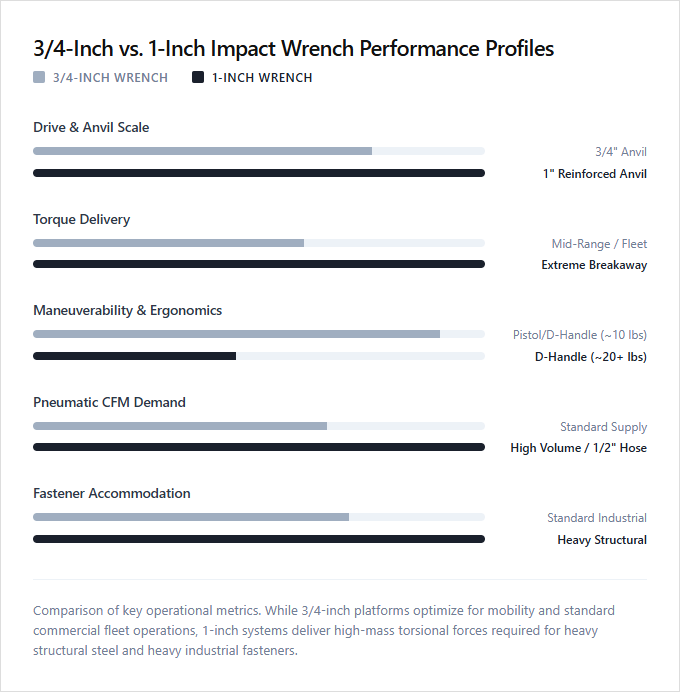
| Drive Size and Anvil | The 1-inch impact wrench features a larger anvil designed to transfer massive torsional force without shearing, whereas the 3/4-inch anvil is optimized for high-torque mid-range applications. |
| Torque Output | While 3/4-inch models deliver substantial torque for commercial vehicles, 1-inch models maximize breakaway torque and working torque for heavy-duty industrial fastening. |
| Primary Applications | The 3/4-inch tool is commonly utilized in diesel fleet maintenance and agriculture, while the 1-inch variant is reserved for heavy structural steel erection, shipbuilding, and railway maintenance. |
| Tool Weight and Ergonomics | Due to their massive internal hammers, 1-inch pneumatic wrenches are significantly heavier and typically require a D-handle configuration, whereas 3/4-inch models offer better maneuverability to reduce operator fatigue. |
| Air Consumption | Pneumatic 1-inch impact wrenches demand a much higher volumetric flow rate measured in Cubic Feet per Minute (CFM) and require larger hose diameters compared to 3/4-inch models. |
| Socket Compatibility | The 1-inch drive accommodates oversized impact sockets designed for large, high-tensile structural fasteners, while the 3/4-inch drive is limited to standard heavy-duty industrial bolt sizes. |
Breakaway Torque: 1-Inch vs. 3/4-Inch Drives
When selecting high-capacity impact wrenches, the distinction between 3/4-inch and 1-inch drive sizes lies primarily in their raw power delivery. The maximum breakaway torque outputs differ significantly between these two classes. While 3/4-inch models offer substantial force for heavy-duty automotive and medium industrial tasks, 1-inch drives regularly exceed 2,000 foot-pounds of torque to break free the most stubborn, seized fasteners.
This massive disparity in torque output is a result of the larger anvil and more robust internal hammering mechanisms found in the 1-inch platforms. The 3/4-inch units operate at lower thresholds, prioritizing a balance of high torque and manageable tool weight for extended use without operator fatigue.
The 3/4-inch impact wrench is ideal for diesel mechanics and structural steel erectors requiring mobile power, whereas the 1-inch variant is suited for heavy equipment technicians and industrial millwrights tackling massive machinery components.
Superior Torsional Fatigue Resistance of 1-Inch Anvils
When selecting between a 3/4-inch and a 1-inch impact wrench, the primary differentiator lies in the tool's capacity to handle sustained, extreme torque. The shear strength of a 1-inch anvil provides much higher resistance to torsional fatigue during continuous high-load fastening than a 3/4-inch drive. Under relentless stress, the larger cross-sectional area of the 1-inch drive prevents metal degradation and fracturing, ensuring long-term reliability during heavy-duty operations.
While 3/4-inch wrenches offer an excellent power-to-weight ratio for mid-range industrial tasks, they reach physical limits under prolonged, maximum-output conditions. The 1-inch platform is specifically engineered to endure the rigorous demands of large-scale structural steel erection and heavy equipment maintenance. Heavy-duty fleet mechanics and industrial millwrights require the unyielding durability of the 1-inch drive, whereas agricultural technicians and commercial vehicle mechanics generally find the maneuverability of the 3/4-inch model ideal for their servicing needs.
How Tool Size Impacts Pneumatic Air Consumption
When selecting between 3/4-inch and 1-inch pneumatic impact wrenches, the decision involves more than torque output. The primary operational difference lies in their air consumption requirements. While a 3/4-inch impact wrench operates efficiently on standard shop air systems, 1-inch models demand a substantially higher Cubic Feet per Minute (CFM) rating to function at capacity.
To deliver this increased volume, 1-inch pneumatic tools require larger hose diameters, typically 1/2-inch or greater, to prevent air restriction and maintain peak performance. Heavy-duty diesel mechanics and industrial millwrights require the massive power and infrastructure of the 1-inch model, while general automotive technicians and commercial fleet maintenance workers are best served by the portability and lower air demands of the 3/4-inch wrench.
Impact Wrench Mechanisms: Pinless vs. Twin-Hammer
When selecting between 3/4-inch and 1-inch impact wrenches, the internal engineering dictates their performance profiles. The 3/4-inch models frequently employ a twin-hammer mechanism, which delivers rapid, balanced blows and excellent power-to-weight ratios for consistent fastening tasks. In contrast, 1-inch wrenches typically utilize a pinless hammer design. This configuration eliminates high-wear parts to yield maximum blow energy and superior durability under extreme, continuous loads.
These distinct mechanism designs directly influence application suitability in industrial environments. The 3/4-inch impact wrench serves heavy automotive servicing and medium industrial assembly where maneuverability is essential, while the 1-inch variant is engineered for heavy equipment maintenance, shipbuilding, and large-scale infrastructure projects. Heavy-duty fleet mechanics require the raw power of the 1-inch model, whereas agricultural technicians and general industrial millwrights benefit most from the versatility of the 3/4-inch tool.
Fastener Size Limits: 3/4-Inch vs. 1-Inch Drives
Selecting the appropriate impact wrench drive size is critical for torque delivery and tool longevity. The primary distinction between 3/4-inch and 1-inch models lies in their fastener size limits. A 3/4-inch impact wrench is engineered to service fasteners up to M24 thread diameters, making it highly effective for heavy automotive work and medium machinery maintenance.
For larger applications, 1-inch drive wrenches handle M36 structural bolts and larger. These high-torque tools provide the immense breakaway force required for industrial construction and fleet service. Heavy-duty diesel mechanics and millwrights require the robust power of the 1-inch drive, whereas agricultural mechanics and commercial technicians find the versatile 3/4-inch model best suited for their daily service needs.
3/4-Inch Impact Wrenches: Higher RPM, Faster Rundown
When selecting heavy-duty pneumatic or cordless impact wrenches, the choice between 3/4-inch and 1-inch drive sizes often depends on the balance between rotational speed and raw torque. A key operational advantage of the 3/4-inch impact wrench is its higher free speed RPM. This elevated rotational velocity allows for significantly faster rundown times, enabling operators to spin fasteners down to the joint seating position quickly before the heavy impacting mechanism engages.
In contrast, 1-inch impact wrenches prioritize maximum torque output over velocity, utilizing larger internal components that rotate at lower speeds. While the 1-inch model is necessary for breaking loose massive, seized fasteners, the 3/4-inch variant offers superior efficiency for high-volume assembly tasks. Fleet maintenance technicians and industrial assembly workers benefit most from the rapid rundown of the 3/4-inch tool, whereas heavy equipment mechanics and structural steel workers require the uncompromising power of the 1-inch drive.
3/4-Inch vs. 1-Inch Wrenches: Ergonomics vs. Vibration Dampening
Selecting the appropriate impact wrench drive size requires a careful evaluation of application demands and tool ergonomics. A 3/4-inch impact wrench delivers an optimized power-to-weight ratio, making it highly effective for overhead tasks where minimizing operator fatigue is critical. This lighter chassis allows operators to maintain control and precision during prolonged use without sacrificing the torque necessary for heavy-duty fastening.
In contrast, 1-inch impact wrenches prioritize physical mass to maximize torque delivery and provide essential vibration dampening. This heavier construction absorbs high-energy impacts, protecting the user from repetitive strain during continuous, high-torque operations. The 3/4-inch model is ideal for mobile mechanics and structural steel erectors requiring maneuverability, while the 1-inch variant is best suited for heavy equipment technicians and industrial facility operators performing stationary, high-torque bolting.
Leave a comment