
Selecting the wrong impact wrench often leaves professionals caught between two frustrating extremes: lugging around an unnecessarily heavy tool that causes rapid fatigue, or using an underpowered unit that fails to break stubborn fasteners free. Before allocating capital equipment budgets or traditional tool procurement funding to upgrade your fleet, it is vital to understand the operational divide.
Identifying the sweet spot between these platforms grants technicians the precise mechanical advantage required without over-specifying their gear. However, the critical stipulation is that sheer power must never supersede control; excessive torque can easily shear grade-8 bolts or strip threads. For instance, while heavy-duty diesel fleet maintenance relies on high-torque giants to break seized leaf spring bolts, general automotive garages achieve peak productivity with agile mid-torque models.
This guide compares fastening capabilities, weight distributions, and application limits to help you choose the optimal wrench for your operational demands.
| Factor | Summary |
|---|---|
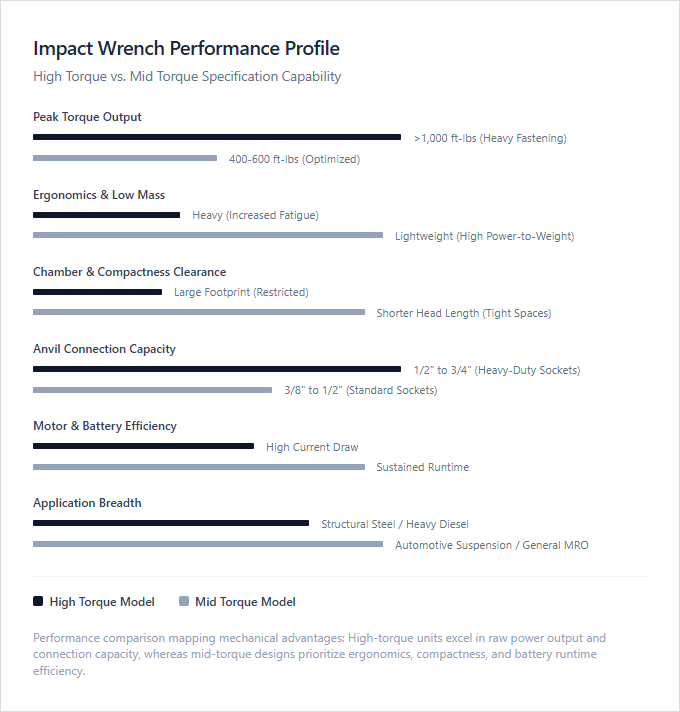
| Peak Torque Output | High-torque models deliver massive breakaway torque exceeding 1,000 foot-pounds for heavy-duty fastening, whereas mid-torque models optimize power output around 400 to 600 foot-pounds. |
| Tool Weight and Mass | Mid-torque wrenches offer superior power-to-weight ratios that reduce operator fatigue, while heavier high-torque units require significantly more physical exertion during prolonged use. |
| Physical Dimensions | The shorter head length of mid-torque tools allows access to tight spaces, whereas high-torque models feature a larger footprint that limits clearance in compact engine bays. |
| Anvil Connection Type | High-torque impact wrenches typically utilize a larger 1/2-inch or 3/4-inch square drive with a friction ring or detent pin to secure heavy-duty sockets under intense rotational force. |
| Motor and Battery Efficiency | High-torque tools utilize heavy-duty brushless motors that draw higher current from high-capacity battery packs to sustain peak performance under heavy loads. |
| Primary Applications | Mid-torque wrenches are ideal for automotive suspension work, while high-torque models are engineered for industrial structural steel construction and heavy equipment diesel maintenance. |
Breakaway torque capacity differences for loosening seized fasteners
Selecting the right impact wrench depends heavily on breakaway torque, which is the maximum force a tool exerts to loosen seized or heavily rusted fasteners. High-torque impact wrenches deliver massive breakaway forces, often exceeding 1,000 foot-pounds, to easily shatter the stubborn corrosion bonds on heavy-duty commercial bolts. Mid-torque models offer a more compact, balanced output, generally ranging from 450 to 800 foot-pounds of nut-busting torque, which efficiently handles standard suspension components without risk of shearing the fastener.
While high-torque units require a larger, heavier chassis to manage supreme energy output, mid-torque alternatives provide a lightweight profile for superior maneuverability in tight engine bays. Heavy-duty diesel mechanics and industrial millwrights require the raw power of high-torque models for large-scale machinery, whereas general automotive technicians and residential DIY enthusiasts are better suited to the balanced control and reduced fatigue of mid-torque tools.
Impacts per minute and free speed rotation specifications
When selecting between high-torque and mid-torque impact wrenches, free speed rotation (RPM) and impacts per minute (IPM) are critical performance metrics. Mid-torque models generally feature higher RPM and IPM specifications, enabling rapid fastening and efficient run-down times on standard fasteners. In contrast, high-torque units operate at lower free speeds and fewer impacts per minute, prioritizing pure rotational force over velocity to successfully transfer maximum energy to stubborn, heavy-duty bolts.
The higher frequency of a mid-torque tool excels at quick, repetitive assembly tasks without over-tightening. High-torque alternatives rely on a heavier internal hammer mechanism to deliver slower, high-energy blows that break loose seized components. Mid-torque wrenches are best suited for automotive technicians handling routine chassis work, while high-torque models are essential for industrial millwrights and heavy equipment mechanics dealing with massive, high-tensile fasteners.
Anvil size configurations including friction rings and detent pins
Mid-torque impact wrenches typically utilize 3/8-inch or 1/2-inch anvil configurations, balancing power with maneuverability. These tools offer a choice between friction rings for rapid, tool-free socket changes and detent pins for superior socket retention in overhead applications. This design flexibility makes mid-torque options highly effective for standard mechanical repairs and assembly lines.
High-torque impact wrenches require more robust anvil designs, commonly featuring 1/2-inch, 3/4-inch, or 1-inch drives to manage extreme rotational forces. These heavy-duty anvils employ friction rings for quick transitions or specialized through-hole pin systems to prevent socket slippage under maximum load. Mid-torque units are best suited for automotive technicians performing frequent, varied repairs, while high-torque models are indispensable for heavy equipment mechanics and industrial steel erectors dealing with seized, large-diameter fasteners.
Power-to-weight ratio considerations for operator fatigue
Mid-torque impact wrenches provide an optimized power-to-weight ratio, delivering substantial fastening force without excessive physical bulk. By minimizing tool weight, these models significantly reduce operator fatigue during repetitive or overhead tasks, allowing professionals to maintain high productivity and precision over extended shifts.
Conversely, high-torque impact wrenches prioritize sheer power over ergonomics. While necessary for loosening stubborn, large-diameter fasteners, their heavy chassis increases muscle strain and accelerates user exhaustion during prolonged operation.
Mid-torque models are best suited for automotive technicians seeking all-day comfort for general service tasks, while high-torque units are ideal for heavy industrial operators who regularly confront seized, massive bolts.
Brushless motor efficiency and thermal management
High-torque impact wrenches utilize advanced brushless motors to deliver maximum rotational force while optimizing battery consumption. Because these demanding applications generate significant heat, manufacturers integrate robust thermal management systems, including advanced heat sinks and optimized airflow channels, to prevent overheating during prolonged, heavy-duty fastening tasks.
Mid-torque models offer a balanced alternative, leveraging brushless efficiency to maximize run-time in a lighter, more compact form factor. These tools require less intensive cooling mechanisms, yet still benefit from intelligent electronic monitoring that throttles power to protect internal components under sustained loads. High-torque models suit heavy industrial mechanics and structural steel erectors requiring maximum breaking power, whereas mid-torque units are ideal for automotive technicians and general contractors seeking a balance of maneuverability and sufficient fastening capability.
Multi-stage drive control settings for precise torque application
Mid-torque and high-torque impact wrenches serve distinct operational demands, yet both leverage advanced multi-stage drive control systems to maximize versatility. This electronic feature allows operators to pre-select specific speed and torque ranges, mitigating the risk of overtightening delicate fasteners while ensuring maximum power is available for stubborn bolts. By regulating RPM and IPM, these settings provide the precision necessary to transition seamlessly between delicate assembly work and heavy-duty fastening tasks.
While mid-torque models utilize these precise settings to maintain a balance of power and agility in cramped spaces, high-torque units employ drive control to safely manage immense breakaway forces. Mid-torque wrenches are ideal for automotive technicians seeking a versatile, lightweight tool for daily chassis work, whereas high-torque variants are suited for industrial millwrights and heavy equipment mechanics tackling stubborn, large-diameter fasteners.
Fastening torque limits relative to structural bolt grades
Mid-torque impact wrenches typically deliver between 300 and 600 ft-lbs of fastening torque, making them ideal for medium-duty structural applications. They safely secure fasteners up to Grade 5 or Class 8.8 structural bolts without the risk of over-stretching or stripping the threads. This precise output prevents material fatigue in standard construction and automotive assemblies.
High-torque models routinely exceed 1,000 ft-lbs of fastening force, which is necessary for securing high-strength Grade 8 or Class 10.9 and 12.9 structural fasteners. These heavy-duty steel connections require immense clamping forces that only high-torque tools can reliably deliver. Mid-torque units suit automotive technicians and general contractors seeking maneuverability, while high-torque models are essential for industrial millwrights and heavy equipment mechanics tackling massive structural steel projects.
Leave a comment