
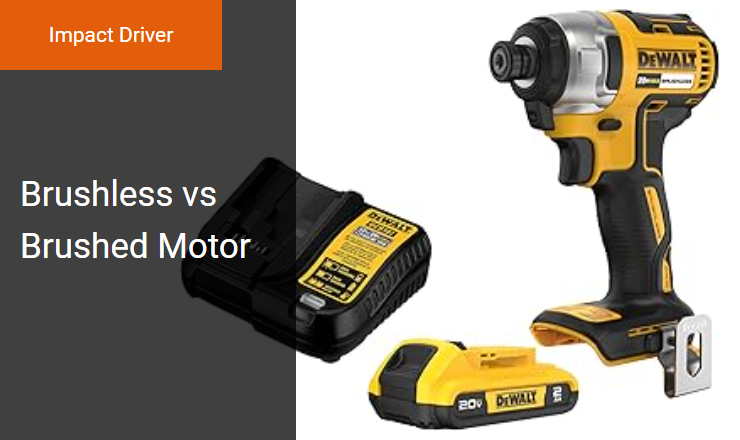
Contractors and serious tradespeople frequently face the frustration of an impact driver stalling mid-application, wasting valuable labor hours and damaging fasteners due to inconsistent torque delivery. When seeking to upgrade your fleet, bridging the gap between basic utility and high-performance output is crucial.
While many businesses rely on standard equipment financing or annual tool budget allocations to procure new gear, acquiring a tool that grants sustained, maximum torque output is what truly secures a competitive edge on the jobsite. However, a vital educational stipulation must be made: achieving peak power is entirely contingent upon understanding internal motor mechanics rather than just raw voltage ratings.
For instance, heavy-duty fastening tasks-such as driving large 6-inch structural lag screws into dense engineered lumber-demand the advanced thermal efficiency and power delivery unique to brushless systems.
In this article, we will examine the mechanical differences between brushed and brushless impact drivers, analyze their torque-to-weight ratios, and provide a clear framework to help you choose the right tool for your specific operational needs.
| Factor | Summary |
|---|---|
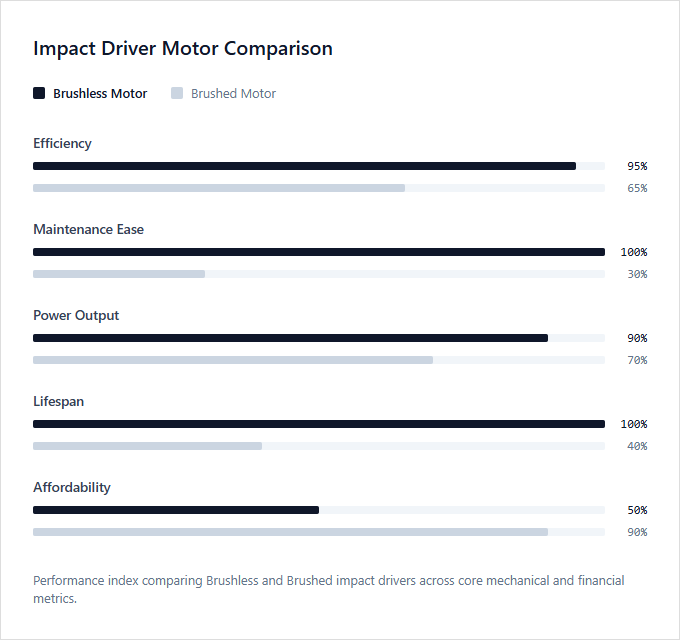
| Efficiency | Brushless motors achieve higher energy efficiency by eliminating physical friction, thereby reducing thermal loss and extending battery runtime. |
| Maintenance | Brushed motors require manual replacement of wearing carbon brushes, whereas brushless motors utilize electronic commutation for virtually maintenance-free operation. |
| Power Output | Brushless impact drivers optimize torque delivery dynamically by communicating with the battery through an internal electronic microcontroller. |
| Lifespan | The absence of contacting parts in brushless motors mitigates mechanical wear, significantly extending the tool's operational lifespan. |
| Cost | Brushed tools offer a lower initial retail price, whereas brushless models require a higher upfront investment due to the complexity of their integrated circuit boards. |
How Eliminating Friction Boosts Brushless Motor Torque
When selecting an impact driver, the choice between brushless and brushed motors significantly influences performance. Traditional brushed motors rely on physical carbon brushes to deliver electricity, which creates internal friction and heat. In contrast, brushless motors utilize an electronic controller rather than mechanical brushes. The absence of carbon brushes in brushless motors eliminates this mechanical friction, allowing the tool to deliver higher sustained rotational torque and greater energy efficiency during heavy-duty fastening tasks.
This mechanical difference directly impacts daily utility, runtime, and tool longevity. Brushless models run cooler and require virtually no maintenance, whereas brushed models offer a simpler, more cost-effective design. Budget-conscious DIY enthusiasts typically benefit from the affordability of brushed impact drivers, while professional contractors requiring maximum endurance and sustained power are best suited for brushless models.
Electronic Commutators: Optimizing Torque Under Heavy Load
When selecting an impact driver, the choice between brushed and brushless motors significantly impacts efficiency and tool lifespan. Traditional brushed motors rely on physical carbon brushes to transfer electrical current, which generates friction and heat. In contrast, brushless technology utilizes a digital circuit board to manage energy transfer, eliminating physical contact and reducing maintenance needs.
This sophisticated internal design enables smarter energy management. Specifically, electronic commutators dynamically adjust power delivery to optimize peak torque under heavy load, drawing only the necessary current to complete the task. Brushed motors lack this real-time adaptability, delivering a fixed power rate regardless of resistance.
Affordable brushed impact drivers are ideal for occasional DIYers tackling basic home repairs, while high-performance brushless models are best suited for trade professionals requiring maximum run-time and power on demanding jobsites.
Lower Thermal Resistance Prevents Brushless Voltage Drops
When evaluating impact drivers, the internal motor design directly dictates performance sustainability under load. Brushed motors rely on physical carbon brushes that create mechanical friction, generating substantial heat during operation. Conversely, brushless designs eliminate these contact points, which significantly lowers the motor's internal thermal resistance.
This minimized thermal resistance prevents heat-induced voltage drops during continuous, high-torque applications. By maintaining cooler operating temperatures, brushless impact drivers deliver stable power output and preserve battery runtimes, whereas brushed motors experience efficiency losses as heat accumulates in the circuitry.
Budget-conscious DIY hobbyists undertaking occasional home maintenance will find affordable brushed models highly practical, whereas professional tradespeople requiring relentless daily performance under demanding jobsite conditions are best served by the durable, high-efficiency brushless alternatives.
Maximum Torque in Compact Brushless Tools
When selecting an impact driver, the choice between brushless and brushed motors significantly influences performance and ergonomics. Brushless technology eliminates physical brushes, reducing internal friction and energy loss. This engineering advancement yields a superior power-to-weight ratio, packing substantially higher Newton-meters of torque into a compact, lightweight housing that reduces user fatigue during prolonged use.
Traditional brushed motors rely on carbon brushes to deliver electrical current, which limits overall efficiency and increases the physical size of the tool. Heavy-duty construction professionals requiring maximum endurance and torque will benefit most from brushless models, whereas budget-conscious homeowners and occasional DIYers will find brushed tools highly suitable for basic household projects.
High-IPM Energy Transfer for Maximum Torque
Brushless impact drivers offer superior efficiency compared to traditional brushed models. By eliminating physical brushes, brushless motors reduce internal friction and heat, allowing the tool to sustain higher rotational speeds under heavy loads. This synergistic high impacts per minute (IPM) capability increases the total kinetic energy transferred to the fastener, yielding maximum fastening torque and faster driving speeds.
Brushed motors, while more economical, experience energy loss through friction and cannot match the sustained IPM or torque output of their brushless counterparts over extended periods. High-demand professionals requiring maximum power for continuous, heavy-duty construction tasks benefit most from brushless models, whereas cost-conscious DIY enthusiasts performing occasional light home maintenance will find brushed impact drivers to be a highly practical solution.
Smart Current Control Sustains Maximum Torque
When selecting an impact driver, the internal motor technology directly dictates performance efficiency and run time. Brushless motors utilize electronic communication for intelligent current draw management, actively monitoring application resistance. This continuous adjustment prevents battery sag under heavy loads, allowing the tool to maintain its maximum torque output significantly longer than traditional brushed alternatives.
In contrast, brushed motors rely on mechanical carbon brushes, which generate friction, heat, and inefficient energy consumption. Brushed models are suitable for occasional DIYers seeking cost-effective tools for light, intermittent household tasks, while brushless impact drivers are ideal for trade professionals requiring daily, high-torque endurance on demanding jobsites.
Hall Sensors Maintain RPM Under High Resistance
Brushless impact drivers offer a significant technological advantage over traditional brushed models through their advanced electronic control. At the core of this efficiency are integrated Hall effect sensors, which monitor the rotor's position and provide continuous, closed-loop feedback to the microprocessor. This real-time monitoring allows the tool to dynamically adjust power to maintain consistent RPM, even when facing high resistance during demanding fastening tasks.
In contrast, brushed motors rely on physical carbon brushes that create friction, leading to energy loss, heat generation, and voltage drops under load. While brushed tools remain a cost-effective choice for DIY enthusiasts tackling occasional household projects, brushless impact drivers are the ideal match for trade professionals requiring sustained torque and reliability for heavy-duty daily operations.
Leave a comment